The 'hill child' is changed forever when they leave
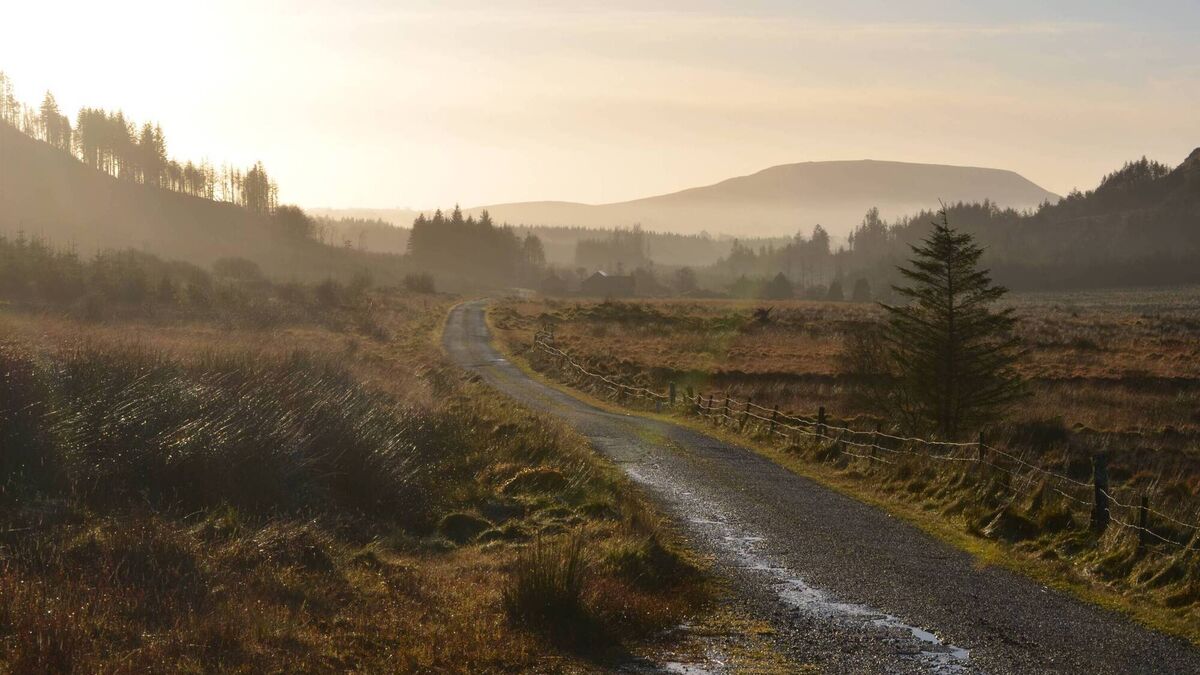
A road winds into the hills of the Ox Mountains. Picture: Pat McCarrick
- from by Dolly Parton
I heard a saying in recent weeks that really resonated with me. I was watching a documentary on the life of Dolly Parton shortly after her passing, when one of the contributors quoted the following line: "Something in a hill child changes the moment he heads down to level land."
This was a reference to Dolly Parton’s origins and her upbringing in a humble, two-room log cabin located in Locust Ridge in the Great Smoky Mountains in Tennessee. The phrase reminded me of anyone who has to leave a home they love and the many people who left simple Ox Mountain homes over the last 200 years.
A little research on the phrase points to an alternative version where the word ‘changes’ is exchanged for ‘dies’. It seems the original phrase comes from an old Appalachian folklore legend and while the literal wording sounds harsh, the 'death' in this phrase is entirely metaphorical.
In the folklore of Appalachia, the term 'hill child' refers to a person who is born, raised, and lives exclusively in the isolated culture of the mountains. One account expands on legend.
, a poem by Lillian Mayfield Roberts, first published in 1923, expands on the feeling and explores the fact that the deep longing and homesickness felt by someone leaving home is universal: “felt the same by a person from the mountains who is forced to live in flatlands, as an ocean-bred person pushed away from the sea."
Whatever pain and heartbreak was experienced by people leaving the Ox Mountains of their own choice in former times, it must pale into insignificance when compared to those who HAD to leave, because of fear of famine, political persecution or economic exhaustion.
As a result of the Great Famine, between 1841 and 1851, the population of Ireland plummeted from over 8.2 million to 6.5 million. While roughly one million people died of starvation and disease, more than another million left the country entirely. In 1847 alone, upwards of 100,000 desperate people attempted to cross the Atlantic.
The English port of Liverpool became the primary transit point. Between 1846 and 1851, an estimated 1.25 million Irish refugees passed through Liverpool alone. The vast majority of emigrants crossed the Atlantic with most of those settling in places such as New York, Connecticut, New Jersey, Pennsylvania, Ohio, Illinois, and Massachusetts. Thousands more landed in Ontario, Quebec, New Brunswick, and Nova Scotia. The less adventurous or less well-off settled nearer home in the industrial cities of Britain - Liverpool, Manchester, and Glasgow.
One hundred year later, in the 'lost decade' of the 1950s, economic stagnation and high unemployment forced roughly half a million people, almost one fifth of the population, to leave Ireland, most crossing the Irish Sea to Britain.
That all amounts to a lot of leaving; leaving loved ones, leaving home, leaving the mountains. While many escaped death by famine and economic death, they all experienced the ‘death’ that the hill child felt when he was taken to the level lands.
I have a fondness for Patrick Kavanagh - not sure I could spend much time with him - but I like his sentiments and descriptions of all things rural. Kavanagh wrote his poems based in the homeplace; his lyrical reflections on rural life, largely drawing from his upbringing and early adult years on his family farm in Inniskeen, County Monaghan.
Born there in 1904, Kavanagh spent his youth and early adulthood working as a small farmer. His local bogs, fields, and country lanes formed the emotional and physical heart of his early poetry, written during the 1930s and 1940s. Kavanagh moved to Dublin in 1939. There, he created his poetry looking back at his Monaghan hills, poems that reflected a life that was more familiar, more alive, before he departed for the level lands. The following lines, from Kavanagh’s classic poem, , give some idea of his passion for home. He may not have come from the mountains but his drumlin landscape was as precious to him as the Alps.
Pride in my heart, pride in family, pride of place... and they tell us pride is a sin. Is it pride and the loss of it that we feel when we move away. Is that the death referred to in Appalachian folklore? Probably. Leaving is a form of bereavement, a coming to terms with parting.
is a poem written by the late Johnny Carroll from Cloonacool in Co Sligo. Johnny ended his days in darkness due to a genetic eye condition. Much of Carroll’s poetry reflects on his early life, reliving memories of the places and the people he knew and loved. He never left home but he was an exile due of his loss of sight and, while he never complained, I imagine he suffered a loss similar to that of the hill child.
The following lines come from , one of Carroll's poems from his recently published book of poems, (Cloonacool Heritage Group, 2026).
Johnny Carroll, his life and poems, will be the subject of next week’s .