Curious case of the landlord that wasn't there
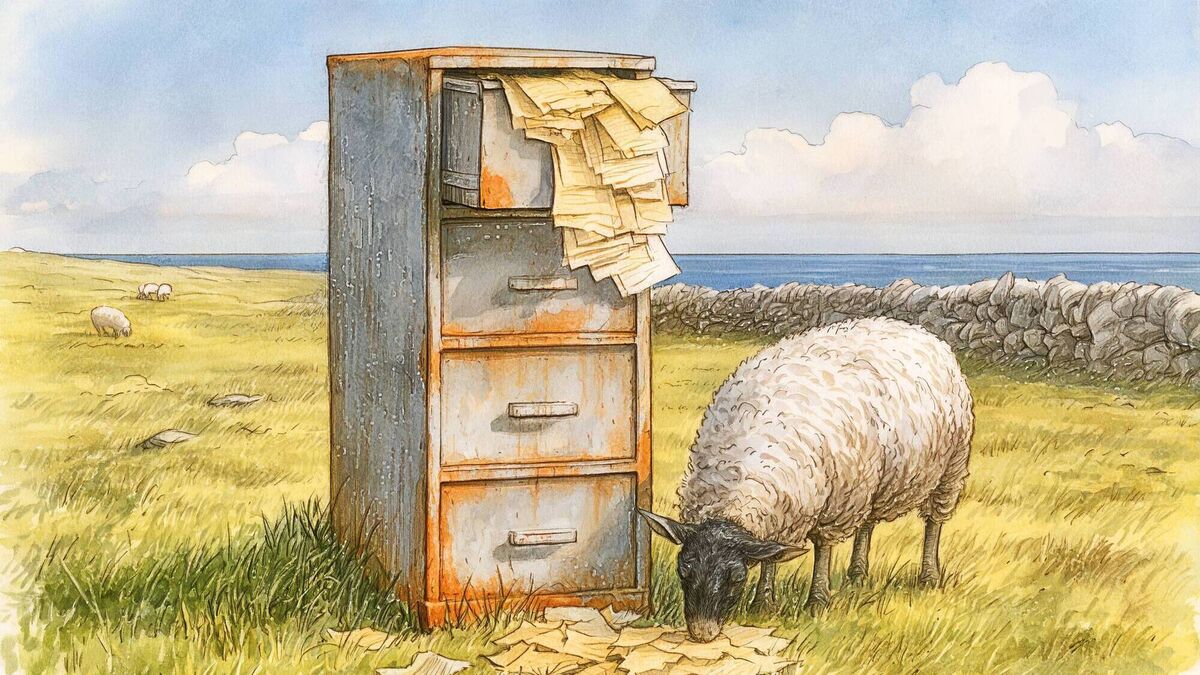
Farmers have grazed their sheep on the commonage for generations. Illustration: Conor McGuire
For 42 years, a caravan park on Achill Island has been paying rent to a landlord that cannot show it owns the ground. This year, the cheque was €20,000. The landlord is Mayo County Council, the ground is the Sandybanks at Keel, and the paperwork, as far as anyone has been able to establish, stops somewhere in 1970, like a letter left in a coat pocket.
I'd call it a scandal, but a scandal needs somebody to have got rich, and nobody did. This is something more Irish than that. It's a mess that has been rented, subsidised, voted on and sworn to for half a century because the alternative was opening the drawer.
Here is what Mick Clifford has laid out in the in a series that began in September. The Sandybanks is 440 acres of commonage looking at the Atlantic from the village of Keel. The Land Registry has it in the names of 557 owners, mostly farmers, who hold it in shares, the way families in the west have held bog and mountain since before there were councils to hold anything. In 1970, Mayo County Council issued a compulsory purchase order for it, and the then Minister for Local Government signed it that October. Three other tracts under the same order were duly transferred to the council. The Sandybanks wasn't. No vesting order. No evidence anyone was ever compensated.
The owners say nobody told them. Martin Calvey, now in his mid-eighties, remembers a meeting in a local hotel where the room agreed to resist, a committee was appointed to go and see the council, and the council, in his account, never turned up.
"We didn't hear any more about it," he says, which is the most complete summary of the Irish planning system I've come across in a decade.
Then there's the hearing. An inspector was told there were no objections. The has seen the transcript and says that is wholly inaccurate. There was an objector, but his objection concerned land elsewhere on the island. The council's current municipal district manager Seamus O'Mongáin says his understanding is that there was one objector at that hearing, and the file bears him out. Both things can be true at once, and that is how a thing like this survives. Nobody had to lie. Only someone who had failed had to ask the next question.
Now the money. A caravan and camping park has operated on the commonage and, the reports, has paid rent to the council since 1984. The current operators, Lisa and Michael Fitzsimons, won the lease four years ago and say they've had four good years. They'd prefer not to be caught in the middle of this, and who could blame them. They've done nothing wrong except pay the person who asked.
Meanwhile, up to 350 farmers claim EU grazing subsidies on the same acres, something over a million euro between them, on the understanding that the ground is theirs. The Department of Agriculture thinks the farmers own it. So does the Land Registry. Mayo County Council thinks it owns it, and only one of those parties has been collecting rent.
In 2004, the council proposed selling four acres to the old Western Health Board. Members voted to go ahead, and the sale fell through, which the suggests would have exposed that the council had no title. The hole in the floor was visible from the street 20 years ago, and everyone stepped round it.
This February the councillors, who have an unfashionable habit of reading what they're asked to sign, deferred the lease renewal until the executive produced the deeds. Nothing came. Two years ago, Calvey was refused entry to the caravan park when he went to see to his animals on his own commonage. A few weeks ago a council spokesperson was still telling the paper, repeatedly, that the council owns the land.
Then, at the recent municipal district meeting, Seamus O'Mongáin, confirmed that the council is seeking a vesting order to complete the 1970 purchase, thereby giving the park operators security of tenure. He has said he only learned this year that there was a CPO at all.
For 42 years the rent was collected on the strength of an order which, by the council's own latest account, it now needs to complete. The landlord is applying for title to a thing it has been letting for decades, and the people whose families have grazed it for longer than the county council has existed are being told they have the problem. Paul McNamara, the Achill councillor, said he had been told the Sandybanks was privately owned, and asked the question that should be carved over the door of Áras an Chontae: "So I have to ask, which is it?"
In fairness to the council - and I'll try to be fair - there is a case. The order was made in 1970 and signed by a minister. If the law allows a vesting order to be completed 56 years later, a body acting in good faith might want to tidy it up, and security for a family business is not a wicked aim. I'm not a lawyer, but I imagine this is a point on which lawyers will have a very long afternoon.
But the aim isn't what snags, it's the confidence. Anyone Irish native who has tried to put an extension on a kitchen west of the Shannon knows what the State asks of a private citizen: endless forms, a myriad of fees, a man walking your property, tut-tutting with a clipboard. And there’s always the neighbour's objection and a further-information request that lands on the last Friday of August. Yet here is a public body that took rent for four decades on ground it couldn't prove was its own, and nobody blinked until a journalist asked for the deeds. The citizen has to prove everything. The council, it seems, only had to say it.
Mick Clifford opens his latest piece with Cromwell, calling the thing audacious even by his low standards. That's a little hard on Cromwell, who at least commissioned a survey. The Down Survey, for all its sins, wrote down who had what before he took it. Mayo County Council, in 1970, took first and filed later, and then forgot to file.
The less comfortable part is that this didn't require a villain, just a series of tired, sloppy administrations. It took a cheque, a clerk, a minister's signature and an unsuspecting people who were told nothing. And a tendency of mind in which anything that has gone on long enough must be right. Every year the rent was paid, the next year's rent became a little more reasonable. That's how a fiction becomes a fact in this country. You don't prove it. You repeat it until it's cheaper to believe.
The owners may not be so obliging. Calvey calls the vesting order the council's last resort, and says it won't succeed "if the people come out and rebel". Rebel, over a commonage, in 2026.
The camper vans will be back in the spring. The lease, the operators have been told, will be renewed. Some cheque will be written to some office for €20,000, and some clerk will stamp it, and the Atlantic, which has been arriving at Keel since long before there was a county to argue over, will go on not being asked for its deed.