Varadkar commentary extremely revealing
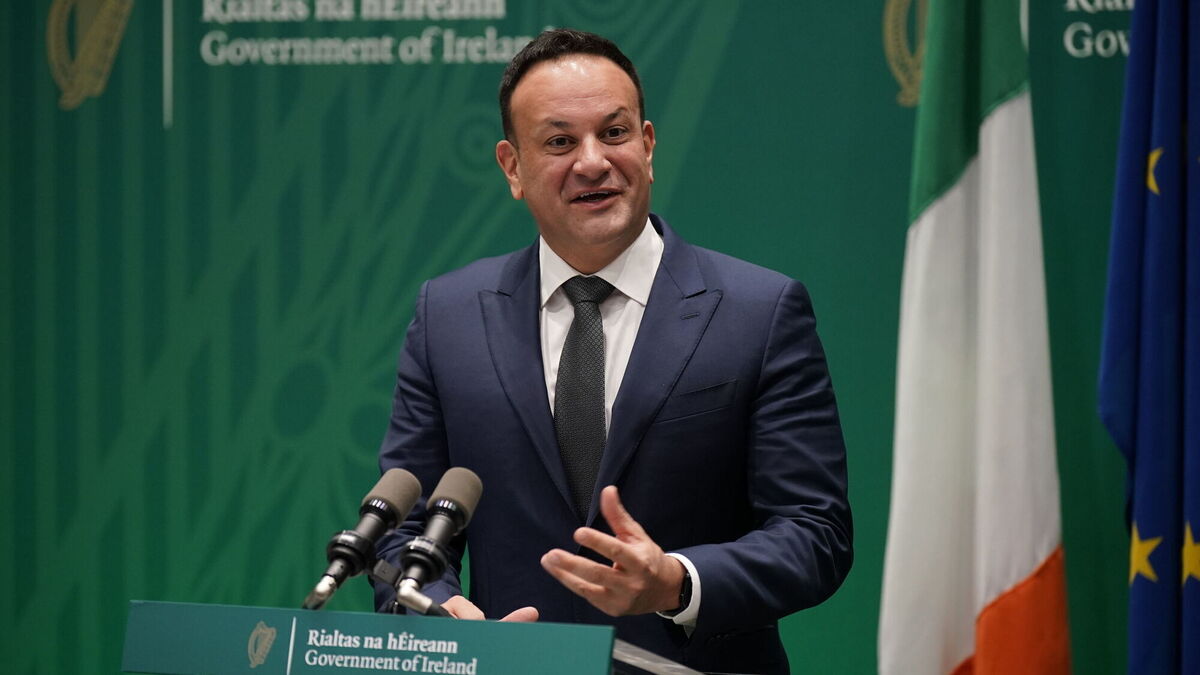
If only people in power like Leo Varadkar could see themselves as the potential authors of change. Picture: Niall Carson/PA Wire
For all his faults - and none of us are perfect - you can certainly not accuse former Taoiseach Leo Varadkar of being circumspect.
Former Taoisigh are generally reluctant to comment on live political issues. But that’s not in Leo Varardkar’s DNA. He has always been willing to state his views plainly.
Therefore, it was very interesting and most revealing to see his recent comments on rural Ireland.
Speaking in April on the Path to Power podcast with Matt Cooper, he launched a broadside on rural Ireland that would have been of little surprise to anyone who has observed his thoughts on life beyond the Pale.
He said people in urban areas were paying more tax while those in rural Ireland were ‘in receipt of a lot of subsidies and a lot of tax benefits that other people don’t get’.
“What’s in the interest of farmers and the agriculture industry is by and large not in the interest of Ireland as a nation,” he told Cooper.
He pulled back somewhat a week later and said he did not set out to be divisive or offend anyone. However, he stood over parts of the interview, saying the vast majority of tax is paid in urban Ireland. So it was, at best, only a partial climb-down.
It was refreshing to hear him speak so candidly and, I would argue, betray the reality of his attitudes towards rural Ireland which have been apparent throughout his time as a Minister and as Taoiseach.
He raised some very important points about rural Ireland and he is not wrong that the vast majority of tax is paid in urban Ireland but it is concerning that someone who has spent so long at the coalface is so unaware of why this might be.
While his comments were specifically about rural Ireland, the overlap with regional development is significant, particularly in the west of Ireland.
When you have a spatial strategy that concentrates so much employment in Dublin and therefore population, housing and all that goes with it, then of course most of the tax is going to be there, and regions peripheral to Dublin are going to need more state support.
Ireland has one of the most economically dominant capital city regions in the European Union and balanced regional development is a fanciful notion here.
Europe divides the Republic into three regions for economic purposes. Mayo sits within the Northern and Western Region, which includes the five Connacht counties along with Cavan, Monaghan and Donegal. Its GDP per capita stands at just over the European average, 100.3 per cent. That sounds respectable until you compare it with the other two Irish regions.
The Southern region (Munster as well as Kilkenny, Carlow and Wexford) has more than twice that – 217 percent.
The Eastern and Midland region (the other nine Leinster counties) is even further ahead with an eye-watering 268 percent.
While Leo Varadkar claimed that rural Ireland was ‘in receipt of a lot of subsidies and a lot of tax benefits that other people don’t get’, the bigger question is what sort of state spending?
Is it investment to systemically address the gap that successive governments have perpetuated over decades?
The evidence is clear that it is not.
The Northern and Western Regional Assembly (NWRA) have shown that the transport infrastructural investment for this region ranks a shocking 218th out of 234 European regions in the European Commission’s Regional Competitiveness Index.
NWRA research has revealed that this region has received less than 10 percent of the nationwide investment in infrastructure projects worth more than €1 million, despite accounting for 17.6 percent of Ireland’s population.
In contrast, the Eastern and Midlands Region received 66.5 percent of investment from projects worth more than €1 million, despite the region accounting for less than 50 percent of the population of Ireland.
So instead of positive discrimination by the Irish Government which may help offset decades of poor spatial planning and stop the region becoming the ‘burden’ on the taxpayer that people like Leo Varardkar assume we are, we’re not even getting close to our fair share.
There is a tendency to assume this imbalance is inevitable. It is not.
It should never be forgotten too that there existed a route for this region to get access to a sizeable level of European funding to help us get close to parity with the other regions in our country.
The best example remains the Trans European Network – Transport (TEN-T) which had the potential to transform our region. Its Core funding network was worth hundreds of billions of euro and represented 90 percent of the EU’s infrastructural budget to 2030.
Initially, Ireland and the UK had an orbital route which took in Belfast, Dublin, Cork, Limerick, Galway, Sligo and Derry. It would have allowed huge funding supports for projects like the N/M17, Knock Airport and the Western Rail Corridor.
But in 2011 the Western Arc from Cork to Limerick onto Galway and Sligo and north to Derry was removed with the stroke of a pen by the then Minister for Transport.
His name?
Leo Varardkar.
The former Taoiseach is, of course, right that Dublin generates more tax revenue than Ballycastle, Achill or Louisburgh.
No one can dispute that.
But if that becomes how a place is valued and judged, then we’ve lost a big battle.
The purpose of a republic such as ours ought never be to maximise economic activity in one corner of the island but, rather, to create the conditions where people can build good lives wherever they choose to live.
Right now, that is simply not true of vast swathes of the west of Ireland.
If only people in power like Leo Varadkar could see themselves as the potential authors of change.
Instead, they seem oblivious to the impact they can have or else feel a laissez-faire approach is the only show in town. Population concentration is something they see as inevitable, rural decline is unavoidable and their job is to manage it rather than reverse it.
The bigger question is how many other powerbrokers feel that way and do enough think differently to bring about meaningful change?
On the basis of all the evidence we have, it would seem anyone looking to bring about systemic change is outnumbered.