US shows again it can do whatever it likes
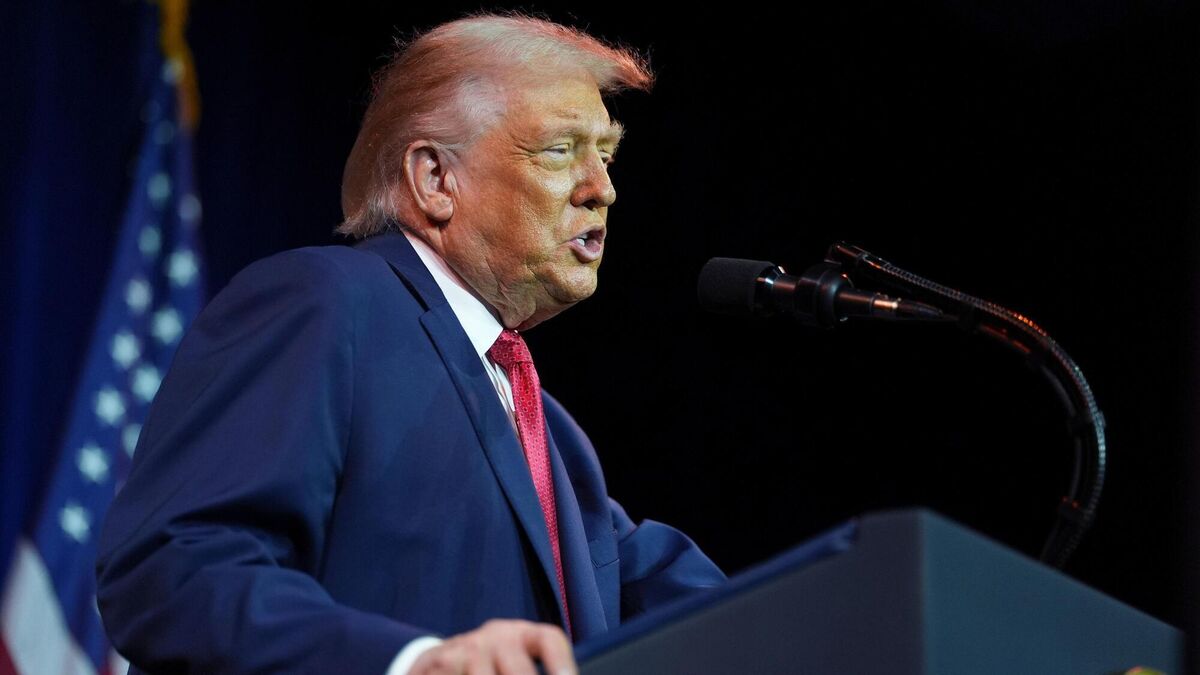
US President Donald Trump speaks to House Republican lawmakers in Washington three days after the audacious seizure of Venezuelan President Nicolás Maduro and his wife. Picture: AP Photo/Evan Vucci
My phone beeped on January 3rd. A simple text from an American friend:
“Ladies and Gentlemen, We Got Him.”
It was clearly referring to the audacious seizure of Venezuelan President Nicolás Maduro and his wife.
Another message followed, impatiently:
“Just like Obama.”
A pause. Typing. Then a final flourish:
“And Happy New Year!”
In the public memory, after the United States Navy SEAL Team 6 killed Osama bin Laden, a solemn but relieved Barack Obama spoke from the White House and declared on May Day 2011:
“Ladies and Gentlemen, we got him."
My very world-weary friend has little respect for either Republican or Democrat politicians, so this was clearly his way of saying that, when it comes down to it, they are all the same.
Except Barack Obama never said those words.
As a prime example of the Mandela Effect - a memory shared by many that does not match the actual historical record - the phrase “Ladies and gentlemen, we got him” was originally spoken by the US Administrator in Iraq, Paul Bremer, when he announced the capture of Saddam Hussein in 2003. Over time, the phrase became conflated with Obama referring to the killing of bin Laden, particularly in fact-challenged posts on X (Twitter).
Instead, the official White House transcript of Obama’s address to the nation opened with:
“Good evening. Tonight, I can report to the American people and to the world that the United States has conducted an operation that killed Osama bin Laden, the leader of al Qaeda, and a terrorist who’s responsible for the murder of thousands of innocent men, women, and children.”
Fair enough. It is, however, Obama’s conclusion that echoes most today:
“The cause of securing our country is not complete. But tonight, we are once again reminded that America can do whatever we set our mind to. That is the story of our history, whether it’s the pursuit of prosperity for our people, or the struggle for equality for all our citizens; our commitment to stand up for our values abroad, and our sacrifices to make the world a safer place.”
A sympathetic reading casts this as Obama deploying his consummate rhetoric in service of American exceptionalism. Yet, delivered in the immediate aftermath of the summary execution of a notorious enemy, it also reads as something else entirely: a warning - to enemies and allies alike - about the reach of the United States.
These are the words that echo in the US Special Forces’ seizure of Nicolás Maduro, placing us all on notice of the overwhelming power of the United States to do whatever it sets its mind to in pursuit of its own interests, irrespective of outside opinion.
At the press conference following Maduro’s seizure, Donald Trump clarified the intent of his government’s actions.
In what he (pretty accurately) described as “one of the most stunning, effective, and powerful displays of American military might and competence in American history”, Trump compared the daring raid to the assassination of Qasem Soleimani - a senior Iranian military officer killed in a US drone strike in January 2020 (also authorised by Trump) - along with other American military operations.
Having accused Maduro of funding narco-terrorism and other criminal activities through oil revenues, the US President made it clear that the home of the world’s largest proven crude oil reserves would now be repossessed by the United States - for the benefit of American interests… oh and Venezuela.
Democrats - and even some Republicans - have decried Trump’s actions. But claims that this represents an unprecedented rupture ring hollow for a United States with a deep and murky history of extra-legal interference in the administration of other countries and organisations, all in the name of protecting American interests.
Aside from the dramatic, ultra-rapid and brazen success of this action - with no reported US casualties - it is the targeting of a sitting head of state that many view as crossing a Rubicon, with potentially unforeseen consequences should other powers follow suit.
Yet it is not so simple.
While bin Laden was not formally a head of state, he was the spiritual leader of al-Qaeda, one of the world’s most prominent terrorist organisations, responsible for the atrocities of 9/11. As with Maduro’s capture, bin Laden’s killing in 2011 was not sanctioned by Congress.
In 1989, George Bush Sr oversaw the invasion and seizure of General Manuel Noriega, the former leader of Panama, who had installed a loyalist in power after it appeared he would lose elections he later annulled. Noriega had already been convicted in the United States of drug trafficking, racketeering and money laundering.
In 2003, Bush’s son, George W. Bush, led his administration into the bloody quagmire of Iraq, removing President Saddam Hussein from power while failing to uncover the weapons of mass destruction that had provided the invasion’s pretext. Hussein was later found hiding in a nondescript hole in the ground, tried by an Iraqi court and hanged.
While Obama’s administration oversaw the extensive use of drones to kill enemies in Iraq and Afghanistan, it was Hillary Clinton who, as Secretary of State, pushed Obama toward NATO intervention against Libyan dictator Muammar Gaddafi. Following the attempt to overthrow the Libyan government in 2011, Tripoli eventually fell to rebel forces and Gaddafi was later hunted down and killed, reportedly by a mob.
There is, then, little that is genuinely new in the American seizure of Maduro, except that it may rank as the most striking echo yet of Obama’s warning to the world, in the words I texted back to my friend:
“But tonight, we are once again reminded that America can do whatever we set our mind to.”
Unlike Obama, Trump can also claim a higher moral victory in seizing Maduro and his wife alive, and apparently unharmed.
Whoever comes next may not be so lucky.