Unredeemed poverty at heart of tragic tale
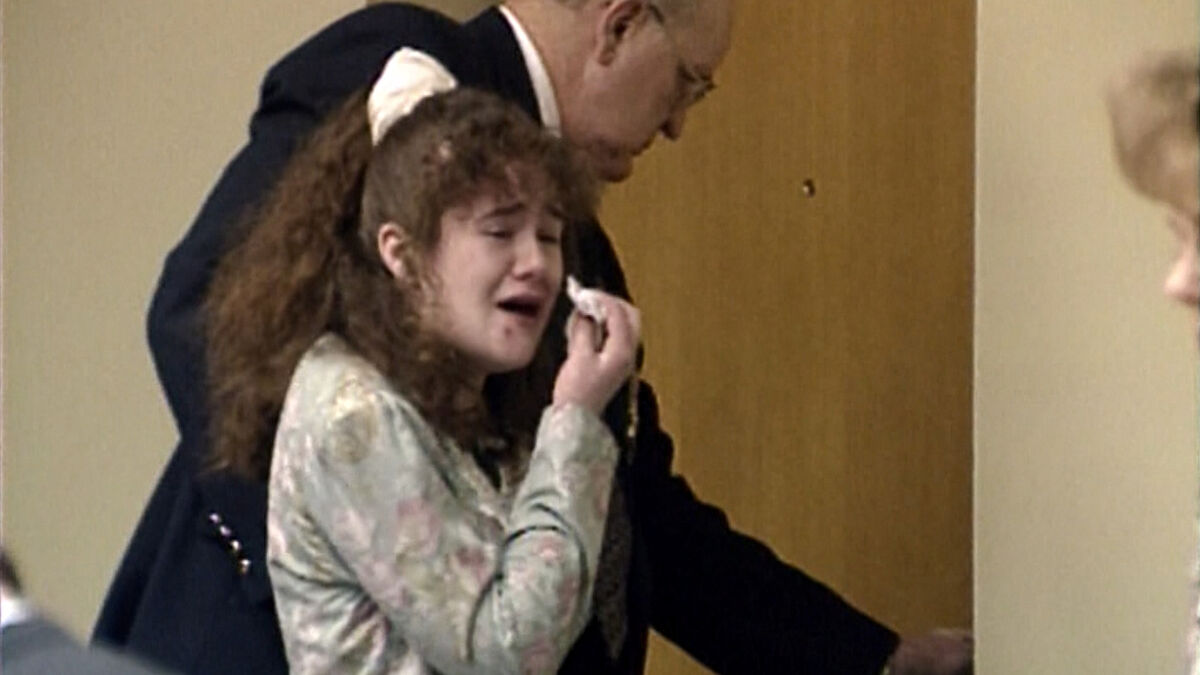
Christa Pike cries after being sentenced to death on March 30, 1996 in Knoxville, Tennessee. Picture: WBIR-TV via AP
Today’s column could be subtitled the parable of . One was the late Dolly Parton and the other, Christa Pike.
Dolly and Christa had much in common, not least that they were both raised in poverty-stricken homes. Dolly never denied the poverty of her home and indeed constantly referred to it – not least when she spelled it out in her song, , a graphic and moving depiction of what a childhood poverty looked like.
That said, throughout her life Dolly always acknowledged that the poverty of her home was redeemed by her parents, grandparents and siblings where love was constant and unconditional. As she grew up, she never lacked that loving support and she harvested from it a huge personal confidence and self-belief – something that enabled her to develop her God-given talents and to share them with the world.
Faith in God was the great hallmark of Dolly’s life, and for her it was a lifelong commitment that expressed itself in the flowering of a moral compass that would later, based on her experience of poverty, activate her extraordinarily generous philanthropy - spending millions on helping children in need.
But there the similarity between Dolly’s life and that of Christa Pike ends. The contrast couldn’t be greater. Raised in the same place – Christa Pike shared Dolly’s experience of poverty but with a very different family support network. No loving family, no community support, no faith in God.
Even before she was born, Christa experienced the absence of the loving embrace of a supportive family when it emerged that her mother’s heavy drinking during pregnancy had caused her brain damage. Much worse was to follow: her father beat her as a young child and when her parents separated she spent most of her early years moving between her father in West Virginia and her mother in North Carolina. During that time she suffered horrific sexual abuse from the age of two; multiple rapes at the ages of 11, 14 and 17; and a failed suicide attempt at 12. And at 18 years of age along with her boyfriend of that time, she brutally murdered another young student, a classmate.
While Dolly after sixty years of experiencing a happy marriage, a successful career and a full life died at 80 years of age and was universally lauded for her obvious talents and multiple achievements – even to the extent of a columnist in the Catholic paper, , suggesting she should be sainted – Christa now finds herself in hospital, recovering (at this time of writing) from a botched effort, not once but twice, by the state of Tennessee to execute her by lethal injection.
Despite two doses administered by ‘experts’, Christa was found to be ‘still breathing heavily, and emitting snoring sounds’. The execution was summarily interrupted and then suspended as Christa was transferred to hospital, where she was put on critical life support and the centre of national and international attention. The spectre of further brain damage has been raised, to complicate the many questions around her possible recovery and what a future life might look like – after enduring and surviving such a long and difficult nightmare of a lived life.
In the execution chamber as she awaited the failed attempt on her life, with a chilling and haunting prescience, Christa was reported to have commented: "I’m going to leave this world the way I spent most of my life."
Meanwhile, the jury is out on what the future holds for Christa and a series of possibilities are being canvassed in the current media feeding-frenzy on her present predicament - including a suggestion that if she recovers sufficiently for her body to be able to bear a further cross - that the Tennessee authorities would attempt another effort at execution.
A letter in this morning (as I write these lines) suggests that if Christa regains her health ‘the state of Tennessee may try to put her to death again’ and adds hopefully that it might be time for the state of Tennessee to rethink their official slogan ‘America at its best’. (It might be time too for to better edit, in circumstances like the present, well-meaning but offensive funny endings to their letters – but that’s another issue.)
Tennessee, of course, is America and, as we are continually reminded, America is a strange place and becoming stranger by the day. American Catholics, for example, are notorious for their unrelieved focus on pro-life or rather on a one-dimensional version of pro-life - condemning abortion. Pope Francis famously and frustratingly tried to broaden their Catholic education on what constitutes ‘pro-life’ by encouraging a broader focus - for example, on opposing capital punishment and on not welcoming the stranger - both of which are regarded in America (and elsewhere) as legitimate policies for the American government (such as it is) to advocate - and, incidentally, both of which are against the teaching of the (Catholic) Church.
Meanwhile, Christa lies in a Tennessee hospital, the victim of a family bereft of the necessary qualities of love and support to redeem her from her upbringing as she awaits her fate at the rough justice that Tennessee has ordained is now her due. At 18, she met a crucial bend in the road of life and she made the wrong choice notoriously for herself and for her victim. Effectively her family had failed to supply early experiences that would have given her life a moral compass as well as herself a personal confidence. Clearly too there was no teacher who showed a sufficient interest or no social worker to intervene early on and no friend to help point a direction. Christa was yet another victim of an unredeemed poverty that underestimated the importance of those early year experiences that are crucial for long-term happiness.
Of the , Christa Pike, unlike Dolly Parton, is another example of the blighted and troubled existence of so many children, including those in abject poverty, who are left without the resources to survive life.