Tuam's complex picture is finally emerging
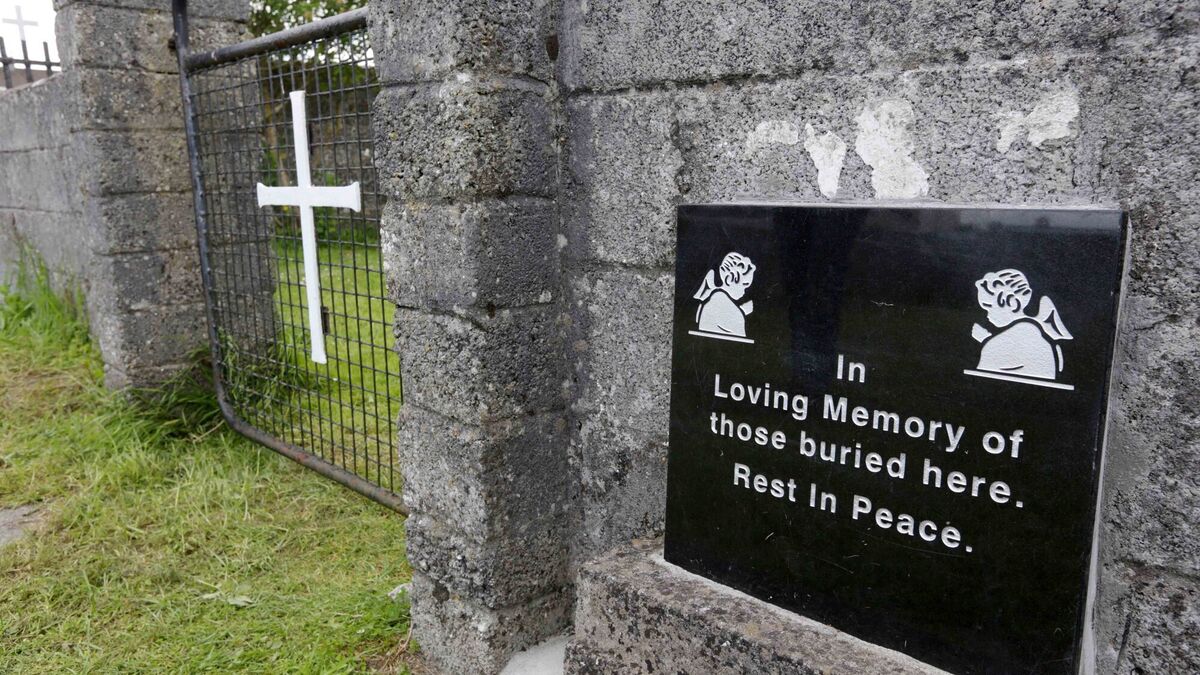
The site of the former Mother and Baby Home in Tuam where the remains of almost 800 children are buried. Picture: Laura Hutton/RollingNews.ie
Some time back an article in by Michael Duggan, a freelance writer living in Surrey, England, brought a new perspective to bear on what came to be known as the Tuam Babies controversy. Readers will remember that in 2014, the former Children’s Home in Tuam, County Galway, and its short but appalling history was very much in the news. The home was owned by Galway County Council, run by sisters of the Bon Secours Order, and was operating between 1925 and 1961.
What suddenly bounced it into the national and international news was the shocking revelation – and it might be said an almost immediate consensus – that almost 800 babies who died in the home were buried in the remains of a septic tank. The reported that ‘Bodies of 800 babies, long dead, were found in a septic tank at former Irish home for unwed mothers’; the , that ‘a mass grave of 796 babies were found in in a septic tank at a Catholic orphanage in Tuam’; and ABC News, Australia, that ‘almost 800 forgotten Irish children were dumped into a septic tank mass grave at a Catholic home’.
Duggan’s article questioned that consensus. But already the outrage at the news on the back of other scandalous histories of homes for unmarried mothers had overwhelmed the response of the Bon Secour Sisters. The accusation was that the Bon Secours congregation had effectively ditched nearly 800 babies into a sewage tank in Galway.
In 2014, when news broke that there were no burial records even though death certificates existed, it instigated an ongoing process of investigation that produced a government's Commission of Investigation, a sustained and sometimes savage attack on the Bon Secours Sisters who had responsibility for the home and at present an ongoing excavation of the site to establish the facts. The Commission Report spread responsibility for the limitations of the Mother and Baby Home between the Bon Secour Sisters, the Irish State, Galway County Council and the families of the mothers and babies, including the fathers of the children. The report was subjected to severe criticism with much of the criticism being directed by the public and the media at the Bon Secours Sisters and by association the Catholic Church.
It led to what Michael Duggan writing in , described as ‘an avalanche of stories of children being starved to death and of dead babies being dumped in their hundreds into septic tanks’. It was, he said, ‘perhaps the single most notorious example of the institutionalised cruelties and depravities of Catholic Ireland’ with the Bon Secours Sisters being subjected to relentless accusation and criticism. Duggan, in that same article, introduced a new voice that credibly suggests that the Tuam story might need serious revision.
Now recently (August 3, 2026) in another article, Duggan has continued his critique of the Tuam Babies controversy and offered a more complex evaluation of it. Listing a series of recent comments, he illustrated how reputable news outlets were years later still repeating the same mantra: ‘Only last year, told readers of 796 babies and infants dumped by the nuns in a disused sewage system’; the BBC reported on 796 children believed ‘to be buried in what former Taoiseach Enda Kenny dubbed ‘a chamber of horrors’; and recent comments from ‘Irish artists’ have compounded the Tuam shibboleth – as with the novelist, John Banville, telling readers of nearly 800 babies buried ‘in an unmarked grave that was once used as a septic tank’.
The picture conveyed, Duggan wrote, ‘was clear, emphatic, horrifying’. It was also brutal in its often unexamined conclusion that effectively ‘nuns of the Bon Secours order had spent three-and-a-half decades dumping the dead bodies of nearly 800 babies and infants into sewage tanks in County Galway’ - stories compounded by other stories of the same children and their mothers mistreated in life as with Enda Kenny, in his ‘chamber of horrors’ speech that children had been starved ‘to the point of their disappearance from life itself’. Tuam, Duggan wrote, ‘has repeatedly been portrayed as Ireland’s holocaust – a holocaust perpetrated by Irish women, by Irish nuns’.
Meanwhile, a new statutory agency, the Office of Authorised Intervention Tuam (ODAIT) commenced investigation at the Tuam site and its senior forensic archaeologist, Dr Niamh McCullagh, has reported that to date, the skeletal remains of 99 infants and children have been recovered. All were buried in timber coffins in the earth ‘made in the traditional style’. And, pointedly, the remains were discovered in a burial area ‘entirely separate from the old sewage system’. This upsets significantly some of core criticisms of the Bon Secours’ role and care and made Duggan wonder why uncontested evidence, for example, about the provision of coffins found in huge numbers (and other lines of evidence) didn’t seem to interest the Commission.
Duggan suggests that there are as yet entirely unexcavated structures that contain ‘a large number of remains of children that bear no obvious resemblance of a septic tank – including a pit close to an area in which bodies had been found – that was the work of a mechanical digger in the late 1970s. And there is another much larger masonry sewage tank whose purpose has as yet not been identified.
A much more complex picture is emerging, albeit painfully slowly as such investigations necessarily proceed step by careful step. The plus side is that ODAIT, in Duggan’s view, ‘appears to be going about its work transparently and meticulously, and with great sensitivity’. Nothing less is acceptable, as once the investigation – which means so much to so many – is completed we will know as much as we will ever know about what happened to the Tuam babies. I suspect that when the full story of the role of the Bon Secours congregation in Tuam is told – rather than the simplistic edit favoured by the media – the Sisters will receive a much fairer wind than heretofore when they were pilloried simplistically and relentlessly as convenient scapegoats. It will provide some consolation but sadly not for those who may not have lived to witness their redemption.