Trump puts his name to Irish unity
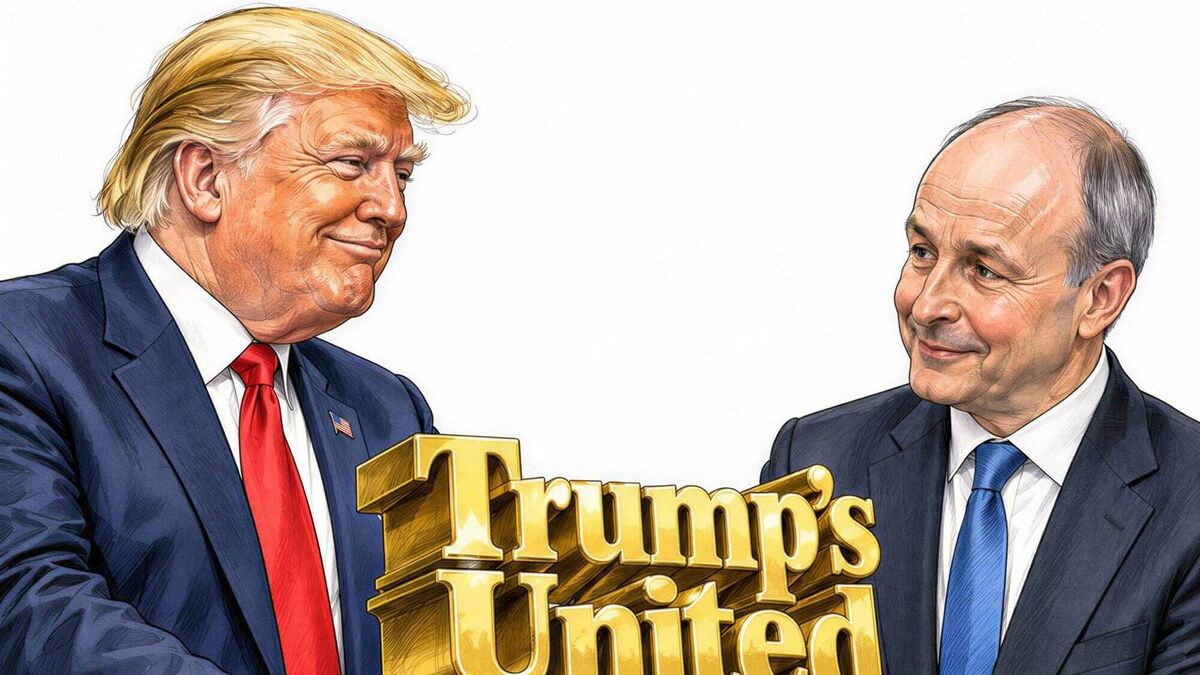
Trump doesn’t endorse things and doesn't sign up or lend support. Instead, he acquires, and then mounts the signage. Illustration: Conor McGuire
The gold letters always go up last. That’s the order of things with Donald Trump. Buy the building, fix the roof, then bolt the name across the front in a typeface you can read from a moving car. Doonbeg has had its set for years, out on the dunes where the Atlantic comes in sideways and the marram grass lies flat eight months of the year. On Saturday he acquired one more property. He put his name on a united Ireland.
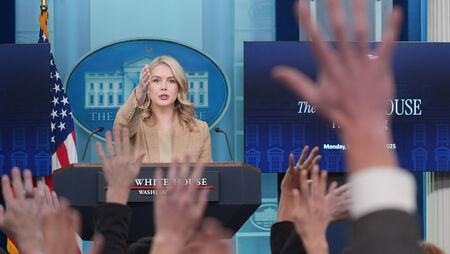
“I’d love to see it happen,” he said in Dublin.
Inevitable, he called it. A great thing. And then, asked about the reaction, the line that gives the whole weekend away: “I love my comments.”
Not the cause. The comments.
It’s important to understand what happened there, because many people in this country went to bed that night deciding it was progress. Trump doesn’t endorse things and doesn't sign up or lend support. Instead, he acquires, and then mounts the signage. For thirty years Irish nationalism has worked on the quiet machinery of persuasion, the long unglamorous business of making the constitutional question feel less like a surrender and more like a sound proposition. Then a man who could not dependably find Fermanagh on a map walked into the Phoenix Park, looked at the thing, liked the cut of it, and hung his name on the front.
Names do come down off buildings. A few apartment blocks in Manhattan had their letters unbolted, and it took the residents years of petitioning and a good deal of money to get them unbolted. That’s the realistic ambition here. Not that the endorsement is withdrawn, because it won’t be, but that some future generation quietly scrapes the residue off the brickwork and hopes the outline doesn’t show in certain light.
Gavin Robinson's haughty answer was swift, invigorated by umbrage. Unionists, he said, "are not interested in the destruction of our country by joining the Irish Republic." Downing Street followed with the trusted liturgy about the Good Friday Agreement and the position being unchanged. Both statements were easier to write than they've been in years because Trump had done the drafting. He handed unionism the thing it has been angling for since Brexit, which is the chance to be the reasonable party in the room.
It’s difficult not to notice who answered him. Belfast came back inside the hour and London by lunchtime. The Irish government, caught off guard, standing directly beside the man, said nothing at all. Not that the constitutional future of this island is a matter for the people who live on it. Not that we'd sooner he kept his name off it. The thing was turned loose in the Phoenix Park on a whim, and the Irish state adopted a posture of diplomatic reserve.
That silence is only one story of the weekend. Partition was only where it started, then Gaza’s smouldering ruins filled the political horizon.
Micheál Martin met him at Farmleigh rather than the Áras, so that nobody would have to call it a state visit, and emerged without uttering a word of condemnation about Gaza. Paul Murphy's account is that the Taoiseach went further and spoke approvingly of the twenty-point plan, the one to be overseen by a board with Trump at the head of it and Tony Blair and Jared Kushner somewhere about the table. Take Murphy's framing with the salt it deserves.
Then Martin was sidestepped and asked about the march underway in Dublin’s city centre. An estimated ten thousand people had walked from the Garden of Remembrance to the Dáil.
“It can’t be a very big one,” he said, “because we’ve been all over Ireland today already.”
And then: “I have seen no protests.”
I have seen no protests. Put that sentence in a frame. It is the purest distillation of the Irish official manner I have read in a decade, a man declining to acknowledge or see a thing on the grounds that he was elsewhere at the time.
There were protests at Shannon, where Air Force One came down. Shannon is the airport we routinely hand over to the American military while describing ourselves to anyone who asks as a neutral country. And this is the autumn the government intends to finish off the triple lock, the provision that made the United Nations sign off before Irish soldiers went anywhere. So the same administration that cannot bring itself to say the word Gaza to the man’s face is busy removing the last mechanism that obliged us to ask anyone’s permission before going to war.
There were less orchestrated protests at Doonbeg too. A woman was arrested at the golf course on the Friday night and two more on the Saturday, which is to say that the only Irish citizens who put their objection where the man could actually see it were swiftly removed from sight.
And, in a fortnight, probably nobody outside their own families will remember it happened. They did the thing a diplomatically bound Taoiseach couldn’t do, at their own cost, on a links course in west Clare, with no platform and no microphone and no press officer to soften it afterwards.
The President did better, and this is where it gets delicate. Catherine Connolly issued a statement after he’d gone. She had conveyed, she said, “the strong view of the Irish people that the normalisation of war and genocide can never be accepted".
Strong words. She did not name a single conflict. Not one. The most forthright president we’ve elected in a generation described the worst thing happening in the world without saying where it was happening, in a document released once the motorcade was on the road to Clare.
She also gave him some modest presents. A St Brigid’s Cross and a copy of the Navigatio, the old sea-voyage of Brendan. More tellingly, she gifted the collected poems of Michael Longley, with 'Ceasefire' in it, the sonnet about Priam going into Achilles’ tent to beg for the body of his son, an old man kneeling to kiss the hand that killed his child because the burying matters more than the hating.
He will never read it, let alone understand the subtlety of the offering. There is no version of the world in which that book acts as a moment of revelation. But she gave it to him anyway, aware of the power of the poetic, with the cameras running, and there’s more cultural depth in that gesture than in anything said loudly from a platform on O’Connell Street. It was a well-considered, civilised rebuke.
Which leaves us where? With a pharma tariff landing on the twenty-ninth of this month and a budget on the sixth of October. With the Irish Open played out to its final round on the sitting American president’s own links, the Taoiseach in attendance, smiling. And with one new fact lodged permanently in the middle of the Irish question: the most consequential endorsement unity has ever received came from the one man whose approval makes it harder to get.
He’d tell you that’s a compliment. He told us he loves his comments.
The letters are still up over the door in Clare this morning. Nobody down there is looking at them either.