The week when Europe came to the Moy
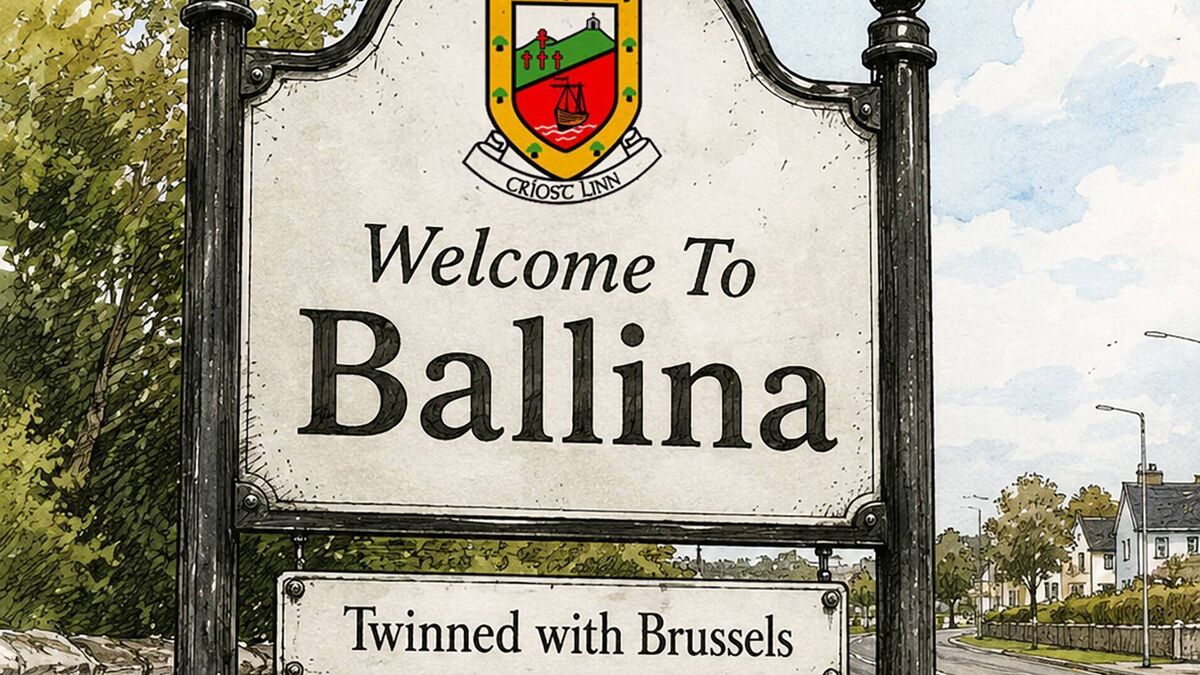
Ballina became the undisputed capital of Europe for the first Monday in July 2026. Illustration: Conor McGuire
For one Monday this July, Ballina was the undisputed capital of Europe. Nobody put up a sign. But the black cars were real, the earpieces were real, and somewhere between the salmon weir and Killala, there were 200 delegates from 27 countries trying to find the good coffee.
They came for a meeting. An 'informal' one, which is the important word, and I'll come back to it. Ministers for social protection, the people who hold the far end of the safety net, gathered at St Mary's Secondary School to talk about poverty, social exclusion, and the gap between people with disabilities and the jobs they can't get near. The Commission sent its executive vice-president, Roxana Mînzatu, all the way from Brussels. The school, I'm told, runs on solar panels. So there's a headline for you. Europe debated the fate of the poor in a room powered by the Mayo sun, which anyone from Mayo will tell you is usually a scarce and mystical commodity.
The plenary took place in the school while the dinner and the press conference happened up at Mount Falcon, in that stately pile above the river where the Moy does the thing the Moy does, sliding past silver and indifferent while representatives in neat suits talked about the marginalised over the unpoached salmon. You could not, if you tried for a year, invent a more perfect Irish tableau. The poor as agenda item. The river as backdrop. The hotel as venue.
And presiding over all of it, Dara Calleary. Ballina's own. There's no cynicism with me about that part, and I'm not trying to find some. The man got to stand up in his hometown and chair the continent, and if you can't be glad for a local who's handed his moment, you've a hole where your heart should be. He's a grafter, Calleary, one of the few in that Dáil who seems to actually like the unglamorous end of government, the forms and the payments and the people who need them. Watching him host Europe on the Moy was like watching someone's decent uncle land the big table at a wedding. Good. Let him have it.
It's everything around him that raises my eyebrow.
Because here's the joke, and it's ours. You want to hold a summit about poverty and the left behind. You want to look the disability employment gap dead in the eye. And you choose Mayo. Of all the places in Europe, you send the motorcades to a county that has been exporting its own children since before the word Brussels meant anything but a vegetable. Mayo doesn't need a strategic dialogue on social exclusion. Mayo has a postgraduate degree in it. Every family here has done the maths at some kitchen table about who stays and who goes, and the going is nearly always to somewhere with more jobs and more reliable weather. The experts flew in to study a wound the locals have been living inside for generations.
Some might consider that the most honest place on the whole continent to examine the issue. Or maybe it's the most tone deaf. I genuinely keep going back and forth as part of me thinks: good, bring them here, let them smell the artfully concealed decay in the villages, allow them to see what managed rural decline actually looks like when it's finished managing. And part of me thinks it's a bit akin to inviting the fire brigade to admire the ashes.
So let's acknowledge that the disability employment gap is not some soft abstraction to be nodded at over coffee. It's the painful, grinding reality for wheelchair users, or if your mind works at a different angle to the rest of us, your chances of a wage fall off a cliff. Ireland's cliff is steeper than most of Europe's. That's a real wound, worth a real gathering of serious people. I only wish the serious people had come to do something about it rather than to agree, warmly and at length, that it was a terrible shame.
Now, back to that word mentioned earlier. Informal. In the language of the European Union, informal means no conclusions. No decisions. Nothing binding, nothing signed, nothing that could later be waved at anyone as a promise. A strategic dialogue, they call it, which is a phrase built specifically so that no single clause inside it can ever be held against you. Two hundred people, three sessions, a river view, and at the end of it all, the official output is roughly: we had a very useful exchange of perspectives. You could get the same result cheaper by putting the poor in a WhatsApp group.
It’s a sobering exercise to consider the effort it takes to produce nothing on this epic scale. The earnest advance teams, the road diversions, the interpreters translating poverty into myriad languages so everyone can fail to agree in their own native tongue. The name badges alone would paper a gable wall. The whole dull circus flown in, fed and watered, photographed, and stood down again inside a day. A flurry of suits, and nodding decorum for an already forgotten conversation engineered from the first email to bind nobody to a single euro. That takes real skill. We should be prouder.
I don't say just to be dismissive. I say it because the gap between the pomp and the produce is the real story of this whole six months. Ireland has the EU Presidency. We get the flags, the summits, the vice-presidents, the earnest talk about values and inclusion. We are, apparently, at the forefront of upholding civilisation. And in the same week that Dara was hosting the good and the great to discuss protecting workers, he was on the phone at home, more or less begging the unions to come and sit down for stalled pay talks. Inclusion abroad. Deadlock in the kitchen. That's not a criticism of the man. He was trying to do both at once, which is more than most manage. It's a description of the country.
So the delegates ate their salmon and flew back out, and Ballina went back to being Ballina, which is to say a fine town that Europe will not think about again until the next informal meeting needs a photogenic river. The panels on the school roof kept turning the rare sun into electricity. The Moy kept moving. And somewhere, a young Mayo one packed a bag for a job in Sydney and the prospect of actually owning a home that no strategic dialogue is going to facilitate in the Ireland of 2026.
They came to talk about the people who leave. Then they left.