The Song Thrush has inspired many a poet
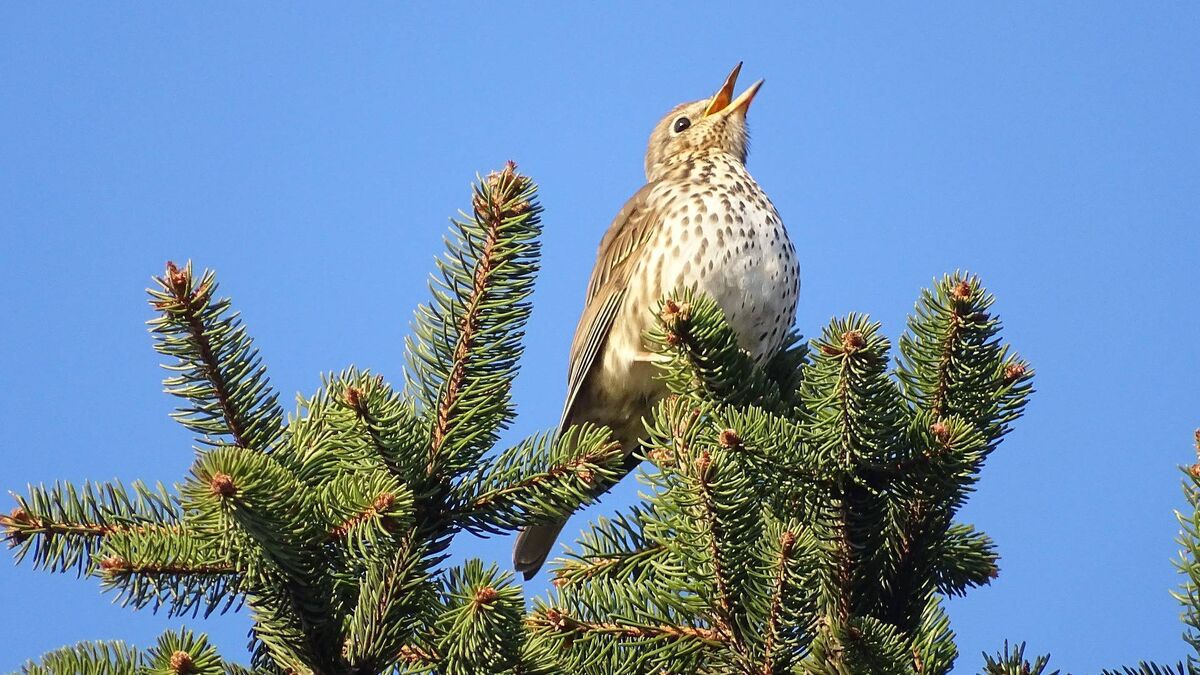
One of Ireland's top 20 most plentiful garden birds, the Song Thrush or Smólach Ceoil, is a champion singer.
- by Alfred Tennyson (1809-1892)
Between white frost and January blues, it can be difficult to get out of our warm bed these dark mornings. As I struggled to the bathroom one morning recently, I heard birdsong. It caught me by surprise because it was the first song of the new year. I whipped out my phone and opened my Merlin Bird ID app and pressed record. When the bird sang again, the app identified the Song Thrush. After that, I got more pep in my step, feeling, if the Thrush was that spritely, I should be too.
I can never remember - and keep with me here - if the Thrush is a member of the Blackbird family or if the Blackbird is a member of the Thrush family. I looked it up and... the Blackbird is indeed a member of the Thrush family. So, the Blackbird is a Thrush and the Thrush is a Thrush. Funnily enough, the Blackbird is the most common Thrush and is more plentiful than the Thrush itself!
Having said all that, our Ox Mountain Song Thrush and our Ox Mountain Blackbird are just two of many Thrushes in a very large clan. The family contains no less than 194 species worldwide. Here in Ireland, species such as the Redwing and Fieldfare are also plentiful. These other Thrushes haven’t a note in their heads and are in fact quite noisy. These toneless cousins often gather in flocks of hundreds or thousands, especially in cold weather. The larger Mistle Thrush is also out there; attracting attention with its loud, raucous call. But for now, let’s just focus on the “serene, ethereal psalm” of the Song Thrush.
One of Ireland's top 20 most plentiful garden birds, the Song Thrush or Smólach Ceoil, is a champion singer. What better way to describe the voice of a young tenor than to say, “He sang like a Thrush!”
Birdwatch Ireland gives the following identification details with regard the bird itself and its song.
The Song Thrush has a diet of insects and other invertebrates, especially earthworms, with snails being a particular favourite. They will smash snail shells against stones, called "Thrush anvils", to break them open, a method that very few other Irish birds ever use. They also eat berries and other fruit, including apples.
They breed throughout Ireland - mainly in hedgerows and gardens. They nest in trees, bushes, ivy, brambles and sometimes conifers. A few years ago, I saw a Thrush preparing her nest, laying her eggs and starting to incubate at a time of year before the leaves had emerged on the birch tree she had chosen. I am not sure what pushed her into such an early campaign but after a few days she was gone, her exposed position making her and her eggs an easy target for the ever-watchful magpie.
The Song Thrush is famed in song and story. He, and it is always the male, is a favourite subject in poetry and folk music, often symbolising hope, the arrival of spring, or a nostalgic connection to home. All the great romantic poets were taken by the song of the Thrush. As well as Tennyson and Browing, Thomas Hardy, Robert Burns and Robert Frost were all similarly smitten, each penning poems extoling the beauty of the Thrush’s song. by Robert Browning highlights the repetitive nature (not in the boring sense) of the bird’s tune.
The phrase 'The Thrush and the Rowan Tree' refers to a classic wildlife pairing, where Rowan or Mountain Ash trees provide vital winter food for various Thrushes, creating in the mind a familiar, picturesque winter scene, inspiring folklore about protection and magic.
The Hermit Thrush is a legend, in the Native American traditions, where the Song Thrush is celebrated for its ethereal, beautiful song. Often called the 'Creator's Song', which it is reputed to have received after cleverly riding on an eagle's back to reach the highest point in the sky. Ashamed of its trickery, the Thrush then flew into the deep woods. This explains why its lovely song is heard but the bird itself is rarely seen, adding to it mystique.
John Burroughs (1837-1921) was an American naturalist and essayist, active in the conservation movement in the United States. He is reputed to have penned the poem, , inspired by the legend mentioned above. His lines really pay a beautiful tribute to the Song Thrush’s “benediction on the air".
As always, it has been interesting to delve into the National Folklore Collection in search of some additional information on the Song Thrush. I had to wade through the countless cures that were listed there for thrush, the fungal infection, but I did happen upon a few little gems about the bird. One came from a contributor in Co Cork in 1939 and referred to the practice of capturing young birds for the purposes of having them in a cage - I imagine this was all in an effort to capture their song as well.
Finally, there was another contribution, this time from the wider National Folklore Collection in 1937 and collected by Áine Ní Ruadháin in Killasser, Swinford. The piece took the form of a little prayer under the title The Thrush, and makes for us a fitting conclusion: