The riddle that was Robert Erskine Childers
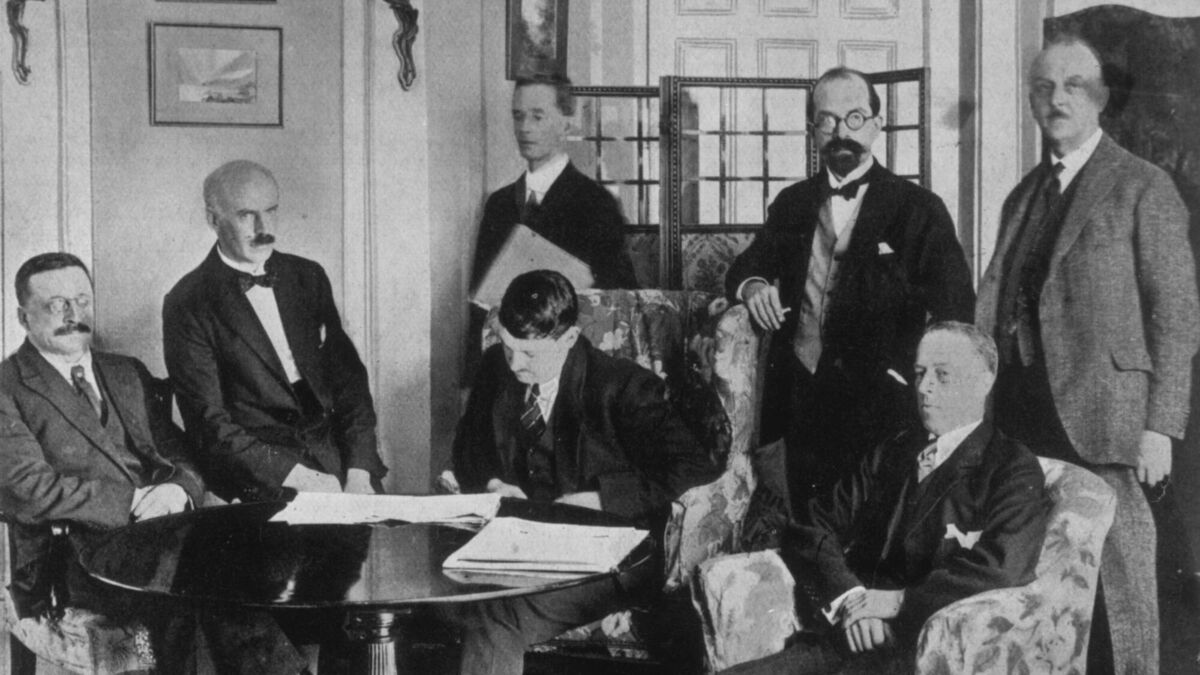
Members of the Irish delegation at the signing of the Irish Free State Treaty on December 6th, 1921. The delegation includes, seated from left, Sinn Fein founder Arthur Griffith, E.J. Duggan, Irish Minister for Finance Michael Collins and politician Robert Barton. Standing, from left, are Robert Erskine Childers, lawyer George Gavan Duffy and John Chartres. Picture: Topical Press Agency/Hulton Archive/Getty Images
Universities can use a lot of strange terms to describe what they do. Instead of classes, they have ‘tutorials’. They award degrees but call them ‘bachelors’. You study your course in bite sizes called ‘modules’. And as you work through your course towards your degree, you gain ‘credits’.
And of course they have professors. In my day, a professor was a Gandalf the Grey type figure, powerful, mighty and rare. Nowadays there are a lot more people called Professor, though some of them are ‘associate’ or ‘assistant’ Professor. The most mighty of professors these days are distinguished by having a ‘Chair’.
This is another example of where university terms can be confusing. No, it’s not something you sit in. A ‘Chair’ is a very senior academic role, focused on some key area of research.
So the news last week that the Irish state provided €4 million for a new Chair of Irish History at Cambridge University caught my eye. Cambridge is an incredible university, one of the very best in the world, and placing the study of Irish history at its heart with a prestigious Chair is a very interesting development. It is also an important and worthwhile one. All throughout the Brexit negotiations for example, it was a major problem for us that so few English people really understood Ireland and its history. This initiative will place the study of Irish history right at the heart of where so many of the British elite are trained. It is great value at the price.
But what caught my eye almost as much was those in whose memory the Chair has been named. It is the Childers Chair of Irish History, named after Robert Erskine Childers and his son, Erskine Hamilton Childers.
The ‘Robert’ might throw you. Robert was better known in his life simply as Erskine Childers. He was Secretary to the Irish side at the Treaty negotiations, the Treaty he would in the end oppose. It was he who was executed during the Civil War, when he was arrested and found in a possession of a gun: a tiny gun given to him for his protection by Michael Collins. Many years later his son, Erskine Hamilton Childers, became our fourth President, succeeding Éamon de Valera.
Whatever about the son, what an interesting and in many ways unusual choice the father is. To understand why it is called after him is something of a riddle - more of riddles later - and as we look at his life we might find some clues to solve it.
Robert Erskine Childers was born in London, and led a privileged life, educated at public schools and - here our first clue - at Cambridge. He spent some time in Ireland as a child with his mother’s relatives. But many people, friends and foes, considered him English. In his early life he was certainly a good imperialist. He went off to fight in the Boer War and made a name for himself in writing about the experience.
He made his name in an even bigger way through one of his books, when in 1903 he wrote one of the first great spy thrillers. That novel, , was about a German plot to launch a sneak naval attack on England. Childers had a hit - and made a fortune - in writing about it.
Childers during this time was a British liberal with Irish connections and so of course supported Irish Home Rule. That was a normal position for many of that outlook to hold, while still maintaining their devotion to the British Empire. But as the implementation of Home Rule was thwarted, so the views of Childers evolved. He became more and more radical. In 1914, horrified by the Ulster Volunteers smuggling in German arms, he played a key role in importing German arms into Ireland through Howth, on his yacht the Asgard, for the Irish Volunteers.
To add to the complexity of the man, he could combine that importation of weapons in 1914 with serving the UK loyally during World War I. After it though, like many others in Ireland, he went from supporter of Home Rule to a committed republican. He became a propagandist for Sinn Féin at the Paris peace talks in 1919 and was very good at it. His move to the more radical position continued apace. Despite being a Secretary at the Treaty talks - some thought he was there as a spy for de Valera - he opposed the Treaty fully and completely. Collins, and Griffith especially, grew to despise him.
He campaigned ferociously against the Treaty. He was captured by Free State forces in Wicklow in late 1922. His execution for carrying that tiny gun Collins had given him was considered a cold-blooded murder by the anti-Treaty forces. They had a point. Childers may well have fought in wars, and he certainly had imported weapons into Ireland, but by 1922 he was no soldier.
His legacy is a complex one. Many thought him no Irishman. Many have never been able to fully figure out how he went from imperialist to republican in such a short time. To explain going from fighting for the Empire in the Boer War, to warning about German invasions, to importing German weapons for Irish nationalists is itself a riddle indeed.
Perhaps his name was chosen for this Chair to show the complexity of the relationships between Britain and Ireland, and the reality that how people felt about them was never really straightforward. That would make some sense, but it would still make him an unusual choice.
So maybe there is a simpler explanation and clue. Erskine Hamilton Childers was a much loved and well regarded President of Ireland, who died much too early and at the start of his term. He too was educated at Cambridge. Like his father, he was a Protestant, and he was considered a welcome representative of that religious tradition in the broad republican family. So perhaps father and son were picked because of that?
Or maybe there is more to it. Robert Erskine Childers was anti-Treaty and a close associate of Éamon de Valera, who went on as we know to form a political party which continues to have some influence in the Ireland of today - and of which his son was a prominent and well-regarded member. While de Valera therefore might well be pleased at the naming of this new Chair, Arthur Griffith and Michael Collins would likely take rather a different view. So in solving the riddle of the name of this new Chair, perhaps we can conclude that Civil War politics, in historical terms at least, are not fully over.