The priest hunter’s ghost is still with us
Under the Penal Laws, a captured priest was worth serious money but in John Mullowney, clergy in Mayo had someone who left them fearing for their lives.
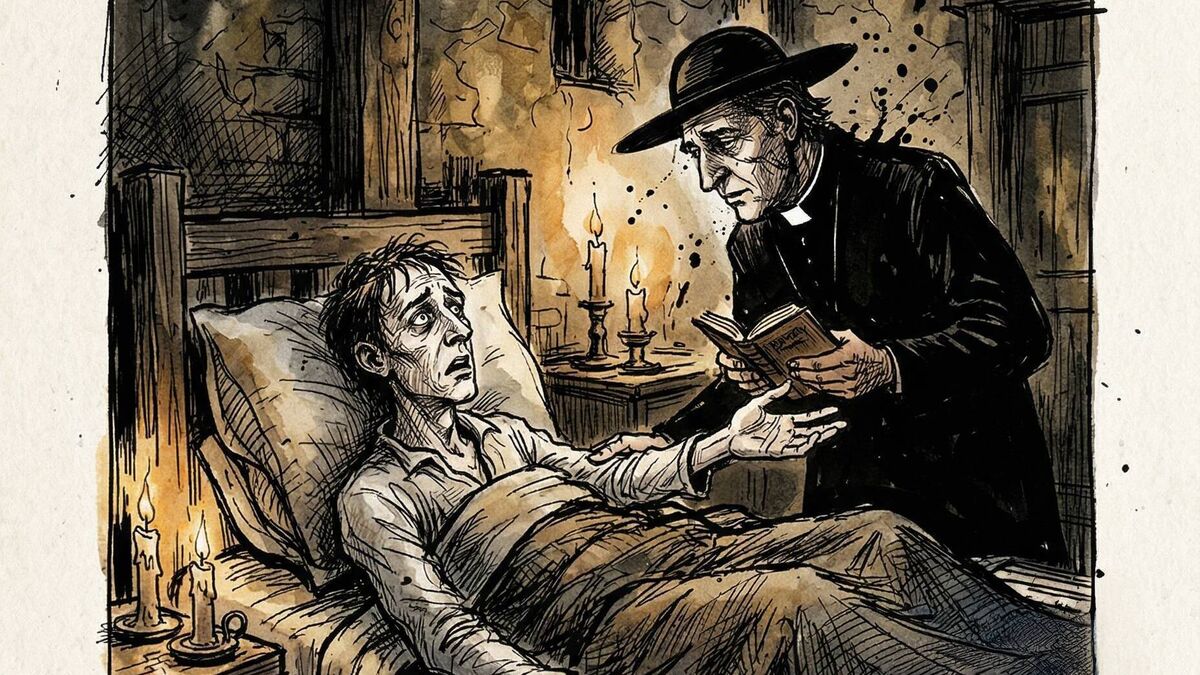
Imagine you’re a priest in rural Mayo, 1720, and a man sends word that he's dying, and you dutifully answer the call. That’s a priest's job, after all; indeed, that's the whole point of his vocation, saving souls. You sit beside his bed, you lean close, you listen to his sins. And somewhere during that moment of absolute intimacy, absolute trust, the would-be penitent reaches under the blankets and produces a knife. That’s the last thing several men ever saw. And somehow, improbably, that’s the part of the story people find almost funny.
Our fake penitent had a name, a Mr John Mullowney, born around 1690, and eventually dying as he lived, violently at the end of his own sharpened blade, around 1726.
He was not long on his blighted corner of earth, but he made his bloody mark. We Mayo natives know him better as Seán na Sagart, or John of the Priests, which is one of those beautifully crafted rural Mayo nicknames that tells you nothing about a man while actually saying everything.
He was, to put it bluntly, a treacherous rat, a lowly horse thief who became a paid informer. A Catholic who hunted his own clergy for money and turned betrayal into a profession in the name of survival. There were worse people in history, obviously, but not many were quite so imaginative about it.
The story goes like this. Young Mullowney, fond of the drink and other people’s horses, found himself in front of a Castlebar judge facing the gallows. The authorities, being practical people, noticed that the qualities which had made him an effective criminal – charm, low cunning, a complete indifference to loyalty – might be redirected usefully. The deal was simple: inform on priests, live to drink another day.
Under the Penal Laws, a captured priest was worth serious money. An archbishop would net you £100. A regular priest, £20. A hedge schoolteacher, £10. In a time when most of rural Mayo survived on not much more than a prayer and a potato, those were extraordinary sums.
Mullowney agreed, apparently without a great deal of soul-searching.
What makes his story so disturbing isn’t the betrayal itself, as history is full of informers, and Ireland has had more than its share throughout its history. It’s the theatricality, as Mullowney was shamelessly creative. He would pretend to be dying, summoning a priest to hear his confession, then produce a knife from beneath the bedclothes and stab the cleric who had come to offer him absolution. We should think about that for a moment. The sacrament of confession, the most intimate act of trust in Catholic religious life, was weaponised by Mullowney as a trap. The priest arrives expecting a soul in distress, in dire need of absolution, and gets a blade through the chest instead.
It’s the intimacy of it that remains with you, as it was never a faraway denunciation, not a quiet shameful word to the authorities, but a face-to-face murder brazenly disguised as a spiritual need.
Mullowney looked his victims in the eye. He let them believe they were doing good, and then he killed them.
Mullowney got what was coming to him, eventually. The last surviving priests in the area, knowing exactly who was hunting them, disguised themselves and moved carefully. One attended a funeral dressed as a woman, because even the dead needed a priest, even then, even at that risk. Mullowney spotted him and gave chase. But this priest, unlike the others, wasn’t arriving at a deathbed expecting gratitude. He was ready, and in the struggle that followed, Mullowney was stabbed with his own knife and died where he fell.
The folk tradition, wonderfully uncharitable, records that his body was subsequently dug up and thrown into a lake. A local priest, displaying considerably more Christian mercy than anyone else involved, ordered the locals to fish it out and bury it again. Some acts of forgiveness are harder than others.
We live in a golden age of Seán na Sagart. Not the horse-stealing, priest-stabbing variety, obviously, but the essential type, the person who discovers that betrayal, performed with enough confidence and dressed up in enough justification, is actually a lucrative career move. They’re everywhere, in politics, media, business, and social media. The methods have been updated, but the soul of the thing remains unchanged.
Think about what Mullowney actually sold. Not information, particularly, and not even priests. In the end he sold trust. He sold the appearance of vulnerability, the dying man, the penitent sinner, as a deceptive mechanism for getting close enough to do lethal damage. The deception wasn't incidental, but it was the main selling point. People let their guard down around apparent weakness, around confessed need, around someone who seems to be asking for help. Mullowney understood this about human nature 300 years ago, and it’s no less true now.
Modern priest hunters don’t need knives. They need platforms. The confidential conversation that ends up in a newspaper column. The private grievance aired as a public principle. The colleague who is extremely supportive right up until the moment they’re not. The whistleblower who turns out to be more interested in the whistle than the blowing. The loyalty that was always conditional on things going a certain way, which they eventually stop doing.
What is genuinely fascinating about Mullowney’s story is how completely he divorced himself from any fidelity to his inherited Irish identity. He was Catholic and a native of Mayo and he blithely betrayed the people who kept his community’s spiritual life alive during a period when the Penal Laws had reduced Irish Catholics to brutal subjugation. He hunted them not out of conviction, not because he believed in the Protestant ascendancy or thought the Oath of Abjuration was a mere formality. He did it because he wanted to drink and lusted after the money.
That’s not ideology. That’s not even pragmatism, really. It’s something closer to a complete absence of the internal voice that most of us call conscience. Whatever the rest of us have — that weak but persistent signal that says you probably shouldn’t do this — Mullowney either never had it or had found a way to turn it off.
The businessman who runs a company into the ground — suppliers unpaid, staff left holding redundancy letters like losing lottery tickets, creditors quietly writing off what they’re owed — and then, after a decent interval and a rebranding exercise, opens a new office three towns away with a fresh set of business cards and precisely the same instincts that caused the preceding disaster. He’ll tell you it was the market. The timing. A perfect storm of circumstances entirely beyond his control. He’ll say it with such conviction you’ll almost believe him. Meanwhile, a modest printing company that did his stationery on account, or a small contractor who poured six months of work into a project that was never going to pay out, or a family business that extended credit because they knew and trusted him, they’re staring in disbelief at their bank statements, trying to figure out where it all went so horribly, catastrophically wrong. Our businessman has already moved on, absolved by the laws that favour the crafty and well-connected. New venture. New pitch deck. New handshake. The charm hasn’t dimmed a bit.
Mullowney’s end is instructive, though, and the last priest was ready for him because he’d watched the others die and drawn the obvious conclusion. There’s a lesson in that. Eventually, the pattern becomes visible, and people stop answering the knock at the door from the man they know has a knife in the blankets. Reputations, once they’ve been properly established, tend to precede people whether they like it or not. The problem for the modern Seán na Sagarts is that the internet is a thorough record-keeper.
He’s buried at Ballintubber Abbey — or was, until someone dug him up and threw him in a lake. Which is, I think, the most Mayo ending imaginable: a burial, a disinterment, a recovery, and a reburial, all conducted with tremendous feeling and no particular resolution. The ghost of it still there, in the bog, in the grey light off the mountains.
Some stories don’t end. They just find new clothes.