The Ploughing... where nobody ploughs
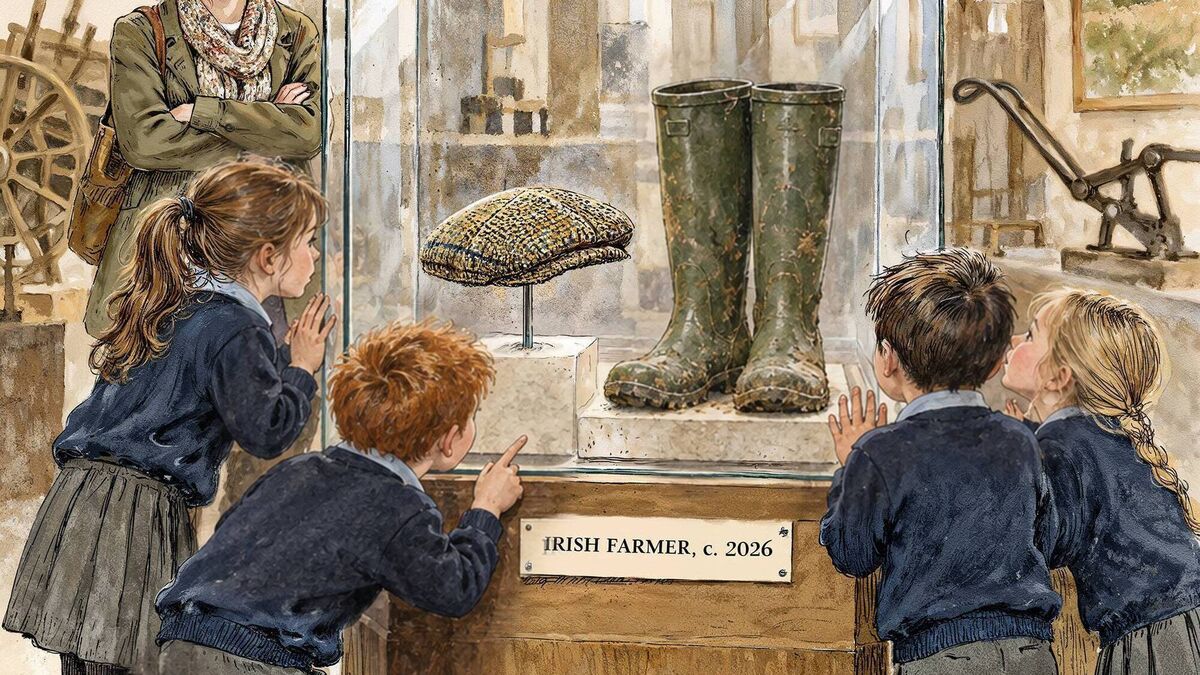
Farming is in danger of being consigned to history and the Ploughing Championships could eventually become another Ballina Heritage Day. Illustration: Conor McGuire
I have never been to the National Ploughing Championships, which I think puts me in excellent company, because as far as I can make out, neither has anyone who goes. I’ve watched it every September through the RTÉ News and whatever the phone throws at me, and I’ve seen everything. I’ve seen a man from Clonmel eat a hastily assembled burger twice the size of a Big Mac while standing up to his ankles in grass-churned mud. I’ve seen a girl from Tullamore wearing a free bucket hat bearing a bank's logo, which is the most generous thing the bank has done for anyone since 2008. I once watched a junior minister approach a Charolais bull with the expression of a man unsure which end was the business end and unwilling to ask. But an actual plough, actually ploughing? Perhaps a ten-second clip, so I'll have to take your word for it.
Somewhere out there, past the four-hundredth stall selling its version of Irishness, there are men in flat caps cutting furrows with grave, unhurried precision. They are judged by other men in flat caps. They are watched by a scattering of people and the odd collie dog with an opinion. The rest, a quarter of a million give or take, are in the queue for chips. The cameras know this. The cameras go where the chips are.
This year’s championships were at Screggan in Co Offaly; say it out loud and you make a good approximation of a tractor's sound as it sputters to a halt. The crowds teemed around the stands in their tens of thousands, parking acres away before obediently wedging into shuttle buses like sheep into a trailer. And the , with a candour I found almost moving, described the whole thing as primarily a social gathering for families and teenagers. It’s the Debs with silage or Electric Picnic for people who own a fleece and wellies. It’s the one week a year when a country that has spent four decades quietly scrubbing the farm off its shoes puts the wellies back on and goes to stand in a field, and calls it heritage.
I’m not knocking the day out. Everyone who’s been tells me it’s a memorable day. A friend of mine came home from Ratheniska one year talking about a crêpe the way other men talk about their first love. You can buy a quad bike, a timber-frame house, a funeral plan and a hoof trimmer within forty yards of each other, which is more or less the arc of rural life in four purchases. The Defence Forces let children climb on an armoured car, and the children, who in any other context would be on their phones, climb on it with real joy because it’s an armoured car. There’s a lad selling a miracle mop who has turned up in the background of the coverage since the Celtic Tiger and has never once, on camera, been seen to mop anything. He is, in his way, a ploughman.
The also said the event lifts the gloom for farmers. I’d like that to be true. I’d like it the way you’d like a wake to lift the gloom for the corpse.
Because the gloom is real, and it’s the kind you can put numbers on. Fuel has gone through the roof. Fertiliser has gone through the roof and kept going, out into the low atmosphere, where presumably it’s doing someone some good. The summer was a scorcher, the sort the radio people kept calling glorious, while men in Roscommon and Leitrim and the hungrier parts of Mayo watched their grass turn the colour of a digestive biscuit, and now the fodder that should be in the shed for the winter is either already eaten or never grew. The contractors, who have their own diesel problems and loans, are expected to raise their rates by about a fifth. A fifth. Ask a man on forty sucklers what a twenty per cent jump in his silage bill does to his year and watch his face do a thing faces don’t normally do.
The IFA, never knowingly overwrought, warned that “the cost of doing business has become quite incredible”. I love that. Quite incredible. It’s the most Irish sentence uttered at the whole championships. This is a culture where a man with a fractured arm will tell you he’s “a bit stiff”, where a gale that takes the roof off the shed is “an awful ould day”. When a farming body breaks out the word incredible, and then softens it with quite, you should hear sirens. In farming, quite incredible means the bank manager has stopped returning calls.
And into this, as they do every September, wade the politicians.
I’ve a theory about politicians at the Ploughing Championships, which is that they’re the only people in the field who’ve actually come to work. Everyone else is there for the chips and the bucket hats. The politician is there to be photographed in the act of being near a farmer, which is a skill in itself, like being photographed near a lion. President Connolly cheerfully shook the muddy hands, and I’ll give her credit, she looked on the news as though she meant it. The Taoiseach turned up too, in the regulation outfit: the Barbour that has never met a barbed-wire fence, the wellies so new you could almost smell the shop through the screen. Every Dublin TD owns exactly one pair of those wellies. They come out of the boot of the car in mid-September, they meet the muck of Offaly or Laois or Carlow for six hours, and then they’re hosed off and go back into the attic to sit beside the Christmas tree until next year. They’ve had a better life than most of the cattle in Connacht.
What none of them will do is stand still long enough to be asked a question that includes a number. The Ploughing Championships are a moving target by design. A minister walks the lanes as a man crossing a bog, never putting his full weight down in one spot. He’ll cheerfully sample cottage foods while telling an irate farmer spouting grievances that he hears him. Then he’s gone, back into the car, while the man from Cavan goes back to a yard where the fertiliser bill is pinned to the fridge with a magnet from the last Ploughing.
But there is the crooked thing at its heart. Over two hundred thousand people go to a farming event to cheer farming, and most of them couldn’t tell you what the ploughing judges are actually judging. Straightness? Depth? The angle of the sod? The general bearing of the ploughman? I genuinely don’t know, and I live in a county where you can’t throw a stone without it landing in a grassy field. We are, most of us, a generation or two off the land. A grandfather with a few acres and a donkey and a grievance. We go to the Ploughing the way Americans come to Ireland, looking for roots in the gift shop, buying the T-shirt, leaving with a sense of having belonged to something we’d never actually put up with.
Meanwhile the people we’ve come to look at are quietly going under. Not dramatically. Farmers don’t do dramatic. They do it the way an old cottage does it, slate by slate, a field let go here, a herd sold off there, a son in Sydney who isn’t coming back to take it on, until one day there’s a For Sale sign at the end of the boreen and a man in his seventies who has nothing to get up for.
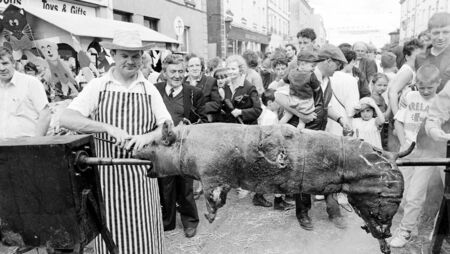
Give it another twenty years, and I’d say the ploughing contest will be akin to Ballina's Heritage Day but on an epic scale, like butter-churning at the folk park, with a fella in a costume flat cap explaining to schoolchildren what a farmer used to be. They’ll find it very interesting. Then they’ll queue for chips.