The land that forgot how to feed itself
There's a particular kind of Irish madness that only reveals itself slowly, like damp coming through a good coat. You don't notice it at first. Everything looks fine. The coat still looks grand. And then one morning, you're standing in the rain on the M50 watching a man on a tractor blockade the country's fuel supply, and you think - how exactly did we get here? And more to the point, if the fuel runs out, how long before the food does?
The answer, it turns out, is not very long at all. Nine meals, apparently, is the distance between a functioning society and anarchy. Three days' worth of breakfast, lunch and dinner, and we're apparently at each other's throats. I find this both alarming and entirely plausible. Have you seen the queues in Lidl on a Saturday morning? That's civilisation under stress right there, and everyone in the line has had breakfast.
There's a realisation that nobody is stating loudly enough an ominous reality that's been hiding in plain sight while we were all watching the tractors choke our main streets and arguing about whether it was a legitimate protest or national sabotage. Ireland has quietly, almost elegantly, stopped growing its own food. Not all of it, mind you and not overnight. Just gradually, one farm at a time, one grower at a time, over the last twenty years, until we woke up in 2026 to discover that we import 83% of our vegetables and have precisely 73 commercial vegetable growers left in the entire country. Seventy-three. Down from 600. In a generation. On an island that defines its entire cultural identity around the land.
Let that sit for a moment.
This is the country that had a devastating famine, apparently inscribed in our collective memories. A blighted scourge that killed one million people and sent another million to Boston and Brisbane and wherever else would give them refuge. The 'Great' famine that we cannot stop talking about, that we teach religiously in schools, so it still underpins our entire relationship with emigration, oppression, England and basically every woe that washes ashore. We have absorbed it into our national psyche and built a haunting skeletal monument to it on the quays in Dublin. Then, apparently, we decided the lesson was merely psychological and not at all practical. Why bother growing your own food when Tesco will do it for you?
It would be funny if it weren't so breathtakingly blinkered in its perspective and historically forgetful in practice.
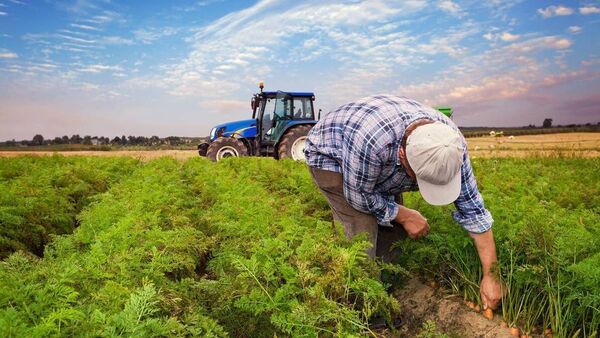
The collapse has been happening in slow motion, and the story of Hughes Farming in Kells, Co Kilkenny - one of the country's largest carrot growers, gone into liquidation this year - is just the latest chapter in a very long and depressing book. Hughes grew 12% of Ireland's carrots. Twelve per cent of one of the most basic, unglamorous, load-bearing vegetables in the Irish diet, just gone. The owners cited the usual grim litany: relentless rain, soaring costs, prices that haven't moved in twenty years. A carrot farmer told a reporter, and I feel the pain personally, that the price he gets for his carrots today is €1.29. Twenty years ago, it was €1.30. If the market had functioned like a market, it should be €1.90 by now. Instead, it went backwards.
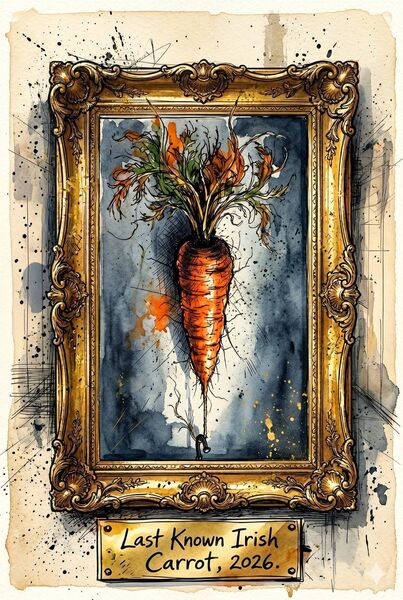
So who's responsible for this particular act of quiet vandalism? Step forward the supermarkets. The great cathedrals of modern Irish life, where we do our actual worshipping these days, where we commune with the weekly shop and push our trolleys with the glazed devotion of pilgrims. The supermarkets have been using vegetables as loss leaders for years - pricing them below viability to get you through the door, because once you're in, buying a bag of carrots for 89 cents you'll also buy the scented candles and the wine and the good biscuits and still manage to keep the lights on. The carrots are just bait. And the poor unfortunate who grew them gets squeezed until he can't make the numbers work and quietly disappears.
The Government has serenely watched all of this with the focused attention of a man asleep in a meeting. Successive administrations have been glaringly efficient at supporting beef and dairy, those big, photogenic, lobby-group-heavy areas of Irish agriculture that fill the export statistics and look good in press releases. Grass-fed. Sustainable. Premium. Very on-brand. Meanwhile, the people growing the actual vegetables that actual Irish people eat every single day have been left to figure it out themselves, with a few million in support thrown at them occasionally to make the optics slightly less embarrassing.
Michael Healy-Rae, former Minister of State for Horticulture, told the Dáil this year that the government fully recognises the importance of the sector. The government secured €8.8 million for horticulture in Budget 2026. Eight point eight million. For context, Ireland spent more than that on tourism advertising last year to persuade Germans to come and look at our countryside. The same countryside, incidentally, that is producing almost no vegetables.
And now comes the geopolitical gut-punch that even the most stubbornly optimistic among us can't ignore. The war in the Gulf - the US-Iran conflict that has been causing the fuel crisis and the blockades and all the rest of it - has a second act coming, and it involves fertiliser. Up to one third of the world's trade in key fertiliser ingredients passes through the Strait of Hormuz. If that shipping route stays disrupted, fertiliser prices spike, food production costs spike, and the countries that have been relying on cheap imported food to paper over the cracks in their collapsed domestic production suddenly find themselves in a very exposed position. Countries like, say, Ireland. A small island nation off the coast of Europe that imports 83% of its vegetables and has 73 hard-pressed growers left.
There's a bitter irony in the fact that Ireland is currently ranked the second most food-secure country in the world, according to the Global Food Security Index. Second out of f 113. Which sounds wonderful until you realise that, as measured, food security is largely about access and affordability rather than provenance and resilience. We can afford to buy food from elsewhere, which means we're food-secure, which means the index doesn't really capture what happens when 'elsewhere' becomes complicated. When the ships don't arrive. When the Strait of Hormuz is a warzone. When a bunch of farmers park their tractors across the M50 for two weeks, and the petrol stations run dry. Then the index stops being interesting, and the empty shelves become very interesting indeed.
What I find maddening is that none of this is complicated to fix, at least in principle. As Irish consumers, we can pay our growers a fair price and insist that the Government regulate the opportunistic supermarkets' loss-leader practices. We can also extend the basic income support that cattle farmers receive to the people growing native vegetables. We can introduce procurement policies that ensure fresh Irish produce is supplied to Irish schools, hospitals, and public institutions. We can morph vegetable growing into a viable sector, treating food self-sufficiency as vital to our island's survival. This is not a lifestyle choice nor a heritage sector to be preserved like a folk museum, but life-preserving infrastructure.
Instead, we've chosen to hollow it out completely and call it progress. We've built a food system that runs on cheap oil, long supply chains, geopolitical stability and supermarket price wars - four things that are, at this precise moment in history, not particularly reliable. We've built a prosperous, sophisticated, world-class little nation that cannot feed itself. And we've done it while carrying within our cultural DNA the memory of what happens to an island when the food stops coming.