We learn a lot from how we treat animals
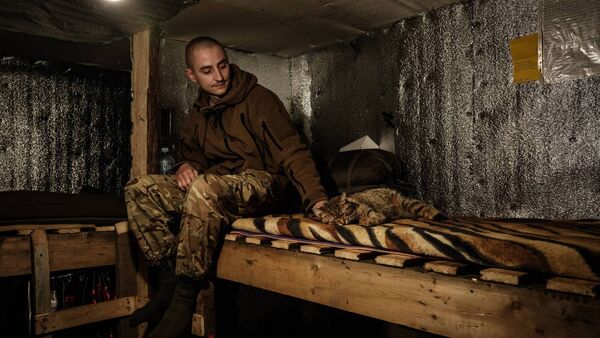
A Ukrainian serviceman strokes his cat Sardine brought from his village to his shelter near the frontline in the Donetsk region on February 4, 2023. Picture: Yasuyoshi Chiba/AFP via Getty Images
At the heart of the John Wick story is a retired hitman, played by Keanu Reeves, hollowed out by grief after the death of his wife. She leaves him a puppy, his last fragile connection to love, to tenderness, to something resembling a normal life. When that dog is killed, he doesn’t just mourn it; he unleashes a campaign of ruthless, almost operatic violence (over this film and its extremely successful sequels).
At one point in the third movie, Anjelica Huston’s character asks him:
“All of this for what? Because of a puppy?”
Wick slowly but definitely replies:
“It wasn’t just a puppy...”
And here’s the thing: nobody questions it. The audience understands. Instinctively. John Wick doesn’t say he prefers his dog to people. He doesn’t need to. The audience accepts, without hesitation, that a man might burn the world down for a dog, but might hesitate to do the same for a neighbour. But perhaps that’s where we are now, living in a culture where the emotional weight once reserved for spouses and children is quietly being transferred to cats and dogs.
According to a recent Harris Poll, 43% of Americans say they would prefer to have a pet as their child rather than a human one. As the fertility rate dropped to a record low in 2024, some Americans say concerns about finances are shaping long-term life plans. Commentators point to economic instability as one factor influencing decisions around parenthood and this preference for pets over kids.
Los Angeles truly loves its pets. But I do find it a weird kind of love. Too often I have met people who have openly introduced their pets as if they were they’re kids. Giving their names, ages and health condition while their child is just standing there. Dogs wearing clothes, being transported in prams and strollers. Cats in hats on leashes. Meanwhile, social media is now is full of talking AI pets as if there were not enough animal clips shared on platforms from YouTube to Telegram.
I once met an actor who told me she had to quit her day job because her dog was having anxiety over her being away for too long from the house. Our Trader Joe’s grocery store in Glendale has a sign that says 'No Pets Allowed' except service animals, which is routinely flouted when people bring cats, dogs, and even on one occasion what looked like a ferret with ADHD, into the shop. One Sunday, I won a bet with my wife on our walk to the Americana shopping mall on the amount of buggies being pushed along which contained dogs and not babies. No joke... it was 100%.
These animals are being carted around like infants: wrapped, pampered, and insulated from the very instincts that make them animals in the first place. It feels a little unmoored from reality, excessive, even self-indulgent. The affection is real, no doubt, but it carries with it the uneasy sense that something else has been quietly displaced.
Recently, we spent time in Alanya in Turkiye (yes, that is how it should be spelled now!), where the relationship between people and animals presents an altogether different picture. The streets are full of cats - hundreds of them - but they belong to no-one and to everyone. Bowls of water and food are left outside doorways, small shelters appear at the edges of streets, and in parks one finds little feeding stations dedicated to cats, where locals quietly tend to them.
What is striking is the distance maintained. People stop to stroke a cat, yes, but the cat decides. It approaches or it doesn’t. It stays or it wanders off. These are not pets in any conventional sense; they are creatures very much of their own world, coexisting with humans rather than depending on them. And yet, there is warmth in that relationship, arguably a healthier kind. The animals are lean, alert, fully themselves.
Compare that to the dogs of Los Angeles, some of which appear so overfed and over-handled that walking seems cruel. Pushed in buggies, shielded from exertion, they become less like animals and more like projections, extensions of their owners’ emotional lives.
To be fair, the attachment people feel to animals is not something to dismiss lightly. I have seen, how deep that bond can run. A friend of mine, after a breakup, lost not only his partner but the dog they had shared. Though it was technically hers, he had formed the deeper connection. By all accounts, the dog felt the loss as well. He was genuinely heartbroken, and it would take a cold person not to understand that.
Which brings us back to John Wick. When Wick says, “That dog was a gift from my wife... to help me grieve,” I understand exactly what he means. The dog is not just a dog, it is the last remaining thread tying him to love, to memory, to something human. His reaction, extreme as it is, feels emotionally coherent.
But there is a long road between that kind of grief and the everyday spectacle of pushing a perfectly healthy if obese dog through the streets in a pram.
There is, however, another version of this relationship I have witnessed, one shaped not by comfort, but by hardship.
We have close friends in Poltava in Ukraine, where the war has altered even the lives of animals. Our friend Vova, a lawyer, remains there, continuing his work while much of the country is mobilised. He has a particular fondness for cats, and like many Ukrainians, he has found himself caring not only for his own, but for strays, animals left behind as families flee, or simply lost in the chaos of war.
There are more of them now. In some cases, their owners are gone; in others, they have drifted into a kind of half-wild existence, surviving as best they can. Vova feeds them when he can, pays for treatment when they are sick, and does so quietly, out of whatever money he has to spare, which is not much. It is not ownership. It is not indulgence. It is care stripped of vanity.
Recently, there was footage shared widely across Ukraine of an army drone lifting a cat and a dog from the front lines to safety, two small lives carried out of danger in the middle of a brutal war. It struck a chord, not because it was sentimental, but because it felt instinctively right. Even there, amid destruction, the impulse to protect animals endures.
Here, the relationship feels different again. It is not the curated, almost performative affection one sometimes sees in Los Angeles, nor the easy, communal coexistence of the cats of Alanya. It is something more elemental, a recognition of vulnerability, perhaps, or a refusal to abandon what cannot fend for itself.
Somewhere between the wild cats of Türkiye and the rescued strays of Ukraine, we might begin to see not just how we treat animals, but each other.
And with the pampered poodles of Los Angeles, we could question what are we asking them to replace.