The Holocaust must never be forgotten
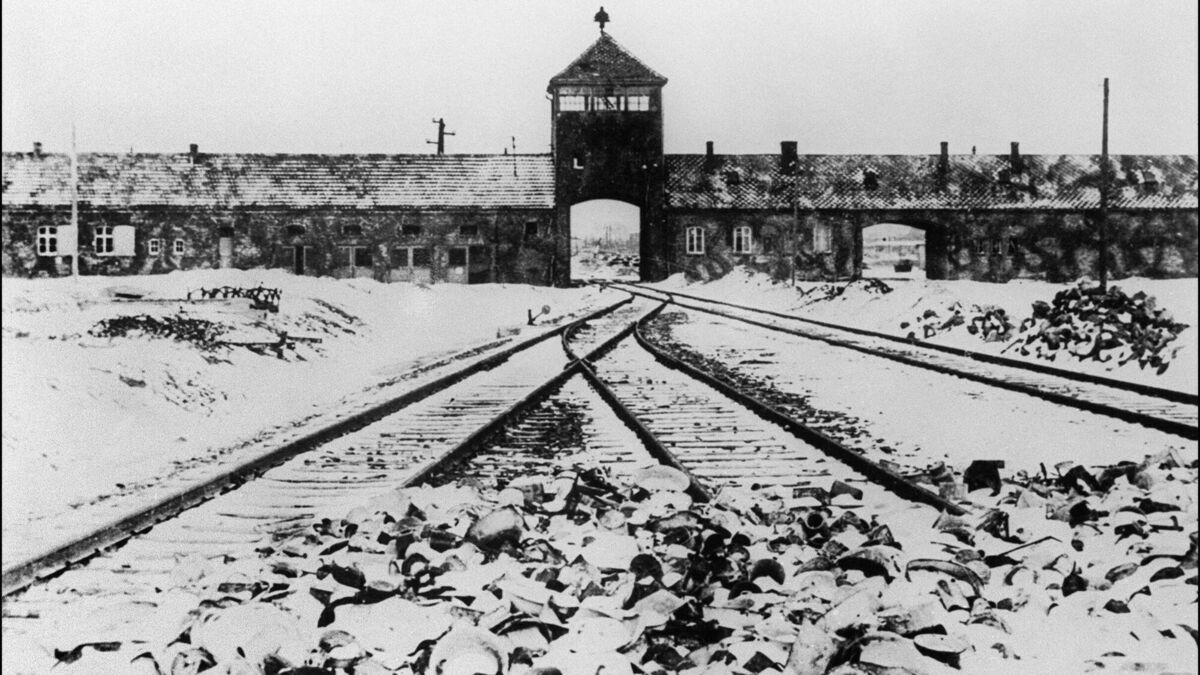
A picture taken in January 1945 depicts Auschwitz concentration camp gate and railways after its liberation by Soviet troops. Picture: Yad Vashem/AFP via Getty Images
It is worrying that a recent report found that almost 10% of young adults in Ireland believe the Holocaust was a myth and did not happen. Almost twice as many thought that the number of Jews murdered in the Holocaust has been exaggerated. That is just as worrying, if not even more so.
It was six million by the way. Six million Jewish children, women and men were murdered in the Holocaust. Most of the killing took place from 1941-45. Every place you can imagine was used. Mass graves were forcibly dug in the countryside by those about to be murdered. Jews were locked up in ghettoes in cities. They were brought to extermination camps, where the sole purpose of the false facilities – they were often made to look like train stations – was to get people to co-operate more easily in their own murder. Enormous work and death camps were built, where the fittest were kept alive to work while the less fit were murdered on the day they arrived.
The actual killings included mass shootings, deliberate starvations, and diseases allowed to run untreated. People were literally worked to death, babies were murdered by lethal injections within seconds of taking their first breath, and of course the murder rate was accelerated to a massive extent by the use of poison gas. Gas was first used on people locked into the back of running mobile trucks into which exhaust fumes were diverted. This was then replaced by gassing through shower heads in large industrial-style buildings. As well as speeding up the kill rate, the gas was favoured as a method of killing because some Nazis were worried about the effect on the morale of their men of shooting so many defenceless people in the head from point blank range. Yes, they worried about the effect on those holding the guns. In that mindset, killing by gas was less personal.
I share those details out of no desire to shock or offend. I share them because we should not forget them.
The Holocaust takes its infamous place in the history of human crime not just because of the scale, but because it was an attempt to systematically exterminate an entire group of people. The Nazis also set out - in their minds - to sanitise this enterprise even as they carried it out. They considered the organisation of the ‘final solution’ as an improvement on impromptu hate filled attacks on Jews, a method they considered ‘crude’. They would replace this inefficient and unsophisticated approach with a rational, organised and industrially planned process of elimination. The mass murder became a management project, organised by sophisticated and - they thought - cultured people who were going to kill the Jews in a planned and methodical way. They would have said - alas, this is no dark joke - that it was more humane.
So in the Nazi ‘modern’ mindset, the previous centuries of hatred and pogroms of the Jews were to be replaced by a bureaucratic and industrial process. This was a murder machine of data collection; of railway timetables; of demographic statistics; of academic and management studies of how many could be killed, in what way, over how long; of the use of new technologies. That it was so methodical makes it all the more monstrous. They had active collaborators all over Europe, but secured even more collaboration through pure cynicism. In the Nazi-occupied Netherlands, the authorities asked the general population to fill out a form, where one question asked the respondent to confirm their religion. Answering that question if you were not a Jew made it a lot easier to find - and then kill - Dutch Jews. Aided by this, three quarters of Dutch Jews, over 100,000 people, were transported by train and murdered.
I studied some of the detail of the Holocaust a long time ago, and I have seen some of those details with my own eyes. In the west part of the city of Berlin, there is a pleasant villa type house in a suburb called Wannsee. In this house in January 1942 there was a meeting held between senior members of the Nazi government where the details of how all the Jews of Europe were to be killed were planned out.
I have been in the house. You can see there some of the documentation they used to help them shape those plans. It includes a carefully compiled and researched document which lists out how many Jews lived in each European country. The purpose of this document was to help figure out how long it would take to kill them all - and to be sure that none were left. In some countries which the Nazis had conquered they had already started killing them. In other countries which they did not control directly, plans were made at that meeting to force their governments to hand over their Jewish population. In the document, you will see, written in German, the name of Ireland, with a number beside it: their best estimate as to how many Jews lived here. Anyone who engages in a debate about Irish neutrality in the Second World War should have a look at that document first.
On another day, I visited Auschwitz-Birkenau. Auschwitz-Birkenau is today in Poland, an hour or so west of Krakow. It was both a work and death camp - what would be called a Concentration and Extermination camp. The whole complex was made up of a number of different sites. The two I visited were named Auschwitz, which is a smaller camp in the town, while out in the countryside is the altogether larger Birkenau - that is the place you recognise from movies, television and documentaries. It is the place the trains arrived.
When you arrive at Birkenau today and you stand at the observation spot looking over its vast expanse, you get a real sense of the scale of the process.
It is a monstrous place. Here - and in other such places - not only Jews were killed but Roma and many others who did not fit the Nazi idea of the ‘master race’. When it was clear the war was lost, the Nazis tried to destroy the records of what they had done, but there was too much evidence. This is why historians can be confident of the figures.
So for all those reasons it is very important that more people should know of what happened in the Holocaust, and speak of it, and push back against those who would deny it happened, or try to lessen its significance.
There is another point about it that should also be remembered, and more than remembered, understood. Adolf Hitler was elected to power in Germany in 1933. He did not win that election by promising to kill all the Jews. How his regime ended up killing so many was a process, a process of radicalisation made more dangerous and more possible by the dynamic of war and fear.