The giant fish that kept coming back
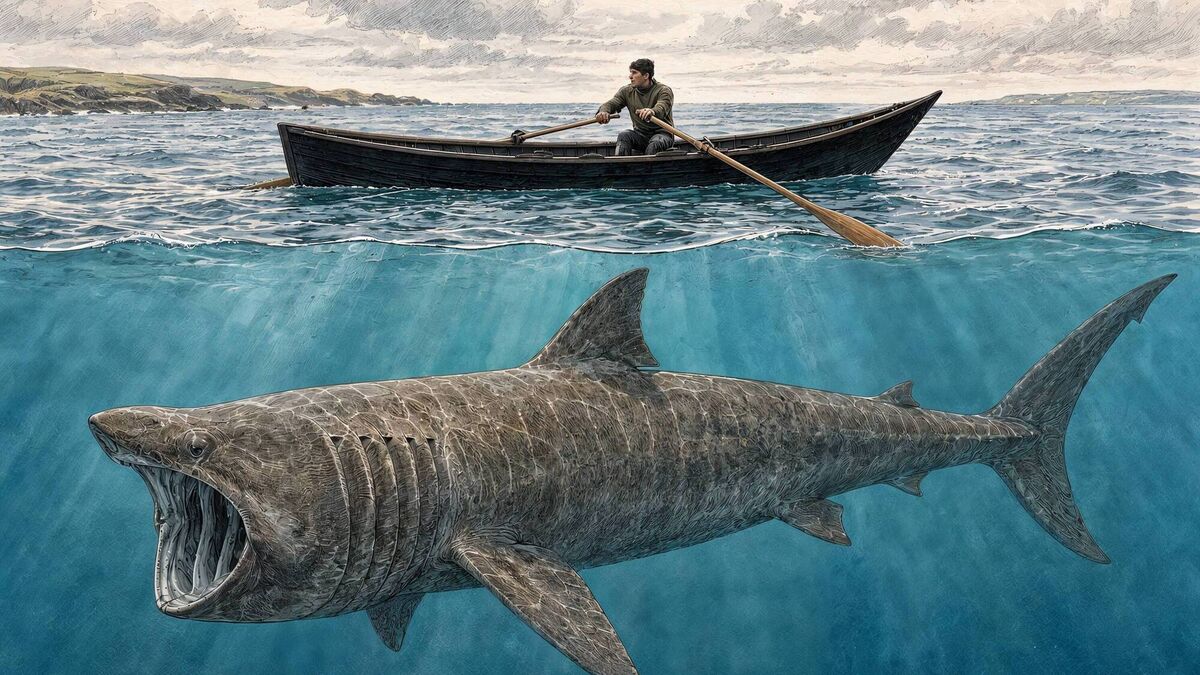
For a period in the mid-20th century, Achill had the largest basking shark fishery on the planet. Illustration: Conor McGuire
The car park at Keem fills by about 11am most days in August.
Later than that and you're walking, or you're taking the shuttle out from Keel at five euro the return, which is a sentence that would have meant nothing at all on this island seventy years ago. Lonely Planet has the beach among the hundred best in the world. A share of the crowd are here because they saw it in and fancy standing where Colin Farrell stood being wretched at Brendan Gleeson.
It's a lovely spot. Not in the brochure way, actually lovely, and the road in over the cliff still puts the heart crossways in people.
Nobody on that sand is thinking about the water having run red.
Between 1950 and 1964, the fishery operating out of Keem and Purteen Harbour took 9,000 basking sharks. In 1951 alone, it took more than 1,630. At the peak, they were killing up to fifty in a day. Simon Berrow of the Irish Basking Shark Group reckons that as recently as the 1960s, fifteen hundred a year were being killed off Achill Head.
It was the largest basking shark fishery on earth. It was also the best documented, because somebody kept the books properly, and there's a bleak comedy in that. We were thorough.
What it was all for was the liver, which in a basking shark runs to about a quarter of the animal's body weight and works as a flotation organ, keeping the thing hanging weightless in the water. Rendered down, the oil lit street lamps for a while. Later it went out as a fine-grade lubricant, some of it into aerospace. When the oil price collapsed, they took the fins instead, for the soup and ornament trade out east.
Sit with that for a second. Men in currachs off the west coast of Mayo killed the second-largest fish alive so that a moving part in an aircraft, somewhere else entirely, would turn a little more smoothly.
Consider what they were killing.
Cetorhinus maximus runs to five or seven metres as a rule, and eleven has been recorded. It eats copepods, which are the size of a grain of rice. It has rows of small teeth and no use for them at all, filtering its food through gill rakers instead. It's what the literature calls an obligate ram filter-feeder, meaning it has to keep swimming in order to eat. It cannot stop.
It dives to eight hundred metres as ordinary business and has been tagged below fifteen hundred, so the great bulk of its life happens somewhere no person has ever been. It navigates by sensing the Earth's magnetic field. And it's warm-blooded, which we only established in 2023, so we're still finding out elementary things about an animal we spent a century rendering into oil.
Six pups. That's the whole reproductive output. Long-lived, desperately slow to breed.
We Irish had four names for it, and they're all better than anything in English. , the great leviathan. , the great fish of the sun. , the monster with the sail. And my favourite, , the unwieldy beast with two fins, which is affectionate in the way you'd be about a big harmless eejit of a dog. There's a proverb too. - as tranquil as a basking shark.
You don't give a thing four names unless you've spent generations looking at it.
Nobody has ever properly watched a basking shark being born. There is only one recorded eyewitness account in the scientific literature. Two Norwegian fishermen, Hans Goksøyr and Jonas Sørdal, were towing a female they'd harpooned when she expelled five live young and a sixth dead.
The living ones swam off.
That's it. That's the entire body of human observation of this animal giving birth, and it happened because we were killing it.
The basking shark went from vulnerable to endangered on the international red list in 2019. The North Atlantic population is put below ten thousand. Berrow's estimate is that there may be as few as 5,000 breeding basking sharks left on the planet, and possibly fewer.
Sixteen hundred and thirty off one Mayo beach in one summer.
Basking sharks show what's called interannual site fidelity. They come back. Same water, same headland, year on year. Genetic work published in 2020 found that sharks surfacing together are more likely to be related than unrelated.
It's important to remember that Keem was not a fishery in the sense of a boat going out and finding a stock. It was a fixed point. The men stood at the one place and took apart the same families as they came home, over and over, and the whole enterprise worked precisely because the animal was faithful to the spot.
The State got around to protecting it in October 2022. First fish ever brought under the Wildlife Act, which sounds like progress until you learn the rest. Berrow and his people had been asking since 2008. Three separate ministers were formally petitioned, and each of them declined. Britain and the North had protection in place long before we did.
"Before with fish," Berrow said at the time, "it was either we eat them, or we don't eat them."
Fourteen years of asking to move an animal from the menu into the wildlife column, in the country he describes as more closely associated with basking sharks than any other on earth. We were world leaders at killing them and stone last at stopping. Marine protected areas for the breeding grounds still aren't there.
There's also a revisionist temptation to make the Achill men the villains, and I’ll sidestep that one. They had nothing, less than nothing in the long wet winters of the westerly Atlantic. The oil paid well, and for a few blessed summers money flowed into island pockets that had seen precious little of it. That's not a moral failing, that's a wage.
What's harder is that it didn't save the place. Achill went on emptying right through it, to Cleveland and Camden and the potato fields of Scotland, and the sharks ran out at roughly the same time as the people did. Two populations that kept coming back to the same ground until they couldn't. One of them stopped.
Somebody is standing on Keem Strand this afternoon with a phone up, filming the water for the internet. Out beyond, below eight hundred metres, in the cold and the dark where we've hardly ever been, an animal is turning north by magnetism, warm-blooded, mouth open, on its way back to the only place it knows.
It has no way of knowing we've changed our minds. It'll come anyway, because coming back is the whole content of its life. And it can't stop swimming. It never could.