The Emergency has never ended for Ireland
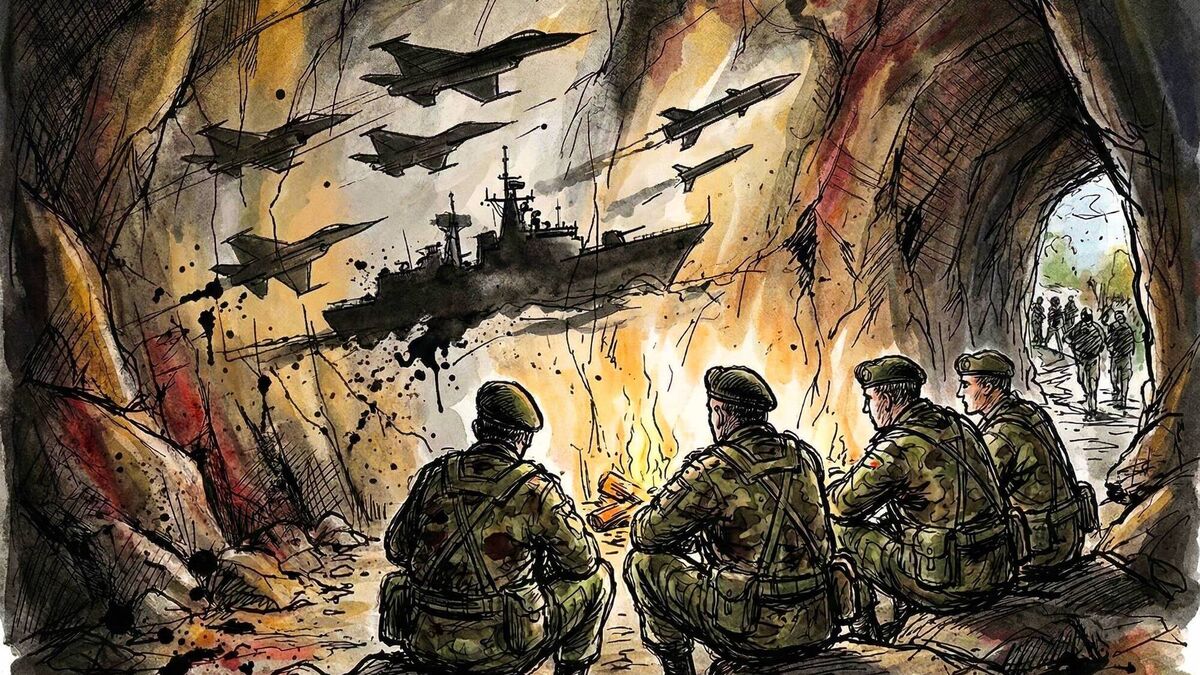
Ireland is clinging to its position of neutrality in a very changed world. Illustration: Conor McGuire
Eighty years ago, de Valera beheld a burning Europe and called it a weather event. We're still doing it.
We Irish have a distinctive talent for extended euphemism. Unlike the well-mannered, restrained English manner of announcing catastrophes, ours is more direct, a bit cunning and rebellious.
Instead, we contrive a renaming of reality so complete, so committed, that after a while the new name begins to feel more real than the thing itself.
As the Second World War spread across Europe in September 1939, swallowing Poland whole in a fortnight and hurtling thirty million people towards their untimely deaths, our reticent Irish forefathers calmly declared a state of emergency. Not a war, mind you, not even a catastrophe, but an emergency, a sort of side effect of Europe's mainland hell.
On reflection, it’s even parochial, the sort of word you'd use for a passing storm or a shortage of petrol at the pumps. De Valera's cabinet passed the Emergency Powers Act and then, with impressive national resolve, agreed to call the entire global conflagration by this one small, manageable, municipally-flavoured word - The 'Emergency' - for the next six years.
It was, in its way, a masterpiece. The word 'war' would have required a response. An 'emergency' merely required administration. And so while Churchill's Britain was bombed into rubble, while France fell in six weeks, while six million Jews were murdered in the industrial dark of eastern Europe, Ireland kept its weather forecasts off the radio - lest the information assist enemy aircraft - and got on with being neutral. It wasn't cowardice. It was something stranger: the fierce, almost theological insistence of a newly independent nation that its sovereignty be expressed, first and most legibly, by the simple act of refusal.
De Valera was not a stupid man. He knew, of course, that Irish neutrality was a performance with a hidden libretto. Thousands of Irishmen - estimates run to 70,000 - crossed the border or the Irish Sea to fight in British uniform. Allied airmen who made a forced landing in Ireland were quietly released, while Axis airmen were interned at the Curragh. Weather data was passed to the Allies. The ports, though not formally surrendered, were never closed to Allied intelligence. Irish neutrality was, in the mordant phrase of historians, a 'benevolent' neutrality - benevolent, that is, to the side everyone hoped would win.
But the performance was everything. It told Britain, which had occupied Ireland for eight centuries, that this was no longer Britain's business. It told the world that this island, which had spent so long as someone else's sentence, could now write its own.
That was 1939, and we now live in a volatile 2026, and here we are again, clinging to a position that makes our predicament seem parochial and manageable.
The Russia that has spent four years grinding Ukraine to powder is not a far-off nuisance. Russian naval vessels, including the Admiral Golovko, a frigate carrying the same Kalibr cruise missiles used to strike Kyiv, have been observed prowling Ireland's exclusive economic zone, that seven-times-the-landmass sweep of Atlantic water that Ireland technically controls and practically cannot defend without European intervention.
Russian submarines have been detected near the undersea cables that carry approximately 75% of transatlantic internet traffic - cables that pass directly beneath Irish waters. When President Zelensky's plane landed in Dublin last December, unidentified drones were spotted over Dublin Bay, not by radar - Ireland has essentially no functioning military radar - but by sailors on a naval vessel looking up.
Ireland, the second-wealthiest country in the European Union by Gross Domestic Product per capita, spends 0.25 per cent of its GDP on defence. This is not simply the lowest in the European Union. It is less than half of what Malta spends, and Malta has a population roughly the size of Cork. The Irish Defence Forces, that proud institution whose soldiers have effectively kept peace from the Congo to Cyprus for 60 years, currently number approximately 7,400 active personnel. To put that in perspective, An Garda Síochána, whose most dangerous regular duty is a Friday night on Dublin's O'Connell Street, is twice that number.
The pressure to change is now coming from all directions and at a significant volume. Finland and Sweden, countries that made neutrality into something close to a national religion, have joined NATO. The former Estonian president, watching President Michael D Higgins lecture Europe about the dangers of increased defence spending, responded with the kind of Baltic directness that cuts through the ambient fog of Irish commentary: 'Do these people have any sense of self-awareness, their privileged geography or the appropriateness of their comments?' In Brussels, officials use the word 'bafflement'.
Ireland holds the EU presidency in the second half of 2026. We will, with considerable poise, chair meetings about European defence architecture while having, in effect, no air force and a navy that recently went to sea specifically to watch Russian warships. The irony is a bravado baroque performance even by our Irish standards.
And yet our new President, Catherine Connolly - elected by a comfortable majority in October - declared in her victory speech that she would be 'a voice for peace, a voice that builds on our policy of neutrality'. Sinn Féin, the largest single party in the State, wants neutrality enshrined in the constitution. The polls show around 60% public support for neutrality, though the same polls also show 55% support for 'significantly increasing' military capacity, suggesting the Irish electorate has inherited something of Dev's own talent for holding two incompatible positions simultaneously with perfect equanimity.
The debate, when it happens, tends to generate more heat than light. Those who suggest Ireland should spend more on defence are immediately - and often incorrectly - assumed to be calling for NATO membership, and are set upon accordingly. The concept of neutrality has become, in Irish discourse, a kind of sacred relic: not really examined or defined, but loudly venerated. It is, says one analyst, 'challenging' to discuss national security 'without opening a contentious debate on the related but separate issue of neutrality'. We, as a nation, have made the two questions inseparable, thereby guaranteeing that neither can be answered.
The current position of the Irish government - 'not politically neutral, but militarily neutral' - is a formulation that sows, in the words of one diplomatic observer, 'confusion in Brussels'. It is the kind of phrase that sounds like something until you deflate it, whereupon it reveals itself to be a very elegant windbag, a balloon that fills a gap where a substantive and coherent policy is always lacking.
With considerable pomp and ceremonial glee, Ireland will chair the EU's upcoming defence meetings without a trace of irony, while woefully lacking a radar network or a fighter air force adequate to any defence strategy, and insistently eschewing any formal military obligations. We will succeed in administering the problem with the detachment of a later-day Pontius Pilate.
De Valera was, whatever his faults, playing a subtle game with genuine strategic logic as he protected a fragile, 20-year-old republic from being swallowed back into the maw of the empire that had only recently released it. The neutrality of 1939 was earned by defiance.
What the resurrected neutrality of 2026 represents may be much harder to define. It may be an honoured principle or an artfully dressed alternative, feigning virtue. It may be, in our oldest Irish tradition, a performance whose audience has quietly changed beyond recognition without the performers really giving a tuppence.
Meanwhile, out in the windswept Atlantic, the Russian ships are watching the cables. The drones are not asking for permission. The emergency is ongoing.
The only question is what we're going to call it this time.