The Emerald Emperors with links to Mayo
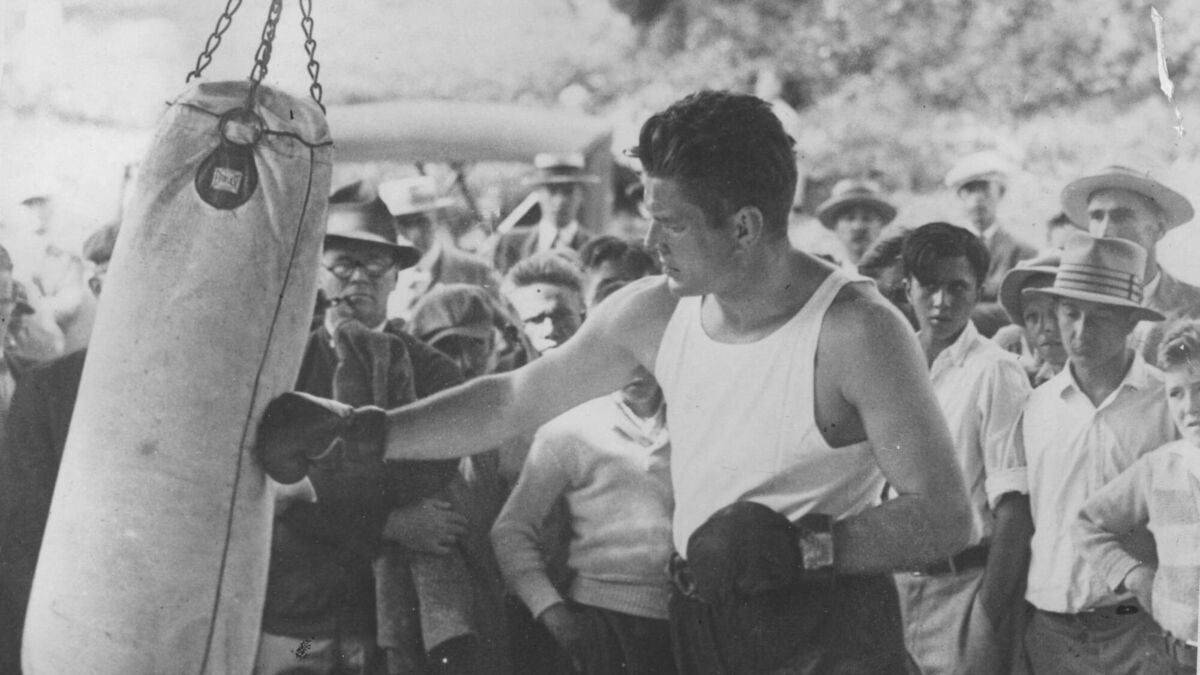
24th July 1928: US boxer and world heavyweight champion Gene Tunney (1898 - 1978) in training at Speculator Camp, New York, for the Battle of the Giants, his forthcoming fight against Tom Heeney. (Photo by Hulton Archive/Getty Images)
For many decades throughout the nineteenth century and the early decades of the twentieth century, the Irishman was the idealised boxer in the United States; the very definition of masculinity. The heavyweight boxers of the era in particular were truly Emerald Emperors. The Great White Hope was, for a significant period, the Great Irish Hope.
Journalist Jim Murray wrote of Gene Tunney: “He was unloved, underrated, shunned by his own people, rejected by history. Still, he was the best advertisement his sport has ever had... He was like no Irishman you ever saw, but he was the greatest Irish athlete who ever lived.”
Tunney’s parents Mary Lydon and John Tunney emigrated to the United States from Kiltimagh, met in New York City, and married after a brief courtship. John Tunney was an ardent boxing fan at a time when five of the seven championships were in the hands of Irishmen.
James Joseph Tunney, born on May 25, 1897, was the second of seven children and acquired the name Gene when his sister could not pronounce his full name. At the age of fifteen, Gene dropped out of high school and found work as an office boy where he progressed rapidly while learning to box at the Greenwich Village Athletic Club before turning professional at the age of eighteen.
When America entered the First World War, Tunney joined the Marines and while stationed in France won the American Expeditionary Forces’ light heavyweight title, leading to his sobriquet ‘The Fighting Marine’.
Tunney preferred to think his way through a match, relying on his fleetness of foot and quick jabbing than all-out punching. He had an excellent left jab and preferred to stay outside and nullify any of his opponent’s attacks using quick counterpunches to keep them off balance. Tunney wrote about his approach to boxing in , comparing his methods to those of a fencer or chess player.
After making short work of the light heavyweight division, Tunney expressed his desire to fight the heavyweight champion Jack Dempsey, but few took his words seriously. Dempsey was considered to be the most savage and brutal fighter who had ever taken to the boxing ring but Tunney was intent on his mission and gave fair warning when he defeated Tommy Gibbons, another Irish-American heavyweight fighter whom Dempsey had only defeated on points in a fight that had bankrupted the town of Shelby, Montana.
On September 23, 1926, in Philadelphia’s Sesquicentennial Stadium, the two men finally met in front of a crowd of 118,736 in a contest which generated an unprecedented $2,000,000.
Dempsey was an iconic figure, viewed as the apotheosis of male virility and his boxing style was in keeping with his personality. Dempsey kept on the offensive continuously, bobbing up and down and moving from side to side as he delivered short swinging blows out of a crouch. His movement and speed of his attack constituted his defense.
Tunney took the first heavyweight title awarded by decision which magazine deemed the ‘Upset of the Decade’. The people’s champion had been defeated.
On September 22, 1927, Tunney and Dempsey met for a second time in Soldier Field, Chicago in one of the most infamous fights of all time. In the first ever boxing encounter covered by a professional radio announcer, 1,200 journalists were in attendance to document proceedings while a crowd of 102,450 generated almost $3,000,000.
When the fight got under way, the first six rounds were even but it was obvious that Dempsey’s reflexes had slowed. At the start of the seventh, Dempsey caught Tunney with a shuddering left hook to the jaw. As Tunney fell to the floor, Dempsey followed on with a flurry of punches. For the first time in Tunney’s illustrious professional boxing career he had hit the canvas in the course of a contest.
Under recently amended rules, Dempsey was supposed to go and stand in the most distant neutral corner but he continued to hover over his fallen opponent. Referee Dave Barry insisted Dempsey return to his corner but by the time he had retreated to his proper place Tunney had already been down for four or five seconds, and only then did Barry begin his count.
Tunney took as much time as he could getting to his feet, and by the time Barry had counted to ten Tunney was upright. Paul Beeler, the official timekeeper, later said he was at thirteen when Tunney got up. However, Tunney rallied and dominated the last three rounds; the fight later became known as the infamous ‘Battle of the Long Count’.
In defeat, Dempsey raised the new champion’s hand and told him that he was the best and fought like the best. The pair remained good friends for the rest of their lives. Tunney retired undefeated in 1928 and promised his wife that he would never fight again.
Gene Tunney is one of only four heavyweights to have retired as champion and one of only five champions to retire without ever suffering a stoppage defeat.
Frank ‘The Fighting Dentist’ Moran, born on March 18, 1887, in Cleveland, Ohio, was a talented all-round athlete and a singular character. His father, Matthew J. Moran, came from Islandtaggart in picturesque Clew Bay.
As well as being a boxer, Moran played professional football and had the distinction of sparring with President Theodore Roosevelt while serving in the American Navy. His sense of humour was evident when he gave his right hand the memorable sobriquet ‘Mary Ann’ because she was such a knockout.
On June 27, 1914, Moran entered the ring against the controversial black heavyweight champion Jack Johnson at the Velodrome d’Hiver in Paris in a contest that went the full ten-round distance. The fight was controversially called against the Irishman.
Frank Moran went on to earn a second tilt at the world title against Jess ‘The Pottawatomie Giant’ Willard who had finally accounted for Jack Johnson in a dubious fight in Havana in 1915. Moran fought the new champion at Madison Square Garden on March 25, 1916, in what was Willard’s first defence of his crown. The fight, organised on a ten-round no-decision basis, meant Moran had to knock Willard out to claim the title.
Willard was a monster of a man; six foot six inches tall and over 250 pounds weight and it was not to be for the brave Irish man; the bout went the full distance and Willard retained his title.
Moran fought unsuccessfully for the heavyweight championship of France against Marcel Nilles on December 22, 1922, after which he declared his retirement from the ring. After winning a role in a Broadway stage adaptation of Theodore Dreiser’s novel , Moran got the acting bug and went on to have a successful career in film and had roles in the Mae West vehicle and a shared credit for the leading role with George Zucco in the 1944 .
Frank Moran died on December 14, 1967, at the age of 80, and, despite his many celluloid outings, is often best remembered for the line: ‘It pays me better to knock out teeth than put them in.’
John Patrick Kilbane, born on April 9, 1889, in Cleveland, Ohio, to John Kilbane and Mary Gallagher of Achill Island holds the distinction of being the longest holder of the world featherweight title, an honour he retained for a remarkable eleven years.
Kilbane did not have it easy growing up: his mother died when he was three and his father went blind when he was ten. At school, Kilbane gained a particular love for gymnastics and developed a strong ability in the horizontal bars which helped him in his subsequent boxing career. In an interesting coincidence, a boxer called Tommy Kilbane lived in the next street to Johnny but the families were not related.
In 1912, Kilbane was pitted against Abe Attell for the second time for the featherweight title, a fighter who was widely believed to be virtually unbeatable. Kilbane stayed the course and won by decision. One journalist described Kilbane’s flashing eyes were redolent of ‘shamrocks in full bloom, the bogs, the turf, the clay pipes and the black tea’.
Throughout his career, Kilbane achieved huge popularity, so much so that his name was once used as a verb. In 1912, the described an incident in a baseball match where a player chased after a heckler and ‘Johnny Kilbaned’ him right where he stood, putting an end to his profane language.
It could be argued that the only real mistake of Kilbane’s career was his decision to step up to the lightweight division to take on Benny Leonard for the title in 1917. The bigger and stronger Ghetto Wizard knocked Kilbane out in three rounds. Four times Kilbane had stepped into the ring against another champion and three times he had come out on the right side, but it was not to be against Leonard. Kilbane retained his featherweight title until losing to Frenchman Eugene Criqui on June 2, 1923, in the Polo Grounds, New York.
Unlike so many others, Kilbane got out of the game while the going was good and subsequently worked as a referee, operated a gym, sold real estate and taught physical education in local schools. He was elected State Senator from 1941-‘42 and State Representative in 1951. He left the State House in 1952 when he was elected Clerk of Courts, a post he held until his death in 1957.
Looking back on his boxing career and personal life, Johnny always credited his wife Irene for her support, claiming, in 1951: “My life has been a very happy one. Ninety-nine percent of this is because of my wife, and the other one percent is the Luck of the Irish.”
However, Kilbane was a realist and once said to a group of reporters: “Show me a business where I can make more money than I can in the ring and I’ll never fight again. I don’t fight because I like it. I fight because it means a living for my family and myself.”
He died on May 31, 1957, in Cleveland, Ohio. In 2012 a statue unveiled of Kilbane in his honour on Achill Island, with a similar honour bestowed upon him in Cleveland’s Battery Park in 2014.
- by Crossmolina native Kevin Martin is published by McFarland, North Carolina and is available on Amazon or can be ordered through all good bookshops.