The crown, the thief and the tarnished jewels
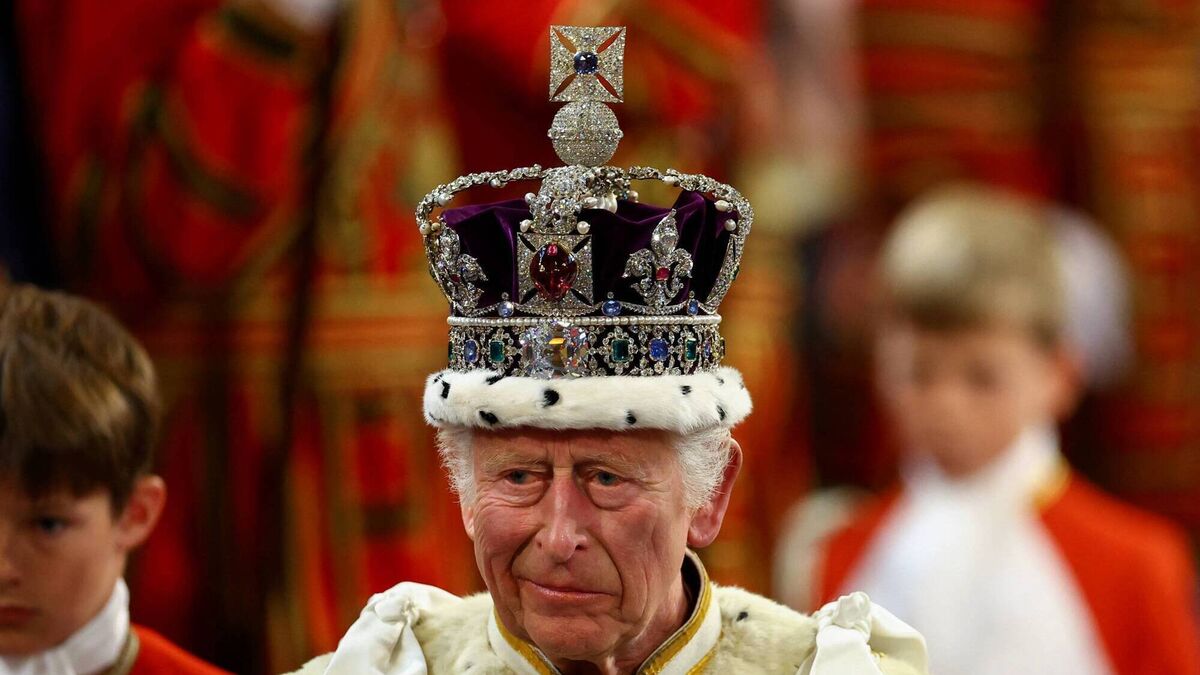
King Charles III wears the Imperial State Crown on the day of the State Opening of Parliament at the Palace of Westminster on July 17, 2024 in London. Picture: Hannah McKay - WPA Pool/Getty Images
The gullible English have always had a weakness for the sort of Irishman who makes them feel both robbed and appreciative of the experience. It's a very specific affliction, a kind of baffled admiration reserved for men who walk brazenly into rooms they have no business being in, help themselves to whatever takes their fancy, and leave even the victim secretly hoping they get away with it.
Colonel Thomas Blood was the embodiment of this type, a rogue from Clare with the brass neck of a dozen lesser men, and possessed of a talent for disguise that would make a trained assassin envious. He also had the Irishman's gift for charming his way out of situations that would have left a less gifted individual swinging from a creaking rope on a Tyburn scaffold.
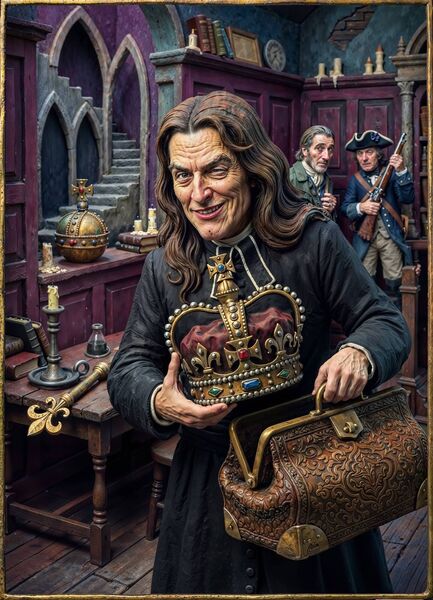
On the bright sunny morning of May 9th, 1671, Blood casually arrived at the Tower of London dressed as a humble parson. Not sneaking or lurking suspiciously, as one might expect, but walking with the cheerful confidence of a man who has absolutely nothing to hide. He amply demonstrated the effectiveness of the oldest and most reliable cover story in the history of human larceny. He'd been working the long con for months by then - befriending the Keeper of the Jewels, one Talbot Edwards, with a friendliness and social ingenuity that speaks either to Blood's extraordinary charisma or Edwards' catastrophic gullibility. Probably both. Blood had brought his fake wife with her appropriately timed stomach complaint, delivered gloves as tokens of gratitude, flattered the Edwards daughter with the prospect of a wealthy fictional nephew - the whole elaborate construction had the baroque quality of a seventeenth-century soap opera, and Blood was its gleeful auteur.
What happened next is so staggeringly brazen it almost demands you stand up and applaud, even as you wince. Blood knocked old Edwards unconscious with a mallet, stuffed the royal orb down his breeches - a detail that no historian has ever managed to make entirely dignified - flattened the crown with the same mallet and crammed it into a bag. His brother-in-law Hunt began sawing the sceptre in half and the whole enterprise had the faintly unruly energy of a heist designed by enthusiastic amateurs who've watched too many professional criminals and slightly misunderstood the lesson.
Edwards woke up. Shouted. The game was up.
This is where Blood's story stops being merely entertaining and becomes genuinely fascinating, because what followed was not the trial and execution that should have ensued. Blood refused to speak to anyone but the king, a demand of such extraordinary cheek that Charles II, to his credit, actually found it funny. He summoned this Irish scoundrel, this recidivist plotter who'd tried twice to kidnap the Duke of Ormond and once attempted to storm Dublin Castle, and he sat down with him for what must have been one of the more remarkable royal audiences in history.
Blood told the king, with magnificent self-possession, that the Crown Jewels weren't worth their stated value of £100,000 anyway - more like £6,000, if you were being honest. Charles asked what Blood thought he deserved if the king spared his life. Blood said he'd endeavour to deserve it, Sire - which is the perfect answer, neither grovelling nor defiant, the answer of a man who understands instinctively that powerful people respect composure over supplication.
He walked out with a pardon and Irish lands worth £500 a year, and became a beloved fixture at court. The Irish rogue who'd tried to rob the king became, essentially, the king's favourite rogue. This was, by any measure, a spectacular result.
So here we are, three and a half centuries on, considering what the British monarchy has made of its own rather different sort of scandal.
Where Blood was audacious, self-aware and ultimately rather entertaining, the modern crisis that has most comprehensively embarrassed the Crown comes wrapped in the considerable, perspiring form of the man once known as Prince Andrew. The former Duke of York managed something Blood never quite achieved: he made the public actively hostile rather than reluctantly charmed. Blood stole things. Andrew, if the accusations are credited, took something considerably less defensible - and then sat down with Emily Maitlis and explained, with the hapless confidence of a man who believes feigned sincerity is an adequate substitute for credibility, that he couldn't sweat. It was one of the great television interviews of the age, though not in the way the Palace had hoped.
Blood's pardon rested on a simple yet brilliant calculation of the King’s political savvy. A wise regent, Charles II, understood that a monarchy that can afford to be magnanimous is a monarchy that appears secure. Pardoning a man who robbed you is a power move which proclaims loudly: I'm so entirely unthreatened by this that I find it amusing. The Crown becomes not a victim but a patron of its own mythology.
The current monarchy's handling of Andrew has demonstrated precisely the opposite instinct. Years of hoping the problem might quietly evaporate. A settlement reportedly costing the former prince around £12 million that bought legal silence but not the public's amnesia. A removal of titles that came too late to seem principled and too partial to seem decisive, and the whole sorry episode made the Palace look neither merciful nor ruthless, but simply incompetent. A besieged institution that would rather not discuss its well-aired laundry, which is the least royal response imaginable, at once paralysed and weak.
The crafty Blood had an instinctive understanding of theatre that the modern Windsor operation has thoroughly forgotten. A monarchy is not simply a constitutional arrangement but an extended performance, and such performances require nerves of Royal steel. The dashing Charles II had bravado in abundance, and he artfully turned an attempted robbery into a story about his own magnificence. With princely instinct, he cast himself as the generous and amused king rather than the violated one and emerged with his reputation burnished to a golden gleam. The audience loved it because the king was clearly enjoying himself, and there is nothing more contagious in public life than a powerful man who genuinely doesn't seem rattled and who possesses Royal composure.
Blood died in 1680, having spent his last years as an improbable celebrity - the sort of figure people invited to dinner to hear stories, the seventeenth-century equivalent of a man with an excellent podcast. His reputation for trickery was such that when he died, the authorities actually exhumed his body to confirm he hadn't escaped that, too. Even death seemed, with Blood, like something that required verification.
There's a chastening lesson here for the now beleaguered House of Windsor, though whether anyone in the Palace has the wit to understand it is another question. Perhaps they need an Irishman to explain the complexity and subtlety of human behaviour. The abject lesson here isn't about criminal behaviour but about the wise and delicate management of reputation, the power of confidence married to the peculiar alchemy by which a monarchy can transform embarrassment into Royal mythology. A brazen Irishman gave Charles II something to laugh about, and he became part of the colourful mythology the Crown told about itself. That's extraordinarily difficult to manufacture, and almost impossible to fake.
The jewels sit in the Tower still, behind rather more sturdy security than poor, malleable Talbot Edwards. The Crown endures. But endurance, as any historian will tell you, is the easy part. What's harder - what requires the sort of nerve Blood had in so reckless abundance - is enduring with style. Charles II managed it magnificently, turning a mallet-flattened crown and an orb stuffed down an Irishman's breeches into one of the great royal anecdotes of any century.
Three hundred and fifty years later, the monarchy is still performing the same essential trick: convincing the public that the institution is larger than any individual embarrassment, that the jewels - literal as well as metaphorical - are safe regardless of who's been at them.
Sometimes you believe it. Sometimes the doubt creeps in.
And on those days, you find yourself rather wishing Colonel Blood were still around. He'd know exactly what to do. He'd put on a dog collar, smile disarmingly, and talk his way into wherever he wasn't supposed to be and out of any predicament.
It's a talent the current occupants of the Palace might consider cultivating.