The call of the wild in majestic North Mayo
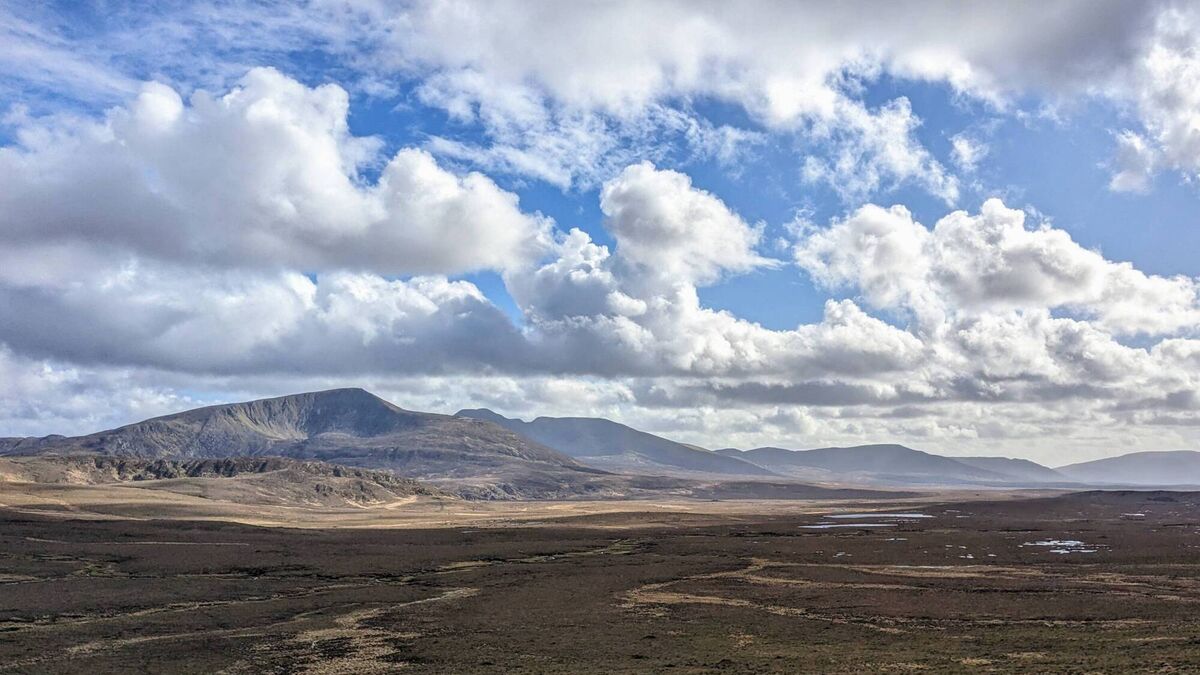
Wild Nephin contains a unique habitat with a diverse flora and fauna. Picture: Pat McCarrick
- From by WB Yeats
On almost any given day, unless the mist is down, if you walk the summit of Knocknashee and turn your gaze to the southwest, you will see Nephin’s proud profile rise up behind the Ox Mountain range which stretches out in the foreground.
Located in northwest Mayo, Wild Nephin National Park covers 17,000 hectares of uninhabited and unspoiled wilderness, dominated by the Nephin Beg mountain range. To the west of these mountains is the Owenduff Bog, one of the last intact active blanket bog systems in Western Europe. There is much to behold, it would seem, at the foot of Nephin.
Wild Nephin contains a unique habitat with a diverse flora and fauna. It was established as Ballycroy National Park in 1998, and later expanded and re-named in 2018, with plans to re-wild the additional lands acquired at Nephin Forest. The National Park also protects other important habitats and species including alpine heath, upland grassland, bogland, lakes and rivers. Additionally, Greenland white-fronted geese, golden plover, red grouse and otters are just some of the important species found within its boundaries.
Wild Nephin includes one of the largest expanses of bogland in Europe and the most remote point of land on the island of Ireland. Because of this, the park showcases some of the darkest, most pristine night skies in the world and is officially certified as a Gold Tier standard International Dark Sky Park. As suggested, in the park’s own information, their night skies are quite spectacular.
A visit to this National Park offers much more than a browse around the visitors centre with coffee and cake before you leave – pleasurable and all as that is. Visitors can also discover walking trails, learn more about the habitats and species that are protected in the park, and explore a range of education programmes.
To highlight just one of the walking trails that are on offer in the park, the Lough Aroher Loop Walk, with a distance of 10km and taking just over three hours to complete, is worthy of special mention. The park describes this as a strenuous walk and one that should not be tackled without due care.
While such a trek is suitable for the more experienced hillwalkers, there are also easier walks that allow visitors of all abilities to enjoy the scenery and wildlife in the park. As with walking anywhere outdoors, the park authorities point out the importance of acting responsibly.
John Muir (1838–1914) is famed as the 'Father of the National Parks' and one of America's most influential conservationists. His writings and fierce advocacy were instrumental in establishing Yosemite and Sequoia National Parks and laying the foundation for the National Park System everywhere. The following is one of his best-known quotes: "The clearest way into the Universe is through a forest wilderness."
I once climbed Kilimanjaro. It was a wonderful experience filled with excitement, adventure and the sights and sounds of nature. I found it remarkable, as one trekked higher and higher towards the summit, how the hum of mankind faded and the voice of nature took over. In time, only the sounds of streams and birds remained and eventually, even they faded as sub-zero temperatures froze the streams and a sterile landscape silenced the birds. On Kilimanjaro, one comes to a place of stillness, where there is neither a blade of grass nor the chirp of a bird. There, nature is at its most silent. Only the breeze, as it plays in the rocks or maybe the rumble of a distant thunder storm five thousand feet below, makes any sound at all.
Let us take a similar journey somewhere in Ireland, to a place where we can hear nature, away from the hustle and bustle of our busy world. It seems one of the very best places to find this is in Wild Nephin National Park. Surely, in such a remote location, with such an expanse of unique habitat all around, nature is communicating with us, whispering a message. If it is, what is it saying and are we truly listening?
In the silence of the largest expanse of peatland in Europe, I am convinced there is a certain wisdom to be found and under such dark skies, I know there is a signal coming in. Let us imagine what we might pick up if we were to tune in.
When I adjust my antenna in search of this broadcast, I eventually hear the word ‘innocence’. It is not a naïve kind of innocence but the innocence of the unprotected, the defenceless. If we listen to our wild places on this station, we will become informed, we will be moved. We will become more benevolent, more protective, more thoughtful. Of all of these qualities, the one we are most lacking at present is thoughtfulness. None of us would like to see ourselves as cruel in the face of innocence, but if we are not aware of nature’s vulnerability, nature’s need, the messages being broadcast from deep within our wild places may well go unheard.
I’d like to think that nature is asking us to develop awareness, asking us to protect its innocence, its virtue. In this regard, we have Wild Nephin National Park to lead us on our way. Make a trip there this summer; take a trek in their wilderness and spend some time under that dark sky they have over there. Mary Gavaghan, Education Guide at Wild Nephin, speaks with justifiable pride when referring to the park: “It is a very special place, of immense ecological, recreational and cultural importance and we are so fortunate to have it on our doorstep here in Mayo.”
Visit wildnephinnationalpark.ie for more details or to plan your trip.