Television as we once knew it is now over
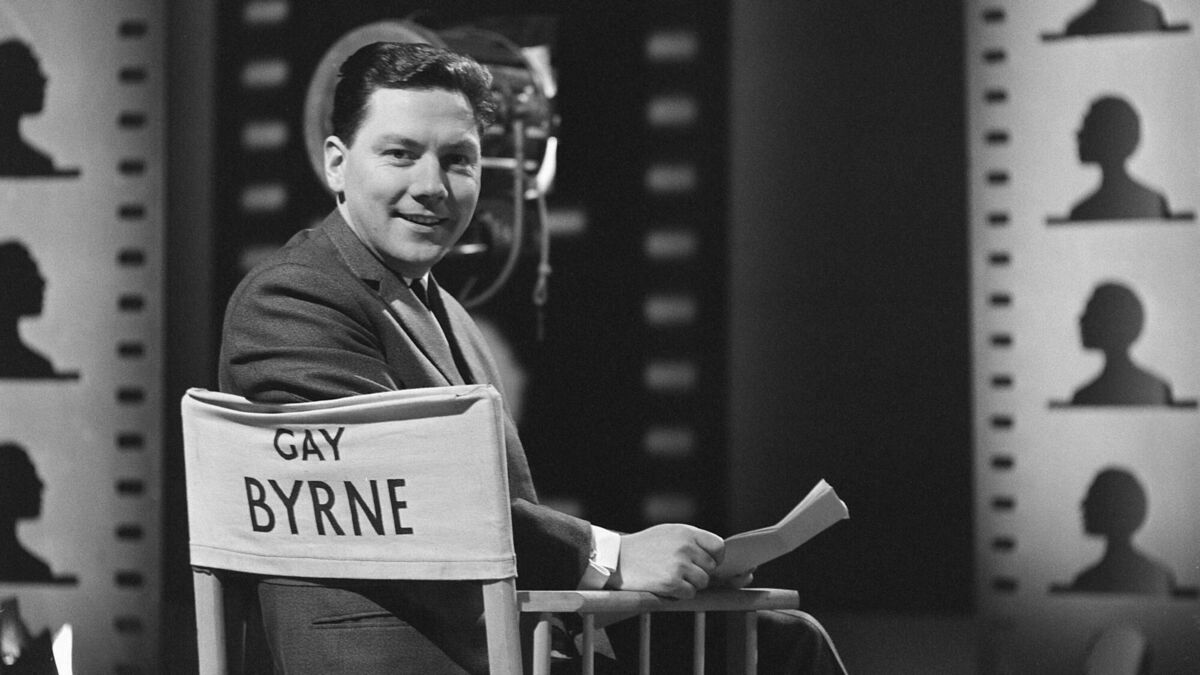
RTÉ broadcaster Gay Byrne in 1965 when television was still in its infancy.
The world of media is changing so rapidly. The way we use it is of course changing also, perhaps not as rapidly, but definitely noticeably. Even the most traditional of houses have experienced it, and that is perhaps particularly noticeable at this time of year, when we would once all have been in by the fire, watching and listening to and reading the same things.
When I left the west thirty years ago, it was simple enough to describe the media: it was the newspaper, the radio and television - television which was enhanced by the deflectors which brought us the BBC, ITV, and God forgive us, Channel 4. What was in front of our noses and within that media bubble was the world we knew.
How that has all changed. You can track those changes by talking about the evolution of the media: the development of satellite TV, the massive expansion of the internet, and then the rise of the smartphone, and social media, and streaming, and all the rest. You could fill a lot of articles with the details.
But you can maybe get a more vivid sense of those changes by considering one particular outcome, which would have seemed more or less impossible to us at the end of the last century.
Talk to any child under 12 today and there is a very strong chance they won’t know what RTÉ is, never mind watch it. Thirty years ago that was unimaginable. We laughed when science fiction movies of that time predicted an era where there was no television. No television? What? Looking back and reflecting now, the question is not how our current media environment will be altered, but rather what unimaginable changes will another thirty years bring to us.
But before we think about that, we can reflect on what has happened and how we experienced and noticed it. Some people of course adapted earlier than others. I remember back in 2008 a friend of mine had a big new telly, and he told me that it wasn’t connected to the television channels. No point, he figured. I didn’t quite know what he meant but wasn’t confident enough to ask. He was well ahead of the game, and he knew what was coming.
Being a lover of printed newspapers and radio, personally I deliberately remained behind the curve on those changes. Oh of course I understood broadly that things were changing, but it didn’t impact my own media consumption in nearly as complete a way as those like my friend.
As it turns out, what really brought it home to me was my own use of television, or more accurately my lack of use. A few years back I started to notice that I was hardly watching it any more. The days of spending an evening – or even the end of one – in front of the box were fading out. The notion of flicking through the channels to find ‘something to watch’ feels like an action that belongs to the Middle Ages.
TV – as we knew it from the 1950s to the 2010s – is over. Nowadays it would be a very rare occasion when I would tune in to watch something scheduled. That isn’t true for everyone – yet – but it isn’t hard to see the trend. Even when people ‘watch’ the TV now, there is often another screen competing for their attention. The only exception to that really is of course live sport, which is pretty much the only time now I sit down to watch the scheduled TV.
Live sport is vital to linear television, of course, because it is one of the few things you have to watch at a set time. Anyone under 40 finds the idea of watching any other programme at a set time – and only at that time – to be incomprehensible. It would be like those of my generation and older being told that you could only read your newspaper at 6pm.
And that is of course why the streaming services want to buy up every bit of live sport they can. They are after your eyeballs dear reader.
For a while there was a feeling that traditional radio could buck the trend. But the tendency towards playing what I want when I want it is now spreading to radio. People are increasingly turning to podcasts and music streams when they want to listen to something. Whether that is when you are driving or hoovering, these are increasingly the background noises.
Interestingly, I find that it’s different when I am in the west. When home, I’ll listen to Midwest. That is I think because the local has more gravitational pull for the listener - it speaks directly to its community, in ways that people can relate to in their immediate neighbourhood, and that retains some purchase. Whether that is analysis or sentiment on my part only time will tell. Nationally it is harder to generate that same sense of community: and so you’d have to imagine therefore that RTÉ is feeling that downward pull. While it must be said that RTÉ Radio is still being tuned into by a lot of people, you’d guess that the generational trend is not encouraging.
For television it must be worse. When you see presenters of the Six One News on RTÉ One leaving what used to be the biggest gig in journalism to go to work on radio, you can see the problem. And when you are competing with Netflix and all the rest of the streaming services in the evening, you can see how hard the challenge is, a challenge made harder when the licence fee hasn’t gone up for years and the streaming services seem to have endless cash.
But you can’t fight the tide, so you have to roll with it. So my feeling during all the discussions about RTÉ over recent years was that those issues were nowhere near being the biggest challenge for RTÉ: the fact that you had to watch a seemingly endless procession of advertisements every time you clicked on anything on the RTÉ Player was a much more important one.
It was for that reason that a whole bunch of people gave up on the Player just as they were switching to streaming services. Are the recent improvements on the RTÉ Player – and it is definitely improved – good enough to bring people back? That, and how quickly the service evolves over time, and not who got paid how much to do what, will determine whether there is even something called RTÉ thirty years from now, in a world that we literally cannot imagine.