Systems of meritocracy have their own flaws
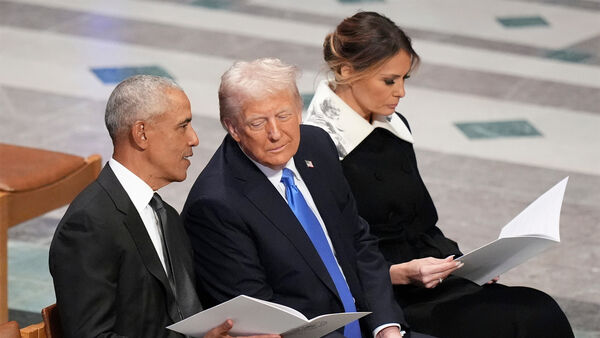
Former US President Barack Obama talks with then President-elect Donald Trump as Melania Trump reads the funeral program before the state funeral for former President Jimmy Carter at Washington National Cathedral in Washington, January 9, 2025. Picture: AP Photo/Jacquelyn Martin
In 2013, the then US President Barack Obama warned us: “We like to think of ourselves as a meritocracy - a place where anyone who works hard can make it, no matter what they look like or where they come from or what their last name is. But the truth is that the circumstances of birth still matter more than they should.”
Little did the President realise what a broken meritocracy would elect in his place. But while he claimed the United States was not meritocratic enough, others argue that ordinary Americans see meritocracy as having gone too far.
writer David Brooks pre-empted Donald Trump’s 2016 election win, foretelling of the coming revolt against “the people who dominate American institutions today [who] are the highly educated meritocratic elite”.
In her study of voters who helped propel Trump to power, sociologist Arlie Russell Hochschild found deep hostility towards the “cultural elite” - the experts who dominate modern institutions. Their revolt was not only economic but also a political backlash directed at a professional class they believed had monopolised merit and status in a system appearing increasingly closed to outsiders.
This is not a new revolution. Nor is it confined to America.
In 1930, Letitia Dunbar-Harrison, a young, award-winning English literature author, was recommended for the position of Mayo County Librarian by the Local Appointments Commission. She had undertaken a training course at Dublin County Library and been in charge of Rathmines Children’s Library for nine months. She had graduated with honours in modern literatures (French and Spanish). There was just one catch. She could not speak Irish.
The Library Committee of Mayo County Council refused to endorse her recommendation, claiming the Trinity College graduate’s grasp of Irish was inadequate as she failed the language test for the role. But a deeper issue arose during the debate when a member mused "could a Protestant be trusted to hand out books to Catholics?”. The dispute escalated into a national political crisis with the government dissolving Mayo County Council and installing Dunbar-Harrison through a commissioner, though a boycott of the library followed and she was eventually transferred in 1932.
Ballina-based TD, PJ Ruttledge, fiercely opposed the merit of Dunbar-Harrison’s appointment, claiming that a librarian “who holds definite religious views” would seek to distribute books which contravene those of an overwhelmingly Catholic Mayo. He was joined by councillor Thomas S. Moclair (father of the great GAA footballer Paddy Moclair) who was another of her most vocal detractors.
The Mayo library affair nearly brought down the government and was repeatedly cited by Ulster unionists and even writer Sean O'Faolain as exemplifying bigotry and narrow-mindedness.
We’re told that merit-based recruitment has since evolved, ensuring the best employment outcomes. Under our meritocratic systems, people advance in institutions and businesses based on their ability, effort and performance rather than their background, wealth, family connections, or social status. Thus, the best student gets the scholarship, the most capable worker gets promoted or the person with the best ideas rises to leadership. The core idea is rewarding skill, effort, achievement, rather than privilege.
In practice this means systems to ensure equal opportunity at the start, with universal access to education, jobs, and competition. The latter in particular is based on measurable performance (exams, results, productivity) with rewards for performance on a graded scale so that higher pay, status, or power goes to those who perform best.
So, we have competitive exams for civil servants, university entrance exams and promotions based on measurable performance. The key utopian promise of meritocracy is essentially that your future should depend on what you can do, not who you are.
But as Obama pointed out, in real life, a true meritocracy rarely exists because starting conditions are unequal as wealthy families can buy better education, social networks open hidden opportunities and cultural advantages help some people navigate systems more easily.
Importantly, what you can’t or don’t measure, can’t or won’t be seen. Thus, meritocracy ignores those aspects of people’s experience, such as Letitia Dunbar-Harrison’s talent and training, in favour of only recognised metrics - such as the County Library’s Irish exam. That gap has always been an issue with meritocratic institutions but it has become a yawning chasm.
Our modern world is transforming at an unprecedented rate, with hundreds of thousands hired for jobs which did not exist a decade ago. Other generational employments are suddenly vanishing. Technology is developing exponentially since the rise of the internet, online social networks, digital media and artificial intelligence (AI) - and is still evolving. In Ireland, we now live in a more multifaceted and complex world due to the most significant demographic, cultural and economic changes to occur in centuries.
By not proactively engaging with experts of this new zeitgeist, our meritocracies are slow to embrace ideas and reluctant to change. As they become increasingly out-of-date, our institutions reproduce privilege, becoming a closed shop by shutting access to non-conforming applicants.
Michael Sandel, a political philosopher at Harvard University, wrote about this in , in 2020. He argues not that talent shouldn’t matter, but that meritocracy arrogantly recognises certain arbitrary merits while ignoring others, even as a changing world needs new thinking.
For him, successful people begin to believe they fully deserve their success, while those who struggle are seen as personally responsible for failure. This breeds humiliation and resentment among the working class. Sandel argues this moral psychology helped fuel populist movements (such as the rise of Donald Trump) and a backlash against the establishment that produced Brexit. Meritocracy turns success into proof of virtue and failure into proof of personal inadequacy. Yet, those in charge are blind to their failings.
Ironically, just as I was researching local meritocracy, I met it face on. Almost a century after the Mayo Library appointments controversy, I applied to be County Archivist in Castlebar. The role has been vacant for over two decades, with dedicated library staff taking on the extra responsibilities of caring for our most treasured records. While serving on the Corporate, Education, Culture, Heritage and Library Services Strategic Policy Committee of Mayo County Council, I had called for an archivist to be urgently appointed so that the appalling loss of our local heritage could be stemmed and a purpose-built repository for Mayo’s records could begin.
As a PhD historian with a first class honours MA, I believe I have a lot to offer as an archivist. I founded and managed one of the largest digitisation projects in Ireland/UK, of 1.2 million records. I partnered with Ancestry to publish this huge dataset with free access to Mayo and Sligo schools. I have worked as digital archivist assistant at the University of Galway’s fascinating Imirce project - publishing emigrant correspondence collected over decades by historian Kerby A. Miller. As chairperson of St Cormac’s Society, a small heritage charity, I worked with Coillte in developing the popular Blanemore Forest archaeological walk. I also write this column!
I’m now employed by a cutting-edge AI firm in San Francisco, managing hundreds of experts worldwide in training AI models to reason and work on real-world problems. Now, none of that means I deserve to be county archivist, but I mention my own achievements only to say that I believe my application deserves to be at the very least considered. There is just one catch. I do not have an archivist degree.
With the ghost of Letitia Dunbar-Harrison peering over my shoulder, I read this letter I received from Mayo County Council, as “merit” once again is used to exclude potential candidates from a senior library appointment.
Every institution has the right to choose its own criteria and its own candidates, but this arbitrary meritocratic exclusion of my application based on a specific qualification means I am not even considered for the role. No analysis of my resume. No interview. Nothing. The council does not see my experience, achievements or expert opinions relevant to the archivist role, therefore it cannot see me.
I wish the very best to whoever does gets appointed and a fair wind behind them in transforming how our local authority should gather, conserve and curate our local historical records. Maybe I would have been totally unsuited for the role. Who knows?
But, by not even engaging with me, not learning what I had to offer, not hearing of my plans and ambitions for how I would develop such a position, using strategic partnerships and embracing the latest technology, the council loses out. And not just from not talking with me, but also from not engaging with the many other would-be applicants who each have unique offerings but no “recognised” archivist qualification.
Letitia Dunbar-Harrison went on to have a full (and by all accounts happy) career after she left Mayo, when the government offered her a position with higher remuneration at the Dublin Military Library.
I shall thus await my own call from Micheál Martin with baited breath….