Surviving the Titanic but drowning anyway
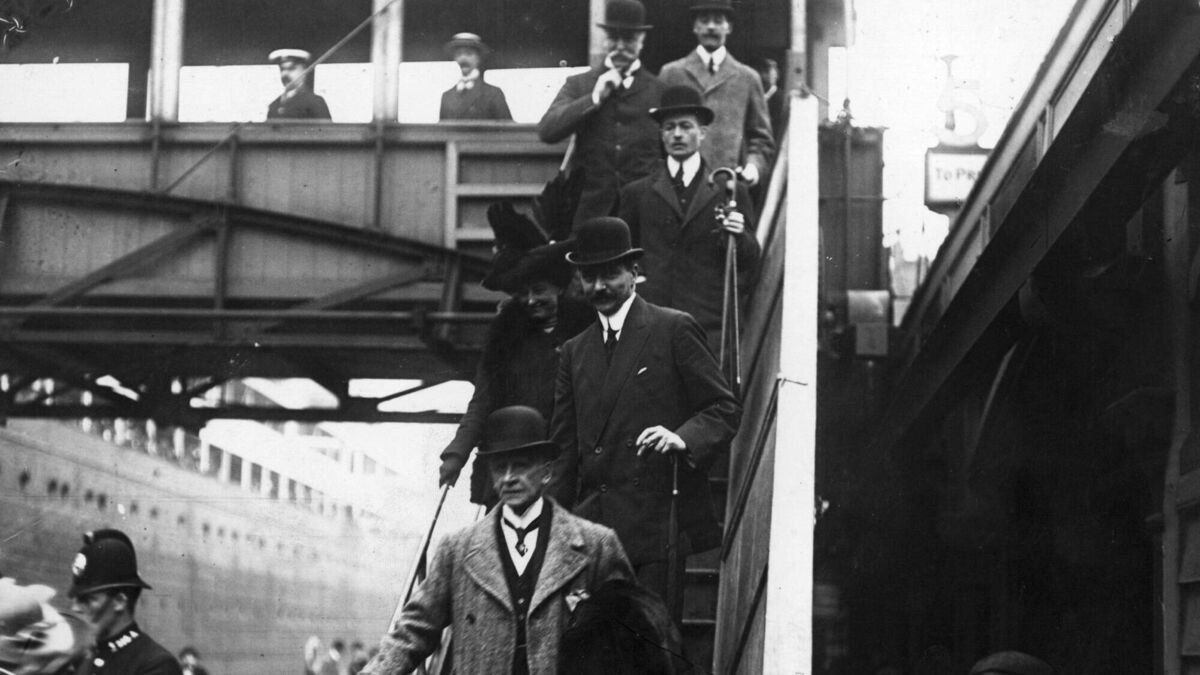
Bruce Ismay, a survivor of the 'Titanic' disaster and chairman of the White Star Line, coming down the gangway at Customs House, Liverpool, after arriving on the 'Adriatic' in May 1912. With him are his wife and brother, and Harold Sanderson, deputy chairman of the White Star Line. They went out aboard the 'Oceanic' to meet him returning home from New York, after the American inquiry into the disaster. Picture: Topical Press Agency/Getty Images
There's a particular kind of hell reserved for the man who lives too long. Not a theological hell, though the Catholics of Connemara might have had a view on that. It is instead the slow daily grind, where the afflicted soul wakes up every morning and the first thought that enters his addled head, before coffee, before the birdsong, before anything decent and half hopeful, is that fateful night on the Atlantic's moonlit expanse. The water gushed while the women and children screamed, and the terrible, irreversibly shameful act of climbing into a lifeboat while 1,500 people were still alive and terrified above you.
J. Bruce Ismay lived with that thought for 25 years in the rain-washed silence of Connemara. Which, if you've spent any time in the west of Ireland in a wet, grey November, you'll know is either the ideal place for penance, or a hint to winter in warmer climes.
He arrived in Casla in 1913, less than a year after the Titanic went down, a broken man in a Rolls Royce. It makes for a striking image, a gleaming motorcar purring through one of the most achingly poor landscapes in Europe, past people who'd never seen a banana, past the ruins of a famine that had killed a million of their grandparents, ferrying the most despised man in the English-speaking world to his self-imposed exile. It must have been a sight the locals never tired of, as they stopped in awe when the motor gleamed past with funereal pomp. They called him "Brú síos mé" in Irish - lower me down - a pun on his name and a reference to the lifeboat, delivered with that particular Irish genius for cruelty dressed up as wit. He probably never knew.
The Titanic was a forbidden subject at Costelloe Lodge. His wife, Florence, made sure of that.
But here's the thing about Bruce Ismay that tends to get lost in the pantomime villainy. He wasn't quite the monster the newspapers made him, but was something more interesting and more human - a vain, ambitious man who made catastrophically bad decisions and then, in a moment of animal panic, chose his own life over his professional dignity. An unforgiving press called him 'J. Brute Ismay', while a Chicago journalist wrote a poem contrasting him with Captain Smith, who went down with the ship in cinematic glory just like a proper Victorian hero. Ismay got into a lifeboat in his pyjamas, and history, as usual, preferred the photogenic corpse.
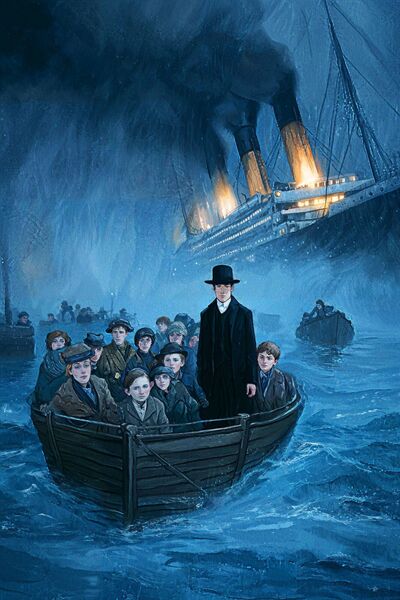
What's rarely mentioned is that before he climbed into Collapsible C, Ismay had spent hours on deck helping women and children into boats, doing whatever a terrified shipping magnate could do in the circumstances. And when the collapsible was being lowered - no women or children visible nearby, the ship minutes from going under - he stepped in. The British inquiry cleared him. The public didn't. They never do. The inquiry was worried about facts. The public was worried about narrative, and narratively, the owner of an "unsinkable" ship who walked away while the band played and the steerage passengers drowned behind locked gates was exactly the villain the story demanded.
The Titanic itself served as a monument to vanity so colossal it almost defies comprehension. Not just Ismay's vanity - though reducing the lifeboats from 48 to 16 to improve the view from the promenade deck was a special kind of hubris - but the vanity of an entire civilisation. Edwardian England believed, sincerely believed, that it had mastered nature. That technology had rendered the old terrors obsolete. That a ship could be unsinkable. The word itself should have been a warning. Unsinkable. There's no surer way to tempt the universe than to declare something impossible. The iceberg, when it came, wasn't just a lump of ice. It was the heavens clearing its throat.
And then came Connemara. Why here? You could speculate endlessly. He'd have known the area through Lord Dudley's hunting lodge at nearby Screebe. He loved fishing - trout and salmon were his real religion in those later years. And perhaps, in some half-conscious way, he was drawn to the Atlantic that had taken in his greatest mistake, as if proximity to the sea might explain it, or atone for it, or simply make the nightmares more honest. One of his Connemara neighbours, years later, wondered aloud whether living beside the ocean was Ismay's private form of self-flagellation. I think that's probably right.
The locals, to their credit, were largely decent about it. They took his employment, ate his fish, brought him milk, and called him "Brú síos mé" behind his back. Fair exchange, really. The IRA burned his lodge in 1922 - one of hundreds of big houses to go up that year, part of the systematic dismantling of the Protestant Ascendancy's grip on the landscape - but Ismay rebuilt it, bigger, and kept coming back. He said it wasn't his neighbours who'd done it, that he'd been on friendly terms with them all. Which was either generous or delusional, or both, which is often what genuine equanimity looks like from the outside.
On visits to England, he'd wander through Liverpool parks when he was there, engaging strangers in conversation. He attended concerts and cinemas alone. He was, in other words, a profoundly lonely man who'd once commanded the finest ship on earth, now killing time in the cheap seats. His grandson, asked once if his grandfather had ever spoken about the disaster, said it had "absolutely shattered his life". Near the end, losing a leg to diabetes and feeling the tide going out, Ismay is said to have murmured a forlorn regret: "I never want to see a ship again, and I loved them so. What an ending to my life." Four words in there that have a greater impact than any inquiry transcript. That's not a monster talking. That's a man.
He died in London in October 1937, leaving an estate valued at approximately 50 million pounds in today's money. His wife, Florence, erected a limestone monument in the garden at Casla. It reads: It's beautiful. It's also, if you think about it, the inscription of a man who spent a quarter century trying to disappear.
Which is the real story of J. Bruce Ismay? Not the cowardice, not the lifeboats, not the pyjamas. The real story is what happens after the worst moment of your life, when the newspapers have named you a brute and history has stamped your face onto its preferred narrative, and you have to get up the next morning and decide what to do with what remains of yourself. A chastened Ismay chose Connemara, where he found silence and the calm grey Atlantic light softly illuminating the salmon rivers punctuated by the quietly detached company of people who called him names he couldn't understand.
There are worse ways to serve your sentence. And fewer, more honest admissions than choosing to live beside the sea that proved you wrong.