Stories that define an age-old GAA rivalry
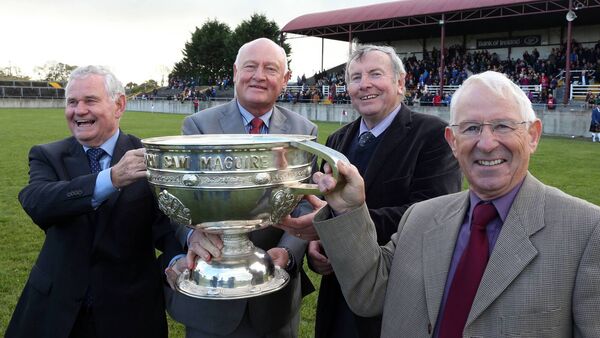
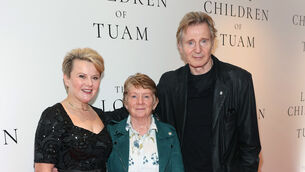
Christy Tyrrell, Jimmy Duggan, Sean Meade and Colie McDonagh at Tuam Stadium with the Sam Maguire Cup in 2016 to mark the golden jubilee of Galway's famous three-in-a-row.
Next month marks the centenary of the first-ever All-Ireland senior football championship to be won by a Connacht county.
In Ballinasloe in November, Galway hosted a celebration of the first of their nine All-Ireland titles. And well they might, says you.
What many people are not aware of, because it was so long ago, is that Mayo were actually the de-facto All-Ireland champions at one stage only to lose the title in the boardroom.
It was an incredible championship. Six draws between Sligo and Roscommon and three between Galway and Leitrim held up the Connacht championship and Central Council were not prepared to wait.
Stephen Jordan, the Galway delegate at a Connacht Council meeting, proposed that Connacht nominate the 1924 Connacht champions, Mayo, to compete in the All-Ireland semi-final.
Against the odds Mayo beat Wexford in their first game in that year’s championship. Kerry beat Cavan in the other semi-final but a Cavan objection to an illegal Kerry player had the Kingdom thrown out and Cavan were set to play Mayo until Kerry successfully objected to a Cavan player.
Farcically, both counties were thrown out and Mayo were considered All-Ireland champions. No one, including Mayo, was too satisfied with the abject nature of the championship but it was far from over.
Afterwards, the Connacht championship was played out and Mayo beat Sligo and played Galway in the final, believing it merely to be a provincial final.
Somehow, at a Connacht Council meeting, the aforementioned Stephen Jordan was appointed the referee even though his county was playing. Mayo, bizarrely, did not object to this.
Mayo were in front when Jordan awarded Galway a penalty which Tom Leetch converted. One of the Mayo players, Michael Mulderrig, claimed the awarding of the penalty was controversial and was awarded at the behest of the crowd.
“My father told me it was absolute mayhem in Tuam that day, with three pitch invasions,” Mick Mulderrig, one of the heroes of 1950 and ’51, told James Laffey in . “And he swore to his dying day that one of the points recorded in Galway’s favour was kicked by a spectator!”
Fast forward to a subsequent Central Council meeting and after most of the delegates and press had left, including Mayo’s Seán T Ruane, who was the chairman of the Connacht Council, believing there to be no other business of significance.
But in the early hours a Galway delegate, quite probably Stephen Jordan, proposed that his county be awarded the 1925 championship on account of them winning the Connacht championship. The chairman, Paddy Breen from Wexford, agreed. When news broke, Mayo and members of the Connacht Council were livid.
A face-saving exercise where a tournament involving the four provincial winners was hastily arranged. Kerry, as annoyed as anyone with the actions of Central Council, refused to compete. Galway beat Wexford and then Cavan, which is listed now as the 1925 All-Ireland final when it was nothing of the sort.
It can be reasonably argued that Mayo did not warrant the title but if that was the case, it is arguable that no one should have been declared champions.
Jim Carney, the revered Galway Gaelic games scribe and broadcaster, has argued that Galway should give that All-Ireland back to Mayo. I’m confident that won’t happen. If the shoe was on the other foot, would we give it back? Perhaps.
I cannot see that we would have had the cuteness or ruthlessness to acquire such an All-Ireland in the first place.
Perhaps we can over-analyse such matters but having read this story in as well as hearing it retold on a recent podcast, , one cannot help but feel that over time, Mayo’s passiveness and naivete stands in stark contrast to Galway’s ruthless, cunning approach.
It is not an isolated example of such a contrast in approach between the two counties.
I was fortunate enough to interview the Galway great Jimmy Duggan recently. A prodigious talent, he is the only player to start on Hogan Cup and All-Ireland senior winning teams in the one year (1966) but the reality is he ought to have been playing for Mayo and we let him slip through our fingertips.
He was born in Tuam to Galway parents but moved to Claremorris as a young child and played all his underage football in the town, as well as winning two Mayo SFC titles with Claremorris.
In March, 1964, as a 16-year-old he scored five points from centre-half forward as St Jarlath’s won a Hogan Cup semi-final. Five days later on Good Friday, he was only a sub’ for South Mayo at Mayo minor trials. After two games, he was told he hadn’t made the Mayo minor squad.
He should not even have had to take part given his form with Jarlath’s and, given his Galway connections, Mayo should have been doing everything they could to lock him down as a Mayo player. But, as was all too common in selections in those times, Mayo made a hash of it.
Duggan returned to Jarlath’s after the Easter holidays to be called out from study by three Galway GAA bigwigs, Fr Paddy Mahon (chairman), Brendan Nestor (selector) and Paddy Stephens (Duggan’s uncle).
They had a transfer form ready for him. Duggan, shocked and caught completely unawares, did not sign it there and then but went home to talk about it with his parents. Frustrated by his omission from Mayo, Duggan signed on the dotted line.
Galway likely could not believe their luck and must have been laughing at Mayo’s reckless stupidity.
No one from Mayo ever thought to approach Duggan and see if he might reconsider.
He played the key role in Galway’s late winning point over Mayo in the 1966 Connacht final and is certain Mayo would have won the All-Ireland if they came out on top that day. Maybe if we minded our patch better and had Jimmy Duggan in the green and red that day, we would have.
Around the same time, two other players could have easily ended up playing for Mayo. The late, great Noel Tierney, full-back on the Galway three-in-a-row team, was a neighbour of the Fitzpatrick family in Ballyglass.
Noel Tierney lived just on the Galway side of the border but played a lot of football with the Fitzpatricks and, in 1959, Billy Fitzpatrick recalls his brother Martin and Tierney going to Mayo minor trials in Hollymount. Word soon got over the border and Galway marked their territory. Tierney would play with Galway minors that year. He was full-back while Martin Fitzpatrick lined out at centre-half forward against him.
Galway beat Mayo in the Connacht final 3-9 to 1-8 with Billy Fitz’ recalling Mayo conceding ‘a few soft goals’. It may not have happened if Noel Tierney was guarding the edge of the square.
Born in late 1941, that should have been Noel Tierney’s last year at minor but when Galway chiefs realised his birth was not officially recorded until February of 1942, they saw the opportunity. Tierney was full-back on the Galway All-Ireland winning minor team of 1960!
Dermot Earley is another star who could easily have worn the green and red. He was born in Castlebar, both parents were from Mayo and he was playing juvenile football with Ballyhaunis. However, he was living just over the Roscommon border in Gorthaganny and Roscommon marked their territory.
Tierney and Earley, of course, should have been playing with Galway and Roscommon respectively and not Mayo but would Mayo have been as guarded of their territory? Just look at Jimmy Duggan for your answer.
Just like in 1925, Galway were opportunistic and fought their corner while Mayo were too passive, dare we say it, too nice.
Conversations with many of the stars of the 1950s, '60s and '70s confirm a cultural malaise at the heart of Mayo football. Have we fully shaken it off? I’m not sure we have.
Culture pervades and can be hard to shift. The beauty and the curse of Ireland is every village, every town, every county and every province have defining characteristics.
Some might say we should not dwell too much on the past but I’m of the view that we need to lean on the past in order to learn from it.