Spending €25m on 'The Pro' is questionable
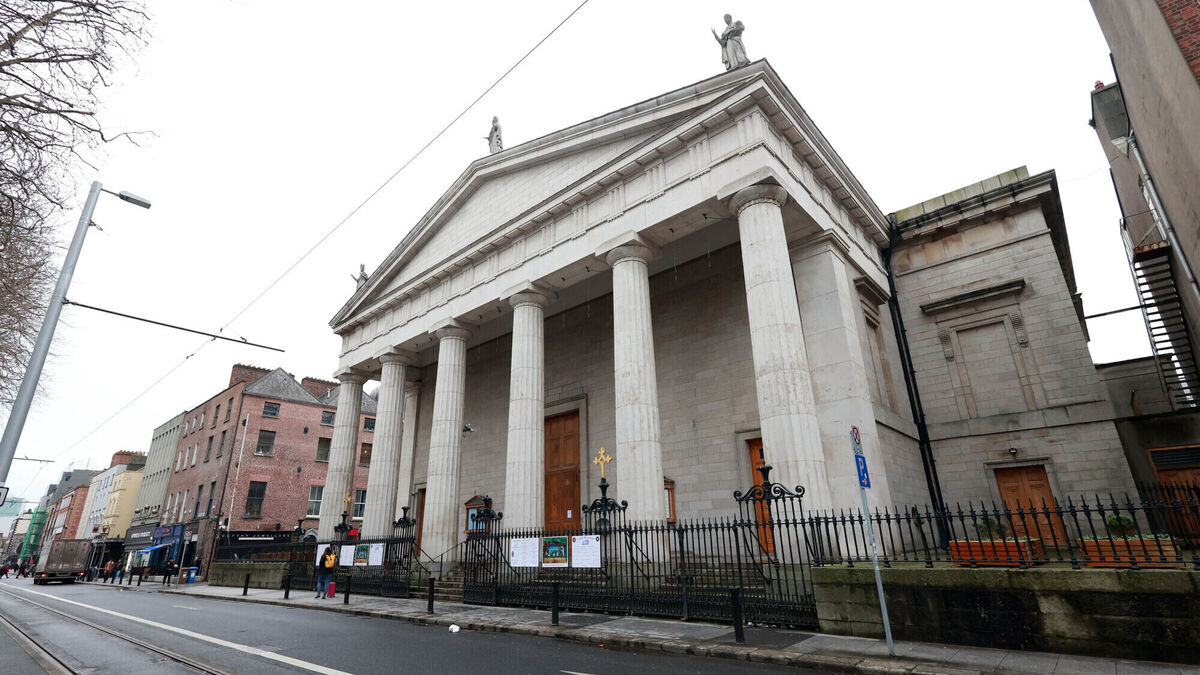
In 1825, the ‘Pro-Cathedral’ was opened on the site of St Mary’s Church on Liffey Street and was soon favoured by generations of Dubliners with the affectionate and long-favoured nickname, ‘The Pro’. Picture: Sam Boal/Rollingnews.ie
In 1825, two hundred years ago, St Mary’s Chapel, Liffey Street in Dublin was constituted as the Pro-Cathedral for Dublin diocese. The moniker ‘Pro‘ in the title referred to what in Catholic eyes was its ‘provisional’ status in that there was an historical presumption or expectation or at best a hope that one of two Protestant cathedrals in Dublin, St Patrick’s or Christ Church, would one day revert to its former ‘Catholic’ status.
But first, for historical context, let’s go back a few centuries. In 1539, at the time of what was sometimes called the Protestant Reformation - when England’s King Henry VIII broke with Rome - all Irish monasteries and churches loyal to the pope, including St Patrick’s and Christ Church cathedrals, were handed over by the newly established state to the Church of Ireland.
Three hundred years later when that Catholic presumption/expectation/hope mentioned earlier had not been realised a substitute cathedral, pointedly designated the ‘Pro-cathedral’ was opened on the site of St Mary’s Church and was soon favoured by generations of Dubliners with the affectionate and long-favoured nickname, ‘The Pro’.
Then last year, 2025, after roughly 500 years without an officially designated Catholic cathedral in Dublin, the Catholic Archbishop of Dublin, Dermot Farrell, announced that Pope Leo had designated ‘The Pro’ as St Mary’s, the official cathedral of the diocese of Dublin. And a few weeks ago the archbishop announced that St Mary’s Cathedral is to close after Easter, that’s April 4th, for a two-year refurbishment programme which will cost approximately €25 million. To paraphrase a frequent Dublin grievance about waiting for ages for a bus and eventually two buses arriving together - it seemed as if Dublin Catholics had waited half a millennium for an official cathedral and within a few months a second had appeared on the horizon.
Incidentally, St Patrick’s and Christ Church Cathedral, despite the historic disestablishment of the Church of Ireland in 1871 and the rivalry between the two cathedrals – though operating at such close quarters with one another – are still in the possession of the Church of Ireland. St Patrick’s is the National Cathedral of the Church of Ireland and Christ Church is currently the seat of the Church of Ireland Archbishop of Dublin and Glendalough.
So why did the Church of Ireland not even undertake what seemed like a necessary levelling-up of the ambiguities of our difficult religious history by gifting (or returning) one of the cathedrals to their long-suffering Sister Church?
That said no doubt the Church of Ireland’s instinct would have been to level the playing fields but the difficult truth is that the Catholic Church never seemed anxious to take on the burden (and the cost) of preserving one of our national cathedrals and seemed content to relinquish that responsibility to their ‘separated brethern’.
So how will the €25 million be raised to deliver the dream of a National Catholic Cathedral for Dublin? That’s an important question. But here’s another: if our Catholic resources can produce such a spectacular sum as if from nothing should we be asking if that’s the best way to spend it? Because even €25 million wouldn’t go any way towards achieving a cathedral that could possible reach the status of St Patrick’s or Christ Church.
But here’s the really big question: could spending €25 million on a new cathedral be not just a waste of money but a waste of resources? The example of the present withering diocese of Killala might be instructive. In the early years of the nineteenth century, the then Catholic bishop of Killala, Peter Waldron, entrusted to his talented coadjutor bishop, John MacHale, the task of building a cathedral in Killala diocese, then one of the poorest - if not the poorest diocese - in Ireland. MacHale was not just equal to the task but ready and willing to take it in his confident stride.
By his own admission, as MacHale on a visit to Rome in 1831-2 confided to the then Pope Gregory XVI that even though there were at the time in Killala diocese few churches, his enthusiasm for building a cathedral was predicated on the belief that his example would inspire the priests of the diocese to build parish churches: the cathedral, MacHale contended, was ‘a model to incite the clergy to undertake the building of like edifices in their respective parishes'. Unfortunately, by pressurising the parishes to support the cathedral project whatever resources were available to parishes were mainly expended on the cathedral with predictably negative results for the standard of parish churches.
This poses the question to Archbishop Dermot Farrell of Dublin: if Dublin diocese is awash with impressive churches which are now more or less bereft of weekend worshippers, would it not make more sense to adopt one of them as a cathedral, preferably in inner city Dublin or in any other of the poorest areas of the diocese rather than to needlessly expend €25 million on what seems in the circumstances arguably not unlike a vanity project and, if such a sum was available, to expend it on some effective project on the poor of Dublin. (Just asking, Dermot, if you don’t mind!)
It also poses other questions: who actually decided on this project? That too is legitimate to ask as we struggle to get the synodality template off the ground in Dublin as in elsewhere. Is it not accepted - as Cardinal Mario Grech, General Secretary of the Synod, the man charged with leading the worldwide effort to embed the synodal way of being church continues to point out – that synodality applies at every level in the Church? So what imput had the people, priests and religious of Dublin into the decision to resurrect 'The Pro’?
I’m sure Pope Leo wouldn’t mind if a more creative and convincing use was made of the €25 million, especially one that would honour the memory of his hero and ours, Pope Francis I, who brought the poor to the forefront of our thoughts and of our care. Just asking.