Small countries like Ireland face a tough new world
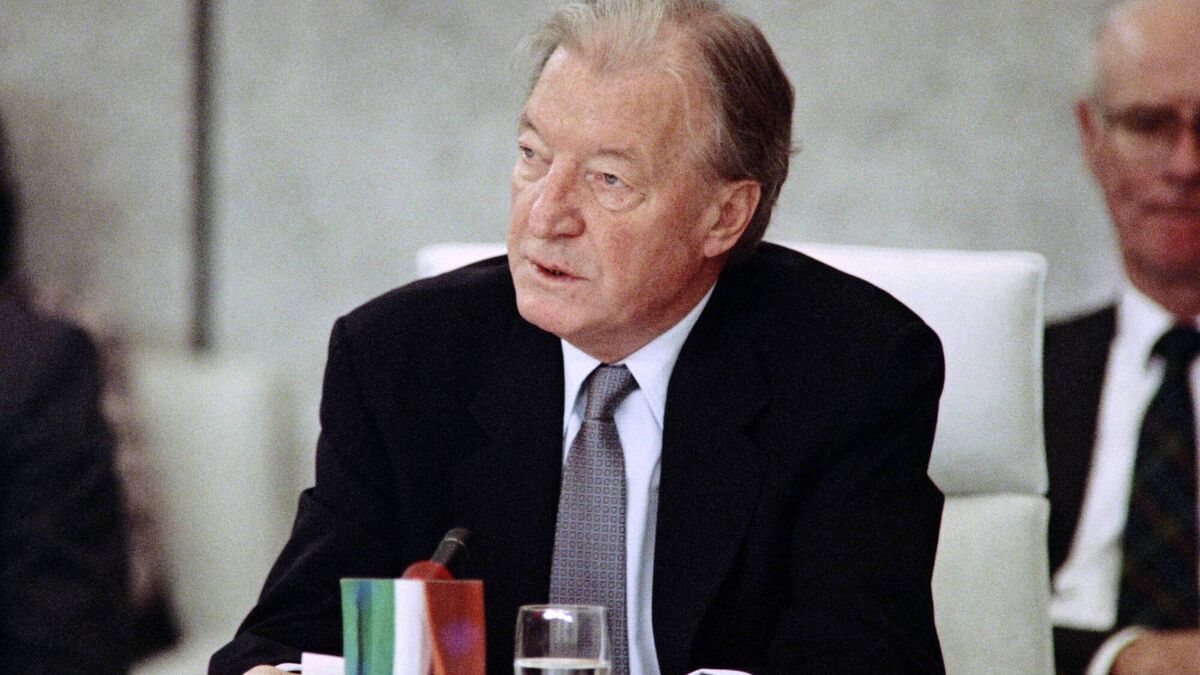
Taoiseach Charles Haughey attends the summit of the Organisation for Security and Co-operation in Europe in Paris on November 21, 1990. European governments, Canada, the United States and the Soviet Union signed the Charter of Paris for a New Europe to reduce the conventional weapons in Europe, ending the Cold War and leading to German reunification. Picture: Jean-Loup Gautreau/AFP via Getty Images
The world we have known is coming to an end. The rules-based and stable international order created after the fall of the Berlin Wall, which has been our backdrop since the beginning of the 1990s, is passing.
That era has shaped our world and our day-to-day lives in every way. What replaces it and what we do about the changed world should now be the most important conversation we are having. But are we seriously thinking about the future? About what comes next? About what we might do to get ready for the new world being born?
Following the fall of the Berlin Wall in November 1989, the tremors were felt not just in Europe but around the world. The period of contest between communism and capitalism had ended with an undoubted win for capitalism, democracy and the free market - and that created a new global era. Globalised trade, international rules, American dominance, European integration, Chinese growth.
The previous era had started at the end of World War II in 1945. We had played no significant part in world affairs during that period. But when it came to an end, we both played a part in the new world then being created and benefitted enormously from changes it brought.
Our small but important part in the creation of that new era was down to chance. 2026 sees Ireland host the Presidency of the European Union (EU) and right back at the end of the Cold War in 1990, we by chance also hosted it. That meant Ireland was chairing vital meetings where the then European Economic Community (EEC) had to make collective decisions about how to respond to these tumultuous events.
The biggest role we had – and one that the then Taoiseach, Charles Haughey, both revelled in and excelled at – was helping to secure agreement to allow for the unification of Germany. Because Germany’s division had arisen from the defeat of that country in World War II, all the great powers who defeated Germany in that war had to agree to end it. In 1990, it was the British and the French who were most against it.
Charles Haughey and the Irish Presidency played a key role in brokering the deal to allow reunification to proceed. Through patient talks, the British – and particularly Margaret Thatcher – finally realised they couldn’t stop it. The French agreed to it in return for German agreement to create and finance the Euro.
That was a diplomatic win for Ireland but we had more than diplomatic wins to butter our parsnips out of the whole process. The period from then until the present day saw a transformation of this country.
The victory of the free market over communism reduced objections to the creation of the European Single Market, which greatly benefitted us. This development was well planned for in Ireland: using EEC money, we massively expanded our education facilities, built the M50 and the International Financial Services Centre and stabilised our public finances. Growth and employment skyrocketed.
That was fuelled by another aspect of the post-1990 world: lots of internationally mobile investment capital. Ireland had failed economically from 1922-'90 because of its absence. After 1990 we got loads of it, and it did great things for our economy - though we certainly didn’t well handle the flood of it into our housing market in the last years of the Celtic Tiger. But we did build about 80,000 housing units a year when it was flowing in.
We also used the end of the Cold War and the decline of world tensions to create space to positively address the conflict in Northern Ireland, and to build a different sort of relationship with Britain.
All those things: premium access to a new globalised market bound by rules which everyone respected; access to internationally mobile investment capital; and a reduction in world tensions which helped us do the same on our own island, shaped and transformed the last decades for us. Those events and that new world created the reality we all lived in – how we thought, how we lived, what we could achieve.
There have been ups and downs on that journey of course, but for someone brought up in the west in the 1980s, the progress to where we are today is remarkable, even if all the challenges have not been solved.
But like in 1990, the world is changing again. On both occasions there was - and is - little we could do about it, but this time we are sure – aren’t we? – that we don’t like the changes that are coming.
We are now entering an era when raw power and not international rules will determine many questions. That is a bad world for small countries. The security provided by others and which we took for granted - or even lectured others about - has changed fundamentally and might even disappear. The flow and terms of free trade which made us prosperous is disputed everywhere, even, bizarrely, here. Protection is now back in fashion. But protection left us dirt poor, exporting nothing but people and cattle, a country where only big farmers had money. We don’t want it back.
In any event, whether we like the changes or not, how prepared are we for what we see happening now before our eyes? What contribution are we going to make as events unfold?
The last time we had times like these was in the 1930s. In that era, as a country we kept our head down and we stayed out of it. The price we paid for that was irrelevance and near economic collapse in the 1950s. In 1990 we made different choices.
What will we do now? As we get ready to once again hold the Presidency of the EU at a time of tumult, what debates are we having about what all this will mean and what we should try and do - collectively - to prepare for it? What does it all mean for the economy? For security? For the way we see the world and engage with it? What should we do in response to all those things? We need answers that are at the level of events and not focused on trivialities or scoring debating points.
And there is no point in sticking our head in the sand. What happens internationally will inevitably impact Ireland, and it will impact the west. The social services we all rely on as well as the jobs in industry and public service have all one thing in common - they are all paid for from the economic model which derived from the world created in 1990. How the new era will impact all of that is where international politics meets the rubber on the road where you live, whether that is just off the M50 or on a boreen in Bohola.