Sligo silence on rail corridor is perplexing
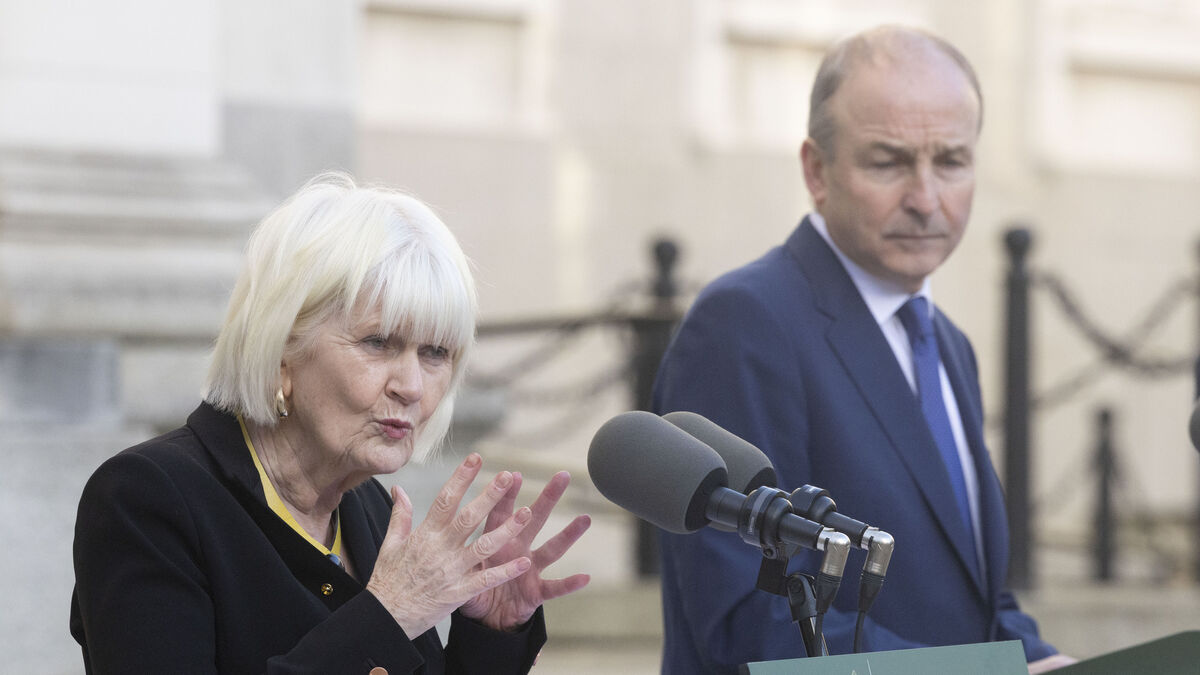
Minister of State at the Department of Further and Higher Education, Research, Innovation and Science Marian Harkin and Taoiseach Micheál Martin TD launching the 'Accelerating Infrastructure Report and Action Plan' at Government Buildings in Dublin last December. Picture: Sam Boal/Collins Photos
With the announcement in November that the long-anticipated extension of the Western Rail Corridor from Athenry to Tuam and onto Claremorris will go ahead, attention naturally enough turned to the next stage. That is the potential for the restoration of the old line from Claremorris to Sligo.
The closure of the Western Rail Corridor from Sligo to Limerick in the 1970s was quite indicative of central government attitudes across many decades – everything had to radiate in and out of Dublin.
Long and tireless campaigning saw the corridor reopen from Limerick to Ennis and then to Athenry (and connecting onto Galway City) with passenger numbers surpassing expectations, hitting nearly a quarter of a million in 2024. The debate then turned to extending the railway line from Athenry to Tuam and onto Claremorris.
Strangely enough, a project that would ensure easier access to Galway City was not met with universal support in Tuam at first. Some felt it was best used as a greenway. Over time, it became more and more apparent that the rail extension to Claremorris was on the table and talk of a greenway gradually dissipated.
The news the extension to Claremorris will go ahead is the result of many things. The strong and coherent advocacy of West on Track was - and is - crucial, but tied into that is the united front so many politicians in Galway and Mayo presented on the issue. Councillors and members of the Oireachtas in both counties, with only a handful of exceptions, were four-square behind the campaign.
That political pressure, combined with a very cogent business case set forward in the Bradley Report (2021) on the Athenry to Claremorris line, made the case compelling and impossible to ignore. Such political pressure is, whether we like it or not, central to achieving results in Ireland.
It is very clear the same political pressure is not being brought to bear on the extension of the line from Claremorris to Sligo because a startling number of politicians there appear to be, at best, indifferent and, at worst, downright opposed to the extension of the Western Rail Corridor to Sligo.
Just like in Tuam, a counter-campaign for the use of the railway as a greenway has been put forward.
Sligo County Council, with considerable political support in the county, were advancing plans for a greenway from Collooney to Bellaghy, on the disused rail line. Such a project would, in all probability, end any hope of the rail line.
However, those plans were shelved after Irish Rail, who own the line, said they could not support its use as a greenway. The chairman of the board of Iarnród Éireann, Steve Murphy, said last August that the extension of the rail line from Claremorris to Collooney is ‘crucial’.
Sligo County Council then conducted a review into plans to run the greenway alongside the railway and found it was not viable.
All systems go then for the push for the railway? It would appear several politicians in Sligo think not.
Editor of the newspaper Paul Deering recently criticised the lack of widespread political support for the Western Rail Corridor among politicians in the county.
Labour’s Senator Nessa Cosgrove, who with Sinn Féin TD Martin Kenny, has advocated for the railway, put it very plainly by calling out the other three Oireachtas members from Sligo.
They are Fine Gael’s Frank Feighan, Fianna Fáil’s Éamon Scanlon and Marian Harkin, Independent, but who supports the Government and is a Minister of State.
“The three Government TDs work together, as a united team,” she said. “My fear is that, as a team, they are not committed to the imminent reopening of the Western Rail Corridor...
“The ambitions shown by the three TDs extend to opening a greenway on Irish Rail’s track, and they are lobbying hard at the highest levels to achieve this. Make no mistake, once the existing railway is covered with a greenway, it will not be reinstated as a rail track.
“It is quite bizarre that we see Mayo and Galway politicians from the Government side lining up to lobby hard for the extension of the line to its logical conclusion, while Sligo-based Government politicians remain silent in public,” added Senator Cosgrove.
Bizarre indeed.
Seán Canney, Minister of State at the Department of Transport with responsibility for rail, has stated publicly it should not be an ‘either/or’ but ‘both’, suggesting a greenway on an alternative route be explored.
But it is very strange to see the three Government TDs not campaigning passionately for a game-changer for their constituency, particularly now that the Claremorris to Athenry route is going ahead. It is an utterly bizarre state of affairs and demonstrates a staggering lack of vision and ambition.
Greenways are fine facilities. I say that as someone with the Great Western Greenway near where I live.
But, as glorious as it is, it is not an infrastructure that can transform local economies in the way that rail can. I dare say a greenway from Collooney stopping abruptly at Bellaghy would not be the same draw.
The late Dr John Bradley published in 2024 a report on the viability of the railway from Claremorris to Sligo which argued there is a ‘strong case’ for the reopening, projecting an estimated cost of just over €400 million and envisioning that a large number of the current railway crossings would be closed or removed.
For Sligo, the Western Rail Corridor can open up commuting options for workers and students in south Sligo, Mayo and even Galway, therefore easing the rental crisis in the town. It can ease access to Galway, particularly for those who have to travel for hospital appointments or for students there and also draw more students to ATU in Sligo.
It can drive tourism numbers too. All too frequently we hear the refrain that it is hard to get foreign tourists to come north of Galway. Their loop often does not stretch beyond starting in Dublin, down to Cork, Kerry, up the coast to Galway and back east to Dublin.
The Western Rail Corridor’s extension to Claremorris has already been championed as a boon for tourism in Westport - such transport makes the proposition of going to Westport from Galway all the easier. Would it not be logical to argue the same for Sligo?
Then there is freight. Opening up more lines of freight is a great boon for industry. We have seen Mayo industries advocating strongly for the Western Rail Corridor for this reason. Such infrastructure can secure existing jobs and create more.
The aforementioned Dr John Bradley highlighted in his Economy of Mayo (2019) study how towns and communities in south and even central Mayo were doing better because of their relative proximity to Galway City’s economic strength than towns in north Mayo who did not benefit to the same extent from their relative proximity to Sligo town.
Every opportunity Sligo gets to bridge the gap between the two largest population centres in Connacht should be seized, not to mention actually connecting them via rail.
Another argument is the poor standard of the road connecting Galway and Sligo. The N17 in Mayo and Sligo has, quite literally, become a death trap with the levels of traffic greater than its capacity. Upgrades to the network are underway but it is unclear if they will be of the desired level either.
It is beyond perplexing why so many local and national politicians in Sligo are not shouting from the rooftops about the need for the Western Rail Corridor.
As we’ve come to learn in the past, it is hard to get your fair share of investment in the west. If you don’t fight tooth and nail for it, someone else will come along and persuade those with their hands on the financial tiller that their project is more worthy. Of course every project should be just on merit but that’s not necessarily the Ireland we live in.
So while many of the politicians of Sligo sit on their hands, precious time is being lost. It is a strange state of affairs.