Shamrock ceremony is rooted in an illusion
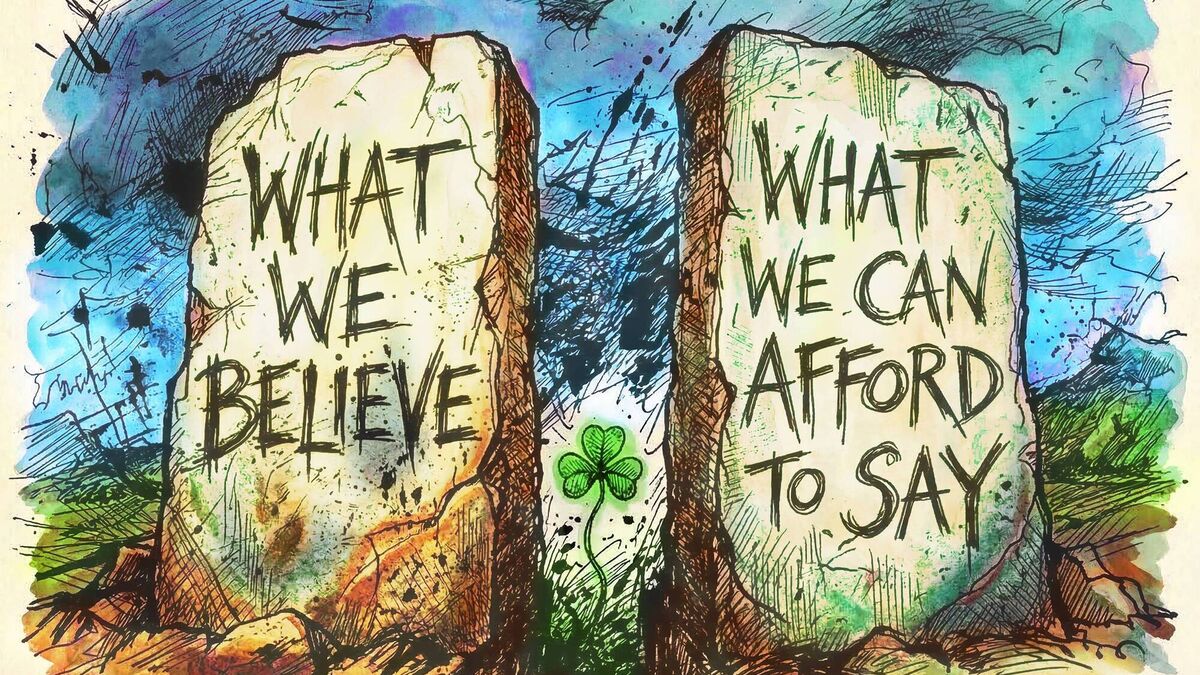
The shamrock is a weed, technically, a thing that grows in the gaps of other things, persistent, undemanding, useful for its symbolism rather than its substance. Illustration: Conor McGuire
Every March around St Patrick's Day, we dutifully dispatch the Taoiseach to Washington with a bowl of shamrock and a practised smile. This year, however, he brought six billion dollars and the knowledge of an outrageous war.
There is a photograph that exists in the memory of every Irish person who has been paying attention this week. Micheál Martin, in a well-pressed suit, presents a bowl of shamrock to Donald Trump in the newly gilded Oval Office. Both men smiling, sporting green ties, flush with warm handshakes, the easy theatre of a diplomatic relationship so practised it has its own choreography. But somewhere in the newly unfolding war, in a bunker in Lebanon, an Irish soldier is waiting for the next wave of missiles to pass.
The shamrock ceremony has been running since 1952 when it began as a gesture of gentle diplomacy: a small country reminding the most powerful nation on earth that it had Irish blood in its veins and might therefore be persuaded to act with due consideration and generosity. Ireland has no army worth speaking of, no nuclear deterrent, no seat at the table of the politically serious. What it has is the great Irish diaspora, the carefully curated Celtic myth, and the wild, unruly shamrock, stuffed into a bowl. Ireland plays the hand it was dealt and acknowledges its place in the scheme of things.
For seventy years, the ceremony worked in the same way that a good confidence trick works because everyone involved understood it was a performance and agreed, tacitly, to treat it as real. The Taoiseach got face time with the most powerful man in the world. The US President got to feel Irish for an afternoon. Ireland got its multinationals, its low corporate tax, its pharmaceutical gold rush, and its data centre bonanza. The arrangement was never stated plainly, because stating things plainly is the one diplomatic error no small country can afford.
This year, however, the performance has become harder to sustain. On February 28th, while Omani mediators in Geneva were announcing that a nuclear agreement with Iran was "within reach," the United States and Israel launched an unexpected and brutal assault on Tehran. The Supreme Leader, Ayatollah Ali Khamenei, was killed. Iran retaliated with missiles and drones across nine countries. The Strait of Hormuz, through which 20% of the world's oil passes, was effectively closed. Brent crude crossed one hundred dollars a barrel. Some 380 Irish peacekeepers in the Middle East were sheltering in bunkers.
Sinn Féin and Labour called on the Taoiseach to cancel the trip. He didn't, of course. He couldn't. And here is the thing that the people calling for cancellation perhaps underestimate: he was right not to. Not because the war in Iran is anything other than catastrophic, and not because Trump is anything other than what Fintan O'Toole and Michael McDowell - two men who have never previously agreed on anything - described him as in the same week: mad. But because Ireland is not in a position to tell the truth, and hasn't been for quite some time.
There are nearly 1,000 American companies operating in Ireland, generating over €500 billion in affiliate sales. Around 260,000 people in this country work directly for US firms. Pharmaceutical exports to the United States last year were €44 billion - the country's single biggest export category. When the Taoiseach says, as he did to reporters this week, that he has "a wider responsibility to make sure that what is valuable in our reputation is not undermined", what he means, translated from the diplomatic, is this: we have bet the house, and the casino owner has a gun.
Martin arrived in Washington carrying a gift. Irish companies, he announced, would be investing €6.1 billion in American manufacturing jobs - €5 billion from Smurfit Westrock, €1 billion from Kingspan, and €100 million from Glanbia. The White House spokesman received this with the contentment of a man who has seen the new rules work exactly as intended. World leaders, he observed, used to come to Washington and walk away with billions in taxpayer-funded freebies. Now they bring trade and investment deals. He did not use the word tribute. He didn't need to.
There is a debased version of this story in which Micheál Martin is a morally bankrupt coward, shuffling to Washington with his bowl of weeds while Iranian missiles fall and Irish peacekeeping soldiers take cover. It is not an entirely unfair version, but it sits alongside another version, equally true, in which he is doing precisely what every Taoiseach has done since 1952 . He's managing the gap between what Ireland believes and what Ireland can afford to say. Eamon de Valera was a genius at this, as he maintained Irish neutrality during the Second World War not out of principle, which is what he claimed, but out of calculation, which is what it was. The calculation then was that Ireland could not survive the truth. The calculation now is identical.
The difference is that in 1943, when de Valera was writing his famous response to Churchill's jibe about Irish neutrality, Irish soldiers were not sheltering in bunkers from the bombs of the country he was refusing to criticise. They are now. That is what has changed, and it’s not a change lost in the diplomatic mirage.
The reassuringly familiar ceremony, with the humble bowl of shamrock, the garish green ties, and the carefully scripted warmth, has always been a kind of controlled but charming fiction. Ireland performs Irishness for American consumption, while the incumbent American administration performs good-humoured affection to court the favour of the considerable American Irish electoral population. It is the most durable piece of political theatre in the western world, outlasting administrations, scandals, wars, financial crises, and at least three Taoisigh who found it personally excruciating. It has survived because it serves the interests of everyone who participates in it. This year, it survives because the alternative - the empty seat, the cancelled flight, the pointed statement - would serve nobody's interests except the conscience.
We are treated to a carefully staged moment in the annual ceremony where the Taoiseach presents the bowl while the President dutifully says something charming if not innocuous. Both men smile obligingly for the cameras while the assembled Irish-American dignitaries bask in the glow of pride. Perhaps it's the sigh of relief from people who have been pretending so long they've forgotten they're pretending.
This year, that moment landed differently, not because Martin is a worse man than his predecessors, or because Trump is more dangerous than other presidents Ireland has smiled at - Nixon got a bowl of shamrock; Reagan got one; George W. Bush, who launched an illegal war in Iraq, got one too. But because somewhere between the spring of 2025 and now, the gap between what is happening in the world and what we are prepared to say about it has become, for the first time, too wide to look away from.
The shamrock is a weed, technically, a thing that grows in the gaps of other things, persistent, undemanding, useful for its symbolism rather than its substance. It is, in that sense, a more honest national emblem than we give it credit for, as we Irish have always lived in the gaps.
We have always been more useful as a symbol of peace than as a power player. The ceremony endures because the gap persists, and its symbolism remains potent.
This year, though, the gap has bodies in it.