Religion is an inextricable part of who we are
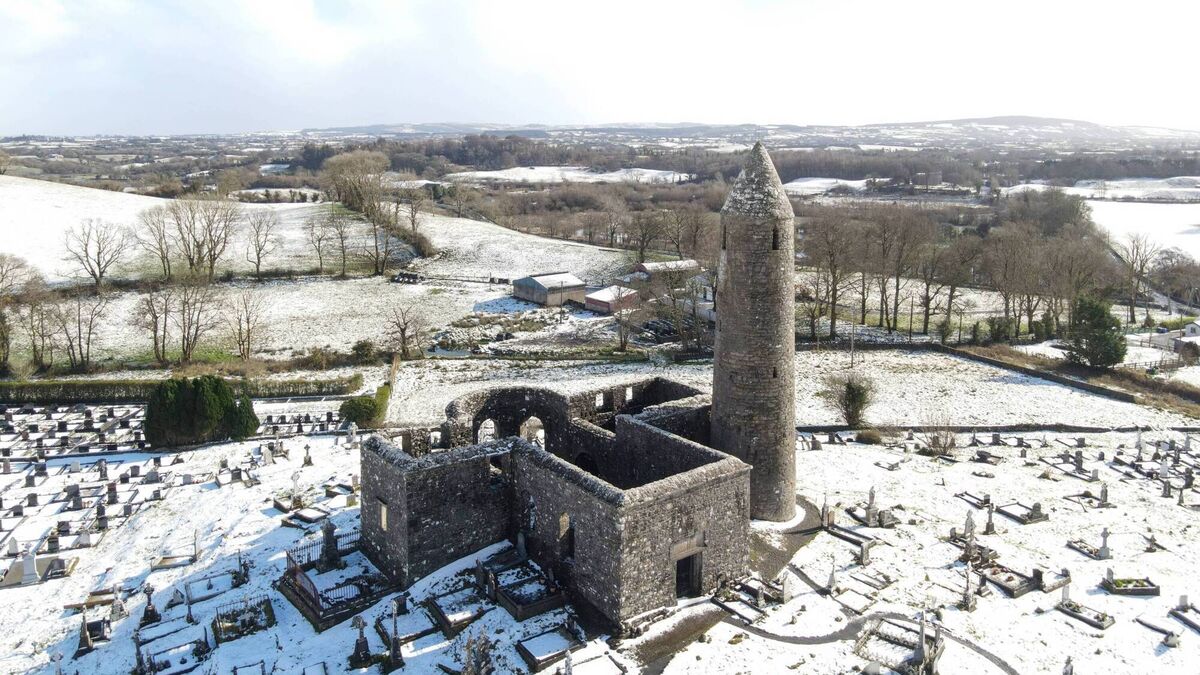
Turlough Round Tower and Church stands on the site of an early medieval monastery, believed to be founded by St Patrick. Picture: Jack Walsh Drone Photography
Early on in his novel, , John McGahern has the main character, Ruttledge, admit to the playful Jamesie that he’s feeling a bit down.
‘Why don’t you go to Mass, then, if you are that down?’ Jamesie offered.
‘What’s that got to do with it?’
‘You’d be like everyone else around here by now if you went to Mass.’
‘I’d like to attend Mass. I miss going’.
‘What’s keeping you, then?’
‘I don’t believe.’
‘I don’t believe,’ he mimicked. ‘None of us believes and we go. That’s no bar.’
‘I’d feel a hypocrite. Why do you go if you don’t believe?’
‘To look at the girls. To see the whole performance. We go to see all the other hypocrites.’
Last Thursday night, Christmas night, churches all over the world were full to capacity. At a time when churches in Ireland and elsewhere are no longer full and sometimes even not half or a quarter full on the weekend, this is a strange truth. It can have a chilling effect when we struggle to decipher why.
It can also have a comical side when those for whom it’s a one and only annual visit take up most of the seats and those for whom church-going is an unmissable weekly event find themselves standing unexpectedly and disconcerted at the back of the Church.
In any case, there’s something about Christmas that compels even the most transient of Catholics to drift towards their local church on Christmas night. It’s complicated, we say. And it is. Is it just an annual deference to a family tradition, if not a family faith? It can be? Is it a statement about belonging, even at a distance, to the local parish? I think so. Is it an echo of a hunger, sometimes long buried and often casually ignored, of a God-space in life that now and again seeks some kind of validation - especially with the knowledge that nothing else really seems to substitute for it. The call of God, often stilled by life and its varied circumstances, is never completely dimmed. At the very least it’s a kind of itch that we find ourselves scratching on Christmas night.
During the lead up to Christmas, Channel Four ran a two-part documentary, , on the life of John Smyth, possibly the most prolific serial abuser ever associated with the Church of England. Smyth was a married man with a family, a Christian evangelist and a moral campaigner, who ran summer camps for teenage boys in England and Zimbabwe during the 1970s and 1980s. He groomed his victims and beat them with incredible viciousness, dealing out prescribed numbers of lashes under the guise of punishment for sins.
Smyth’s brutal abuse lasted for almost four decades and during that time the abuse was known to two archbishops and ten bishops, some of them senior Church of England prelates including the Archbishop of Canterbury, Justin Welby, who were aware of Smyth’s abuse. What seems extraordinary was that such a retinue of senior church figures knew about the abuse but decided to keep silent because of their conviction that the perceived goodness of the perpetrator trumped the evil that was eventually unmasked. The unspoken implication behind the horror unveiled by the documentary was that ‘the man in the street’, if he had known what was happening, would have found it easier to name its truth than bishops and archbishops.
It is also the key reason why the authority of the Catholic Church in Ireland has been similarly so damaged. It is the big question that haunts so many in authority who chose to protect the good name of their church when the people in the pews, bereft of their formal education and formation, would have advised them differently. And it is the main reason - though not of course the only one - why our congregations have withered.
It can also be a convenient excuse to explain a casual disavowal of a source of great human and personal satisfaction, even a kind of happiness. ‘Going to Mass’, as McGahern’s character Jamesie presented an unlikely antidote to unease does not in itself constitute ‘a faith’, but it pays its dues in giving a personal faith the status of the complex reality it is - a moveable feast that waxes and wanes as it is constantly buffeted by the storms of a lived life.
Appearances, as we know, can be deceptive - an old woman telling her beads in an empty church may be closer to the mysticism so often touted by those wrongly presumed to be her spiritual advisers. An old man watching from the sidelines of life can have a firmer grasp of what matters in life and in faith than the modern guru extolling the latest wisdom.
Sometimes we can find it too easy to pontificate on what ‘having the faith’ means and even on what comprises ‘faith’, pitching a preferred option of a specific religious identity as of primary importance rather than merely a matter of fate, as distinct from faith - like the self-righteous parishioner who encouraged his parish priest to say ‘a real Catholic Mass’.
Similarly, though from a different perspective, any form of religious faith can to the secular mind seem simply irrational as with a recent depiction of religion as ‘a sinister conspiracy of elderly men in frocks foisting unnatural beliefs on innocent humanity’.
Yet, others like James Marriott, a columnist in the , who recently professed that he is ‘not religious’ but is ‘all too sensible of religion’s danger to reason and to peace’, accepts that ‘we may yet find that our species cannot do without faith’. That, as TS Eliot wrote, ‘humankind cannot bear very much reality’.
Marriott's struggle with the reality that ‘no human society ever studied has been without religion’ mirrors the individual experience of many today who are coming around to the belief that, as many evolutionary psychologists have argued, religion is an inextricable part of who we are as a species. And even that many modern people who would not otherwise consider themselves to be religious now see it as much part of what it is to be human as falling in love.
The gospel according to McGahern’s Jamesie.