Preserving the Moy for future generations
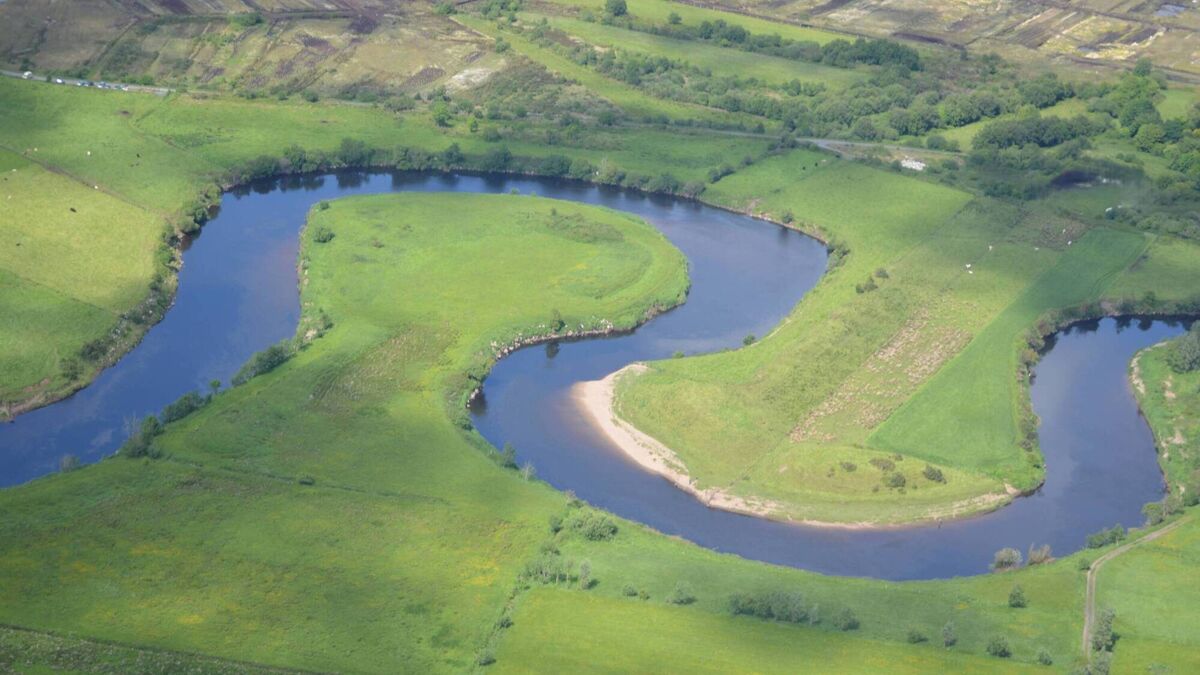
The windings of the River Moy near Foxford. Picture: Pat McCarrick
The name of the River Moy is derived from an old Irish word 'muad', which translates as 'noble'.
I met a group of people lately and our conversation led to a chat about the health of the noble Moy. I was happy to find out that while the river has changed greatly over the years, it is generally in good health.
I was further reminded of the river that circumnavigates the Ox Mountains on reading the best-selling book, by nature writer, Robert Macfarlane. He makes the point that rivers are living beings and in some places around the world, rivers are seen as unique entities with legal rights of their own.
Macfarlane’s book is the story of his visits to three river systems in Ecuador, India, and Canada. Publishers, Penguin, in their promotional blurb for the book explain the concept behind it.
follows the course of three major rivers. The first, in northern Ecuador, where a miraculous cloud-forest and its rivers are threatened with destruction by gold-mining. The second, in southern India, visits damaged rivers, streams and lagoons, where a desperate battle to save the lives of these waterways is under way. The third, in north-eastern Quebec, takes the reader to a spectacular wild river, the Mutehekau. In a river-rights campaign, this river is being defended from death, as a result of damming.
Leon Vlieger, in a blog, , discusses the environmental damage highlighted by Macfarlane. If we think this whole concept sounds a bit mad, well, at least we are thinking.
Information provided by the Environmental Protection Agency's National River Monitoring Programme states that while river water quality in Ireland compares favourably to that in Europe, there is a continuing and worrying trend in the loss of our highest quality river sites. Just 50% of our rivers are in a satisfactory ecological condition. This figure is dropping (it was 55% in 2021) and it begs the question; what of the other 50%? Almost one fifth of monitored river water is in poor or bad status and is severely polluted. The report points to the following causes.
Any assessment will show that Ireland’s unhealthiest rivers are in Leinster and ironically, in the Golden Vale. It isn’t hard to make the connection; according to Southern Scientific Services, agriculture is the single biggest pressure, linked to about 60% of at-risk water bodies.
Caroline O'Doherty, writing in in 2025, presents some startling facts stemming from the EPA report referred to above.
Sustainable Water Network (SWAN), a coalition of 25 of Ireland’s leading environmental organisations working on water, responding to the EPA report, said that "successive governments had engaged in rhetoric around restoring rivers and lakes to health rather than implementing real measures to prevent decline".
While is it difficult to find a positive in all of this, it should be noted that improvements were recorded in some places where targeted efforts were made to address problems, particularly in relation to reducing nitrates in waters in agricultural areas.
The details of the current water action plan for Mayo was outlined by Bernadette White from the Local Authority Water Programme and reported in the in March 2025. White noted that there are 46 catchment management plans in Mayo, which would include the Moy and Erriff rivers as well as waters flowing into the various bays, such as Clew Bay and Killala Bay.
She noted that water quality in Mayo's rivers and lakes is among the best in Ireland, standing at 67% compared to the national average of 54%. There are also more high-status waters in Mayo, she said, with 18% in the county achieving this, which marked a slight decline from previous years.
I had the great pleasure of flying over the length of the River Moy on one occasion. I organised the flight as part of the work on preparing my 2019 book, . It was a joyful experience, picking up the course of the river high in the Ox Mountains near Cloonacool, and then following its windings on through Banada, Swinford, Straide, Foxford and on over Ballina and Killala Bay. It was interesting to see the river grow in length and width and even change colour, from mountain brown to lowland blue to delta turquoise. The bird’s eye view from the small plane flattened out the mountain, tidied up around every cottage and displayed features I had only ever seen in school geography books.
I remember the Moy before the drainage scheme of the 1960s and '70s. It was a winding river of deep holes filled with trout, famous salmon pools that were renowned the world over, and it was as fresh and clean as the day God made it. The Moy has taken a beating and all who love the river agree, while the quality of its waters is acceptable at present, it is no longer the river that it once was. Maybe, if we were to see the Moy as a living thing, a legal entity, with status and rights of its own, as Macfarlane suggests, it might just help us to treat it differently. What if our iconic river could be categorised as, not just “acceptable”, but “noble”, as its ancient name describes it.