Pope Leo continues to follow Francis' road
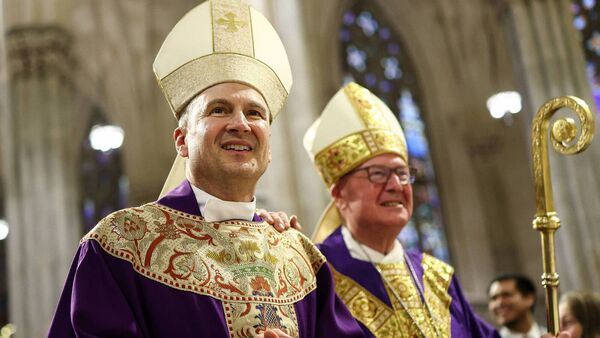
Cardinal Timothy Dolan (right) and his successor Ronald Hicks arrive to lead a mass at St Patrick's Cathedral in New York City on December 18, 2025. Picture: Charly Triballeau/AFP via Getty Images
Two weeks before Christmas, a Vatican announcement indicated that Pope Leo XIV had appointed Bishop Ronald Hicks to succeed Cardinal Timothy Dolan as Archbishop of New York. The appointment was awaited for some time as Dolan had reached the mandatory retirement age of 75 and Hicks, a bishop very much in the likeness of Leo himself, had been mentioned for promotion.
New York was a key appointment not just because its bishop is effectively the leader of the Catholic Church in America but because it would indicate the possible template the Pope would follow in other episcopal appointments.
Dolan was perceived as ‘a Maga bishop’ - traditional, conservative, a Trump supporter, even embarrassingly a member of Trump’s Religious Liberty Commission and much given to obsequiously praising Trump.
Hicks represented a very different style, very much in the image of Pope Leo and he had followed a similar trajectory: a pastor, in the words of Pope Francis, who had the smell of the sheep; later a bishop who was critical of the Trump immigration policy; close to the poor and the marginalised; and noticeably bereft of the toxin that has poisoned American Catholicism - that God loved the rich and poverty was the fault of the poor.
But Hicks’ appointment didn’t follow the usual predictable pattern. It wasn’t just that his name had been widely mentioned for the post or that his un-Maga-like profile was discussed as unsuitable as a replacement for Dolan but that the appointment of Hicks and others like him would indicate a more open and ‘liberal’ direction that Leo intended to move the American Catholic Church.
This became clear when, three days before the actual announcement, the Hicks appointment was leaked - clearly the last throw of the dice to block it by those unhappy with it and what it represented. The Maga-inspired American Church was playing, in every sense, its last ‘trump'.
The Catholic Church moves in cycles. Pope John XXIII’s Second Vatican Council represented a swerve away from the model of church that preceded it. Popes John Paul and Benedict represented in many respects a swing back to the pre-Vatican Two church. Francis represented another swerve back to the unfinished business of Vatican Two and, it is now clear from Hicks’ appointment to New York, that Leo is continuing, as he has already said so often, to follow the road that Francis marked out for a future church.
Bishops, of course, regardless of the swerves mentioned above are regarded as always obedient to the pope. Well, yes and no. Yes, in theory, certainly but bishops and dioceses can be a long way from Rome and papal policy, for example, can be variably ‘interpreted’ at local level.
Just in case what I have to say might be challenged as pointing a finger at any Irish diocese or even at the Irish Catholic Church, let me (metaphorically) cross the Irish Sea for an example of how the obedience of bishops sometimes works. Or rather sometimes doesn’t.
Recently, Cardinal Vincent Nichols of Westminster, leader of the Catholic bishops of England and Wales (E&W), retiring at 80 years of age, at his last conference, mulled over signs of hope for the Church in E&W. Strangely he didn’t register the synodal process as worth mentioning in terms of hope!
Austen Ivereigh, an official expert on ‘synodality’, asked whether this indicated that the E&W bishops had decided to opt out of the synod process, in view of the fact that in June 2025 Pope Leo had approved a plan and a timetable and encouraged all local churches ‘to get on with it’.
Ivereigh, writing in the , pointed out that, on the official document, ‘Pathways for Implementation’, the role of bishops’ conferences over the next three years is clear: ‘To foster implementation in dioceses, to coordinate and network between them and to report to the synod office in Rome.'
When the answer to Ivereigh’s question eventually arrived from the E&W bishops, it pointed out that (i) they were ‘committed to the processes which embody synodality’ and (ii) that implementation of synodality will progress at a different pace, and in different ways, in each diocese’.
In other words, we’re all for it but not yet. Most worrying of all was the clarification, if such it was, that synodality (the E&W bishops intimated) is ‘at heart a spirituality of listening and formation’. Which of course it is but it’s also, as Ivereigh helpfully suggested, about ‘structural reform and a (new) way of making decisions in the church’.
Pope Leo has been crystal clear about what’s involved in embracing ‘the synodal way of being church’. Yes, it’s about listening but also discerning, in particular discerning with the wider church what decisions are made. It’s about pastoral councils and diocesan councils and finance councils which embody a synodal culture ‘through ministries, charisms and formation’.
In a telling comment to those who oppose change, Leo states: ‘We must not delude ourselves that carrying on with a few traditional activities will be enough to maintain the vitality of our Christian communities.'
And, yes, each diocese (and parish) needs to prioritise where and how change is needed and how it can be implemented but, as Ivereigh points out, ‘that doesn’t mean two-speed synodality’. Synodality is not an option or as the E&W bishops seem to think ‘a suggestion’. Or that it can somehow be wished away as a nuisance or a nonsense or, as some are suggesting, another tactical church version of that ‘slow boat to China’.
Not a great omen for the new Archbishop of Westminster, Richard Moth, whose appointment has just been announced and who is widely seen as another Leo appointment – anxious, it seems, ‘to get to China’ sometime soon. Poor man!