On knowing who to keep and who to let go

There's a particularly American bit of research doing the rounds that suggests we're all in the middle of a family relationship crisis. One in four adults is estranged from close relatives, apparently. Two-thirds of families don't spend enough time together. The Cornell Legacy Project has been interviewing dying people about their regrets, and not unsurprisingly, nobody wishes they'd worked more hours or bought a bigger telly. They regret the grudges, the silences, the slow drift apart from people they once loved.
The conclusion? We should all lighten up, accept everyone as they are, and spend our free time socialising with friends and family, regardless of their appalling politics or that thing they said at Christmas.
Which is, if I'm honest, only half right.
Because there's another truth that hovers around these studies like an uninvited ghost at the family table or social gathering. Sometimes the kindest thing you can do for yourself, and possibly for others, is to know when to walk away. Not necessarily in a huff, or with self-indulgent drama, but just walk away. The wisdom of age isn't just about acceptance. It's about discrimination. The good kind. The kind that knows the difference between a friendship or family bond worth salvaging and one that's been quietly poisoning you for years.
I'm not ancient, but then I’m not young either, and I've noticed an interesting change in my social landscape. It's purposely getting smaller, not because people are dying, though that's started too, but because I've become cautiously selective about who gets my time. And I don't mean in a spendthrift way, but in a manner that feels like finally learning to swim with glee after years of thrashing about just to stay afloat.
The latest findings tell us that older adults will either consciously or not prune and fine-tune their social networks, holding dear the close ties that are rewarding while allowing the non-essential ones to wither and die. We're not losing people to attrition, but we're actively choosing quality over quantity. It's called socio-emotional selectivity theory, which sounds like something you'd study in a particularly joyless university department, but it basically boils down to this: when you realise you've got less time ahead than behind, you stop wasting it on people and situations that drain you.
Here in Ireland, we've got our own peculiar relationship with family estrangement. Blood is thicker than water, even when the blood in question belongs to someone who makes you feel small, or anxious, or slightly sick to your stomach.
But scratch beneath that veneer of familial obligation and you'll find whole sub-continents of Irish families who simply don't speak anymore. Siblings who haven't exchanged words in decades. Adult children who moved to Melbourne not just for the weather but because 10,000 miles felt about the right distance from home. We emigrate from people as well as places.
The American research wants us to believe that most estrangements are mistakes, slow drifts caused by busyness and unwillingness to forgive. And sometimes that's true. Sometimes you do just need to phone your sibling or friend, apologise for whatever bloody thing it was, and move on. But sometimes - and this is where the research gets squeamish - the estrangement is the healthiest thing that ever happened to either party.
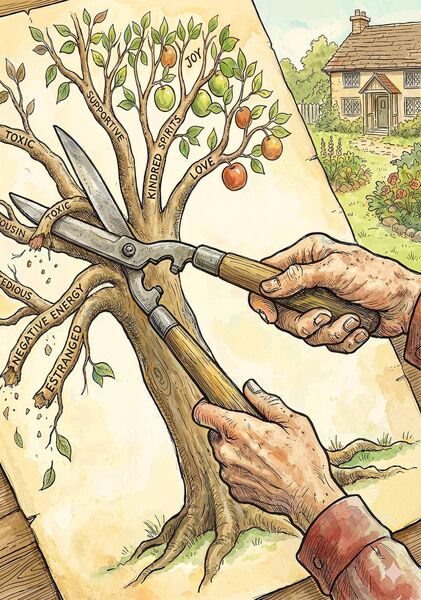
There's a person I know who cut off his eldest child some 20 years ago, an offspring who borrowed money and broke promises with equal facility. The parents tried everything - interventions, tough love, soft love, every possible configuration of paternal devotion. Eventually, they stopped trying. Not with anger, but with something like sorrow and relief mixed together. They realised that they were enabling their beloved child by always being there to negate the consequences of toxic behaviour. And they were destroying the family unit in the process.
The child is still alive, but the family is at peace. They dote on their other children, tend their garden. They don't regret the estrangement. They regret that it was necessary, which is different.
This is what the "just accept everyone" brigade doesn't quite grasp: acceptance and proximity are not the same thing. You can accept that your brother is an alcoholic without bearing witness to his inebriation. You can accept that your friend or relative is narcissistic without volunteering for weekly emotional evisceration. You can forgive someone and still decide they're not safe to be around.
The older I get, the more I value the people who make me feel like myself, not a better version, not a worse version, just... more fully myself. My son is away at college now, and I find myself thinking about what kind of family he'll build for himself. I hope he'll have the wisdom to protect himself from toxicity and the wisdom to recognise a true friend. That's not pessimistic. That's love.
Socio-emotional selectivity research suggests that as we age, we don't just get pickier about people; we get better at relationships overall. Older adults report more satisfaction with their social lives despite having smaller networks. We experience less conflict, more joy, and deeper connections. Part of that is learning to let go of nonsense. But part of it, surely, is learning to let go of non-essential people.
What the Cornell Legacy Project is really telling us, I think, is not that all estrangements are tragic mistakes, but that unfinished business weighs heavily on the dying. The difference is crucial. If you've got something to say- an apology, a truth that needs telling - say it. Don't wait. But if you've said everything worth saying, if you've tried everything worth trying, if the person is genuinely toxic... then walking away isn't failure. It's wisdom.
The real trick is knowing which is which. And that, I suppose, is where age helps. At thirty, you think you can fix everyone. At forty, you realise you can't fix anyone. At fifty, you start to understand that some things don't need fixing - they need accepting. And some things don't need acceptance - they need letting go.
Next Christmas, which will tumble toward us before we put away the Halloween costumes and lanterns, I won't be seeing everyone in my extended network. Some because of distance, some because of busyness, and some because I've made the quiet, sensible decision that I'm better off spotting them from a very great distance and moving swiftly away.
The wisdom of age isn't about becoming softer or more forgiving, though that happens too. It's about becoming clearer. About knowing what matters and what doesn't. About understanding that life is short, time is precious, and you don't owe anyone access to your company just because you share the same hometown or childhood memories.
So yes, tell the family you love them. Apologise where apologies are due. Let go of petty grudges. But also: know when to walk away. Know when "acceptance" is just another word for self-destruction. Know when protecting yourself is not cruelty but kindness.
That's the bit they left out of the research, probably because it doesn't fit the narrative. But it's true nonetheless. Sometimes the greatest gift you can give yourself is your absence.