New world order has put Ireland in a bind
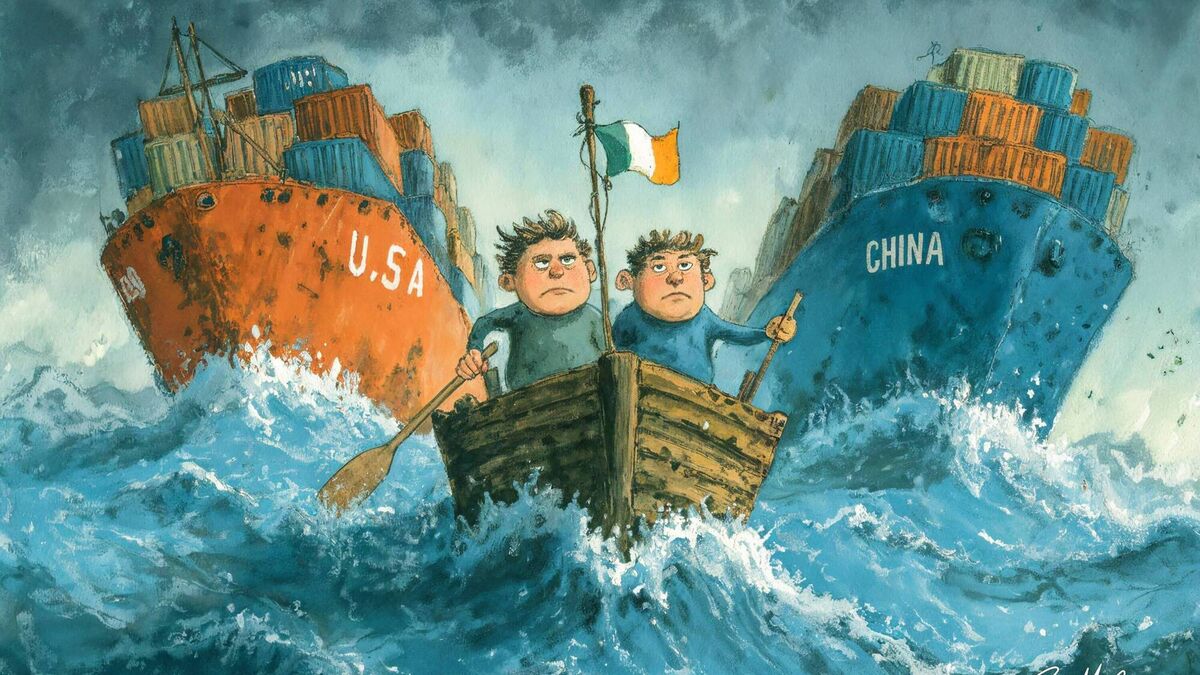
Ireland finds itself caught between a declining United States and a rising China. Illustration: Conor McGuire
You know that feeling when you're on a night out and one of the guests whom you've always relied upon, who's perhaps picked up the bill before, who's told great stories, suddenly stands up, begins ranting about buying the neighbour's garden shed, and threatens to punch anyone who won't help them steal it? That was Davos last week. And the rest of us, nursing our drinks at the Swiss fondue bar of liberal capitalism, had to confront an uncomfortable truth: the grown-up has left the room. Possibly forever.
As we watch nervously from Ireland, perched as we are on Europe's wet Atlantic edge, we've got front-row seats to the great unravelling. And unlike the continentals with their mainland delusions about strategic autonomy, or the British with their freshly minted special relationship comfort blanket, we Irish can't afford the luxury of pretending this is all just badly rehearsed theatre. When America sneezes, we don't just catch a cold, we contract double pneumonia with life-threatening complications.
Consider the mathematics of our predicament: approximately 260,000 Irish people work for American companies, and one in three euros the taxman collects comes from American multinationals. Our successive Irish administrations have designed our entire economic model on the trite assumption that American capitalism would remain both ruthlessly efficient and dependably rational and well disposed towards Ireland. In the Trump era, it turns out we might get the first bit without the second.
What made this year's Davos so clarifying wasn't just Trump's meandering performance, even though that was spectacular in its awfulness. I felt I was watching an elderly car salesman try to give the Gettysburg Address after too many whiskies and a handful of uppers. What differed was watching everyone else suddenly speak the truth out loud, such as Mark Carney, Canada's prime minister, who stood up and said the word nobody wanted to hear: . Not a comfortable transition, not a well-judged adjustment, but a searing rupture. As in torn and broken, the thing that was holding this together has snapped, and the wound's not closing anytime soon.
The Canadian was admirably blunt about it, noting we're not in some orderly handover period where the Americans graciously pass the torch to whoever comes next. We're in the bit where the old order is dying and can't admit it's dying, but instead it's thrashing about, making outrageous threats and breaking things. The American President demanding Greenland wasn't some negotiating tactic. It was the nightmare of an empire that's lost the plot but not the guns.
And the altered economic landscape should terrify our economists, as Trump's not wrong about everything. That's what makes this so much worse because the old arrangement is ending and American power has been steadily corroding. The Chinese have built an alternative model that's working on a scale we can barely imagine or comprehend. While we were all arguing about social media algorithms and reopening disused rail lines, they've catapulted into the 22nd century and built enough high-speed rail to circle the earth and enough solar panels to power it. They've created industrial capacity so vast that they could theoretically green the entire planet - and Trump's putting tariffs on it because... well, because they're not American.
Adam Tooze, a historian who's become the crisis whisperer for our age, made this point beautifully in a recent interview. The Chinese, he noted, speak better Davos than Davos does now, and they roll out the well-practiced multilateral platitudes, the win-win cooperation, all that cosy and reassuring 1990s' rhetoric about rising tides and boats. Meanwhile, the Americans show up and threaten to annex Denmark's vast frozen real estate.
I am reminded of an old headmaster, at once strict but fair, who somehow kept the school running, occasionally caned the errant pupils, but the discipline was acceptable because his motives were transparent. Such mild censure has been replaced by someone who delights in setting fire to the gym hall and demands everyone call it progress while congratulating the arsonist. Meanwhile, the inconspicuous kid from the back of the class who you used to copy homework from has quietly bought the whole school, built a new one twice the size, and is offering everyone scholarships.
The truly unsettling thing - and Tooze captured this as well - is that there's no neat transition in sight. We're not going from an American order to a Chinese order, or even to some multipolar arrangement where sensible people make sensible rules. We're in the interregnum. The time of monsters, as that overused Gramsci quote has it. And monsters don't care much for small, open economies that depend on rules-based trade and stable partnerships.
So what do we do? The coalition government's response has been admirably Irish in its accommodations, as we just keep our heads down, say nothing too provocative, hope it all blows over, and maybe slip away early before anyone notices. The Tánaiste makes careful noises about dialogue and de-escalation. The Taoiseach will toddle off to Washington for St Patrick's Day with the traditional bowl of shamrock, though quite what Trump will make of our quaint Celtic customs is anyone's guess. ("Beautiful shamrock. Probably wouldn't grow in Greenland, though. Too cold. Should really be growing it in Florida.") But hoping for a return to normal is magical thinking. There is no normal to return to. The Biden years were an interlude, a last desperate attempt to restore something that was already dead. And whatever comes after Trump - whether in four years or four hundred years - won't look like what came before.
Europe's talking about strategic autonomy, which is French for "we should probably figure out how to defend ourselves". Ireland's talking about... well, we're not entirely sure. Building up our military from its current strength of three armoured tractors and a strongly worded neutrality clause? Diversifying our economy away from American multinationals? Good luck with that. The Chinese aren't exactly queuing up to move their European headquarters to Athlone; that offer has passed.
The truth is, we're stuck. We've made ourselves wealthy by being useful to an America that no longer exists. And the new America, itself in shock, has become mercurial, transactional, uninterested in alliances or order. In the gold-plated Trumpian order, America doesn't include us the way the old one did, with a mixture of sentiment and practicality. We're the unsuspecting pianist at the hotel bar who's perfected Cole Porter and Gershwin, only to discover the new management wants to install a karaoke machine, rendering our entire repertoire obsolete overnight.
So we watch, from our damp corner of Europe, as the old order dies its prolonged death. We watch the Chinese build their electro-state while we argue about bike sheds. We watch the Americans threaten their allies and cosy up to dictators. We watch the Europeans slowly, painfully realise they're on their own. And we try to figure out what it means to be a small, open economy in a world where the big boys have stopped pretending to play by rules.
I suspect it means we're going to have to become economically creative and look to new markets. The age of monsters isn't kind to the clever and the small, and it never has been. But at least we'll see it coming from our damp perch on the Atlantic - that view's still free, even if everything else is probably about to get more uncertain and expensive.