More than just football in focus this weekend
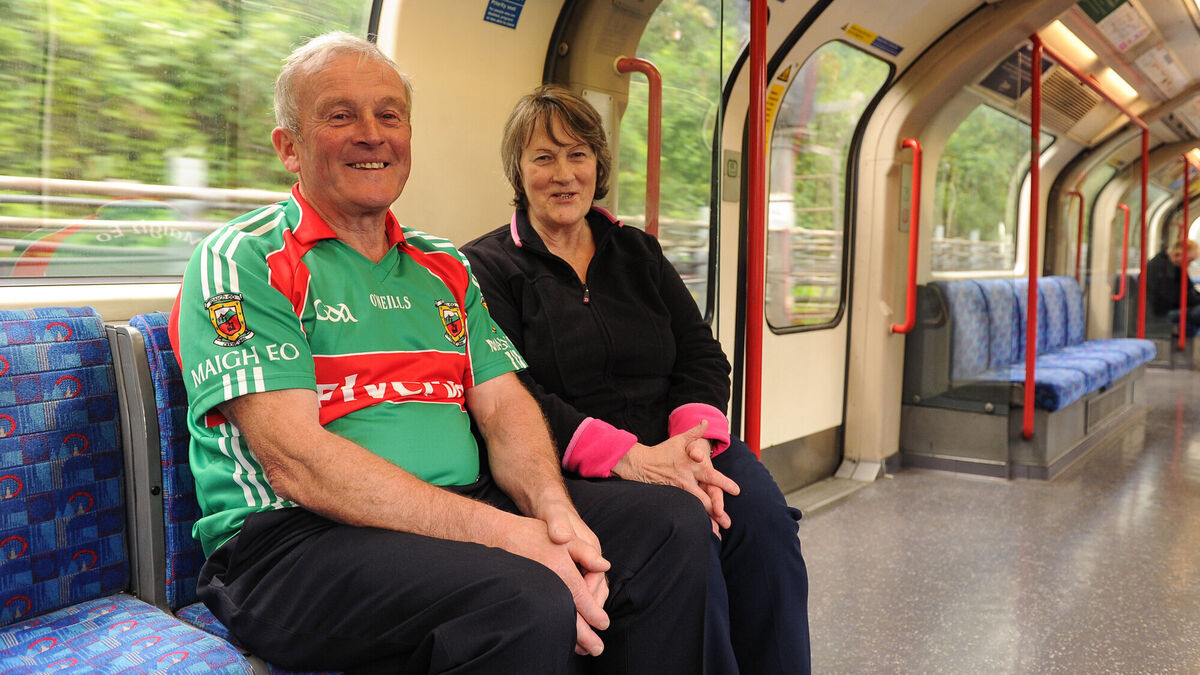
Mayo supporters James and Brigest Maree, from Willesden Junction, London and originally from Tourmakeady taking the London Underground on their way to Ruislip for the Green and Red's 2016 clash with London. Picture: Seb Daly/Sportsfile
To claim that London and New York are part of ‘Greater Connacht’ might seem incredible. It could feel like something that belongs to the lively imagination of people from our part of the world.
Saying that two of the great cities of the world are part of the Connacht Championship always causes some confusion. New York? London? Playing football in the Connacht Championship? When you explain this to people east of the Shannon – especially non GAA people – it raises some eyebrows at first. They then assume you are joking. When you persist, they give you that look that combines politeness and continued doubt. They just don’t understand it, don’t see the logic of it, they don’t – you might say – get these rules.
And why would they not be doubtful? On the surface it makes no sense. But we in the west of Ireland all know what it is about. We know that including ‘the exiles’ in the Connacht Championship makes all the sense in the world.
And just as well, because it is once again upon us. This week, Mayo head to London, and Roscommon to New York, to start the Connacht championship campaign. All around the region, the colours of the counties will be adorning aeroplane seats – the green and red east to Ruislip, the primrose and blue west to Gaelic Park. The proud wearers of those colours who live their lives in or near London or New York will be heading to the match by subway, tube, and cab. Those on the planes and those already there will be busily making plans to renew the ties that bind. The games will act as a focal point for all those who keep the GAA a part of their home, even though they live away.
Having London and New York in the competition is now an old tradition. London first entered the championship as far back as 1975. New York joined the party in 1999. One of the two entered the competition just before I was born, and there will be a special quiz prize of a Big Apple for those readers who think it was New York.
As chance would have it, Mayo were the opposition for both London and New York’s first match. Maybe that was the luck of the draw or proof positive that we are truly box office, even on the West End and Broadway stages. The attendance at Ruislip this weekend – and the scramble for tickets – will confirm it.
Everyone gets a turn to make their guest appearance. The opponents for London and New York rotate each year so that each of the five ‘home counties’ gets to travel in sequence. Since it all began, thousands of west of Ireland people have used the occasions to meet up and connect. The games over the years have oftentimes been more of an occasion to meet than a do or die championship match, but that has been changing. New York beat Leitrim in 2023 and scared the life out of Roscommon not long ago. Sligo and Leitrim were both put to the sword in London’s progress to the 2013 Connacht Final. Every Mayo supporter who knows their stuff will tell you that James Horan’s tenure as manager could have been the shortest ever if London had won an incredibly tight game in 2011.
So no one going – and certainly no one playing – will feel complacent. In both cases there will be a game, and potentially a very competitive one but, in an application of one of the great sporting cliches, what goes on in London and New York this weekend will be much more than a game.
Friends and relations from all across our region will meet. That is the vital dimension to it all, the part which explains why the two GAA counties of New York and London are included in the Connacht Championship. Some assume it is because that provincial competition is the smallest, but it is for a bigger reason than that.
It is instead because the two cities where they will all meet this weekend have absorbed so many west of Ireland people. The depth and breadth of those human connections makes these two cities in a very real sense part of our back yard. Whether that be counted in friends and relations, in experiences, or in memories, we all keep a part of ourselves in some part of them.
That is an old story. And while our relationship to those two cities has changed a lot there remains similarities to the world of old.
Once they were places where vast numbers of our people, predominately unskilled, went to do the back breaking work that made those cities great, and at more a basic level, function. Those people sent back so much of the hard currency that built houses and businesses here, and sustained many.
Since the entry of London into the Connacht Championship, that has changed a lot. From the 1980s on especially, the profile of our emigration to those cities has changed. We now send highly skilled people – in law, accounting, PR, financial services, engineering, construction.
Economic relationships are now more dynamic. Many who live in the west work in businesses which are headquartered or do their main trade with London or New York. Many others do a ‘New York’ or ‘London’ job from a cottage in Killala or Kilmovee.
People now go to those cities more overtly from choice and less for need. People in the west of Ireland go on shopping trips to these cities, where once our own corner shops relied on remittances from them. And also instead of remittances, in the world of today, many of the pensions which keep people in the west comfortable are managed in one of those cities.
The social context has changed also. Once upon a time, we had the ‘American wake’ and those in London would come home maybe once a year, and rarely, twice. Now the world is smaller and distance feels less painful.
So the world changes and we are changed with it. But deep in our souls, west of Ireland people understand why each year two counties from the west head out to play London and New York in the Connacht Football Championship, to renew connections and sustain our games in the places that once sustained us. And if others don’t get it, that’s just too bad. In sport, as in life, these are rules we understand.