Minority groups suffer from culture-war dogma
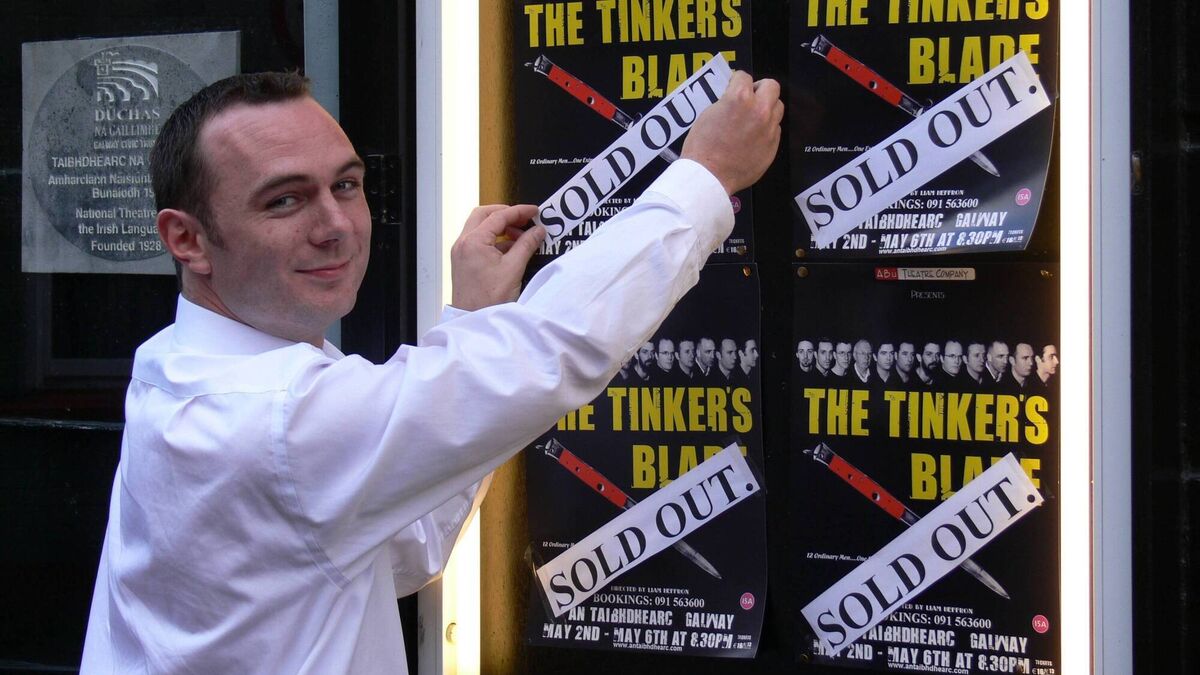
Justin Conboy, producer of places posters outside An Taibhdhearc prior to the play's run at the Galway theatre almost 20 years ago.
Almost 20 years ago, the finished its sell-out run at An Taibhdhearc theatre in Galway. I wrote the play in the aftermath of the killing of John ‘Frog’ Ward by Padraig Nally, after the Traveller trespassed on his Mayo farm in 2004. My aim was to highlight how societal prejudices, groupthink and lazy analysis distorts the truth and could lead to the thoughtless discrimination and bad treatment of minority groups. But instead of berating my audience, I engaged them (Travellers included) in an exploration of how we are all more alike than not, warts and all.
Fast-forward two decades and despite Black Lives Matter protests and oft-repeated warning that the U.S. law and order apparatus is the irredeemably racist arm of a white-privileged state, most Black Americans (61%) want their police presence to remain the same. This is similar to the response of 71% of White Americans, when all were asked if they want the police to spend more, the same or less time than they currently do in their area.
It’s no surprise then that L.A. Democrats are tired of their party’s handling of local crises, including homelessness and rising crime rates despite progressive party policies. Voters are showing their frustration through recalls of district attorneys and a shift toward law-and-order candidates. Meanwhile, despite the growing unpopularity of Donald Trump, Democratic favourability has dropped sharply after the 2024 election, falling from 85% in September 2024 to 67% by October 2025. Subsequent electoral successes hides the fact of growing frustration within the party’s base.
Is this symptomatic of a growing disconnect between ordinary people and a ‘progressive’ professional managerial class embedded in our institutions and politics? Perhaps – as particularly evidenced in policies the PMC push on an increasingly sceptical public, made clear by one such project in 2019.
Created by journalist Nikole Hannah-Jones, the 1619 project sought to reframe American history by positioning the arrival of enslaved Africans in Virginia in 1619, as a foundational moment alongside the formal adoption by the U.S. Declaration of Independence in 1776. It expanded from a magazine issue into books, educational materials, and a television series. She won a Pulitzer Prize for this work.
There is just one problem.
For the basis of her argument, Hannah-Jones claimed that the American Revolution was fought primarily to protect slavery. This assertion was immediately disputed by the own expert fact-checker and multiple historians, who noted there was zero immediate British threat to colonial slavery. Despite warnings, the claim remained, later softened in quiet edits in the paper and the removal of “1619 as our true founding”.
Why persist with a contested claim? Why ignore the prior advice from your own fact-checker (and a renowned History professor of African American life and slavery), who warned that this “series on slavery made avoidable mistakes. But the attacks from its critics are much more dangerous.” The answer is uncomfortable. By presenting a morally coherent and simplified narrative, the project transformed complex historical debate into a cultural battleground, sacrificing introspection and nuance for impact.
Yet, it also needlessly gave credibility to those critics only too happy to downplay the role of slavery in the development of the United States. This divisive tendency to promote advocacy over evidence is not confined to the U.S. It is increasingly visible in how “history” is presented in Ireland.
The Atlantic Technological University (ATU) marked Traveller Ethnicity Day 2026 with exhibitions across its campuses, including Castlebar. According to ATU, these exhibitions were designed to present “diverse perspectives on Traveller history and culture, reflecting students’ research and meaningful engagement with community narratives”.
One such display is located in the entrance foyer of Castlebar Library, as a neatly presented, two-panel exhibition featuring archival photographs of tinsmithing, Traveller camps and explanatory texts on Traveller culture. At first glance it is thoughtful. It is well-intentioned. It is also lacking in meaningful engagement with community narratives.
Despite being created by Fourth-year History and Geography ATU students under guidance from their lecturers, it is mostly polemic, not serious history. That’s what makes this presentation so problematic. These are not beginners. They are students trained in Irish history, folklore, archaeology, genealogy, and geography. Many will soon become teachers, curators, or continue into postgraduate study.
As with the 1619 Project, this sadly is not a thoughtful attempt to create a shared history, to offer alternate views or ask meaningful questions which would bring communities together. This is about blinkered advocacy.
Despite consisting of few paragraphs of long text, the library display still manages to berate those who “are not accepting of the alternative approach of the travelling community and presume to speak for them on what is best for them” and stridently claims this “is evident from the origins of the travelling community, where it is suggested that they must somehow have become displaced from the settled community instead of accepting and respecting them as a distinct and separate ethnic community”.
No proof is provided, even as genetic research by the Royal College of Surgeons and the University of Edinburgh upends this narrative. The RCSI findings indicate that Travellers are of Irish ancestral origin and likely diverged from the settled population during the upheavals of the seventeenth century, while also proving the misconception that Travellers are a hybrid population of settled Irish and Roma as completely false.
The ATU educators know this. Or at the very least should know this. Similar to the 1619 project, why distort history to shame your critics into silence?
Yet, more striking still is what is left unsaid.
The exhibition correctly notes that Travellers have long suffered discrimination. This is undeniable and deserves academic attention. But nowhere is any real acknowledgement of the long-standing, reciprocal relationship between Travellers and rural farmers or urban residents (lumped together as some homogenous “settled community”).
For generations, households across Ireland provided food, money, lodging, seasonal work and places to camp. While Travellers offered tinsmithing, tool repair and horse trading in return, in a functional and interdependent economic system, which Travellers relied upon much more than the “settled community”. This is well documented in government reports, newspaper articles, oral histories and folklore collections (see www.duchas.ie).
Without that generous support from often poor peasant farmers and urban labourers, Traveller life as we understand it would not, and could not, have been sustained. This omission matters, instead framing Travellers as virtuous victims of an oppressive “settled” community.
There are other omissions but you get the picture.
As with 1619, what is presented as history increasingly arrives pre-interpreted, its tensions reduced, its ambiguities resolved, its conclusions implied in advance. The result is not falsehood, but something arguably more problematic: a narrowing of perspective in service to an agenda.
This is not a criticism of the students themselves, who have clearly engaged with their subject. Indeed, a presentation on two displays cannot do justice to all the work these students no doubt have undertaken. However, the showcasing of feelgood claims and unsupported polemics while omitting awkward but important facts, raises a broader question about how history is now being taught, assembled and presented at the point of graduation by educators, to soon-to-be entrants to the professional and managerial class who run our state institutions, agencies and schools.
Both the 1619 Project and the 2026 Traveller exhibition attempt to address real and important questions about inequality, identity and the past. Their intentions are laudable, but are lost in culture-war dogma which does not serve Black Americans or Irish Travellers well. We all deserve better.
may be due for another run.