Mgr Horan's gift to the people of the West
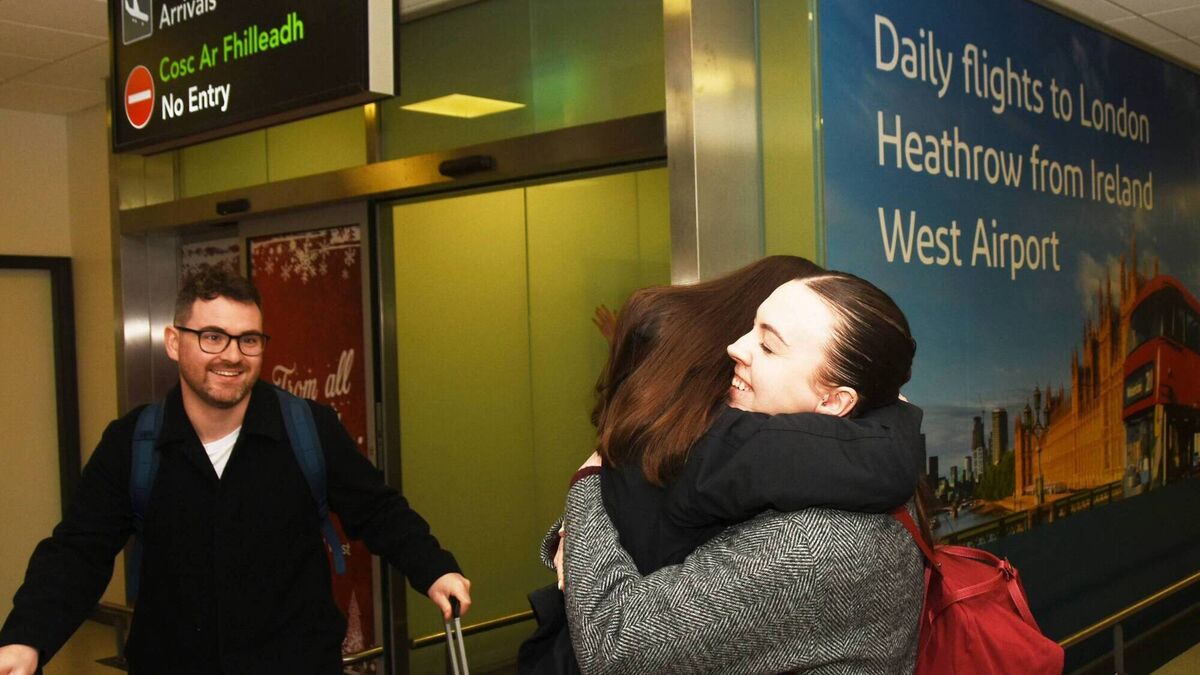
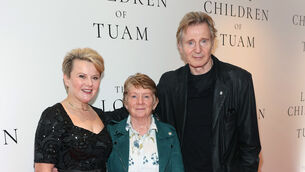
Marie Fitzgibbon from Tuam (middle) greets her sister Emma Fitzgibbon and her fiance Ben Carty from Oxford at Ireland West Airport in Knock last Thursday. Picture: John O'Grady
Whatever you call it, you can only praise it, most especially this time of year. For Ireland West Airport Knock, or Knock Airport as it is to all of us, is never more appreciated than at Christmas. In this season, it brings joy to our world.
Over the last few days and even weeks, the airport has been lit up by more than the runway lights. The true meaning of Christmas is to be found in the arrivals hall. In that hall of happiness this time of year, faces light up as people arrive and are collected. The expectation, the excited chatter, the eruption of cheers: all of these create a glorious atmosphere worthy of the season. There is singing, and Santa hats, and all the good uplifting feeling that you want to be around. When people come through that gate, there will be hugs, and there will be fussing. Bags full of gifts will be placed in boots, and hungry travellers gladly anticipate the hot meals which will be consumed before long.
It is more than a simple matter of practicality, of the type that frequent flyers experience regularly and are grateful for. That particular experience of return, in that particular place, speaks to us very deeply. It is a moment in time that crystallises a large part of who we are.
The last few visitors will be landing in the days running up to Christmas. Even if you have not been on that run out to Barnacogue this year, you can summon it to your mind straight away. For we have all been there on one of those days, on either side of the arrivals gate.
The pain and the joy of departure and return is the central story of the west of Ireland. It is - you might say - our foundation, a story that illuminates the fundamentals of our world and our world view. Much is rooted in pain: too much bad land, too many people. Too little investment, not enough industrialisation. Too many dreams, not enough room. There are plenty of other elements to the tough sides of the story. We have all heard them and some of us have lived the hardest versions of them. We remember all those at Christmas, especially when there weren’t many happy returns.
The other side of the story is the wanderlust, the energy and the sense of adventure that sent us as a people all over the world. In the west of Ireland, you grow up, you get off your backside, and you try and make your way. That’s not only in the wild world, with adventures to be had at home too, but for many it has been and remains our way, our story.
Because that is so, it has imprinted certain markers of that experience in our brains. When we are reminded of them, we are moved to reflection, even tears. Among those markers we all share are the smoke of the train engine; the American wake; the cattle boat for England; the tradition of sending letters - and a few bob - home; the greater number of women who left and the bachelors left at home alone; the landscape of ruined and abandoned cottages and of fields much too small for more than survival: all of those are woven into the songs we sing and the memories that shape us. All these are pillars of our west of Ireland experience. Taking their place among those markers of memory and experience is that arrivals gate at Knock Airport.
It is a suitably festive subject for Christmas because, unlike some of those other markers, the arrivals gate at Knock Airport is predominately joyful. In that wider west of Ireland story of departure and even exile, it is about the return. And so the terminal building on that ‘foggy boggy hill’ has been emanating rays of illumination all this week.
It is also suitable for Christmas - that season which tells us to believe in the possibility of change and hope - because the story of Knock Airport itself is an inspiring one. The building of the airport has of course been often told as a story of triumph over adversity. Its creation is one of the great west of Ireland stories because of the wider context which shapes the arrivals gate this week: it is an example of how we can break that cycle of departure.
All those years of lack of investment, of lack of faith and the consequent emigration were confronted and confounded by the building of that airport. For those old enough to be around in the west of Ireland of 1986, that is ironic of course: the airport which facilitated emigration was and remains a means to defeat it.
This irony is proof to me of how the west will never die so long as there are great people to lead it, to look at a problem and see an opportunity. And Monsignor James Horan was one of those people. His vision, energy and determination were the trinity that drove the project on. The boldness, even cheekiness, of his approach - no money, no approvals - is the archetype of the kind of people we have always admired. All those centuries of landlords and Dublin Castle taught us to smile and bow while doing whatever the heck we could get away with when they weren’t paying attention.
But James Horan was much more than just a character of that type. He was a builder, a leader, a doer not a talker. He was one of our last great chieftains, a chieftain for the modern era. What he left us is more than an airport, it is an example.
2026 will see the fortieth year of both his passing and of the opening of the great airport he built. Both he and that airport spent their lifetimes serving the people of the west. It is James Horan’s enduring Christmas present to us. Those joyful scenes this week at the arrivals gate are markers of the world he set out to remake.