Media keeps underestimating Donald Trump
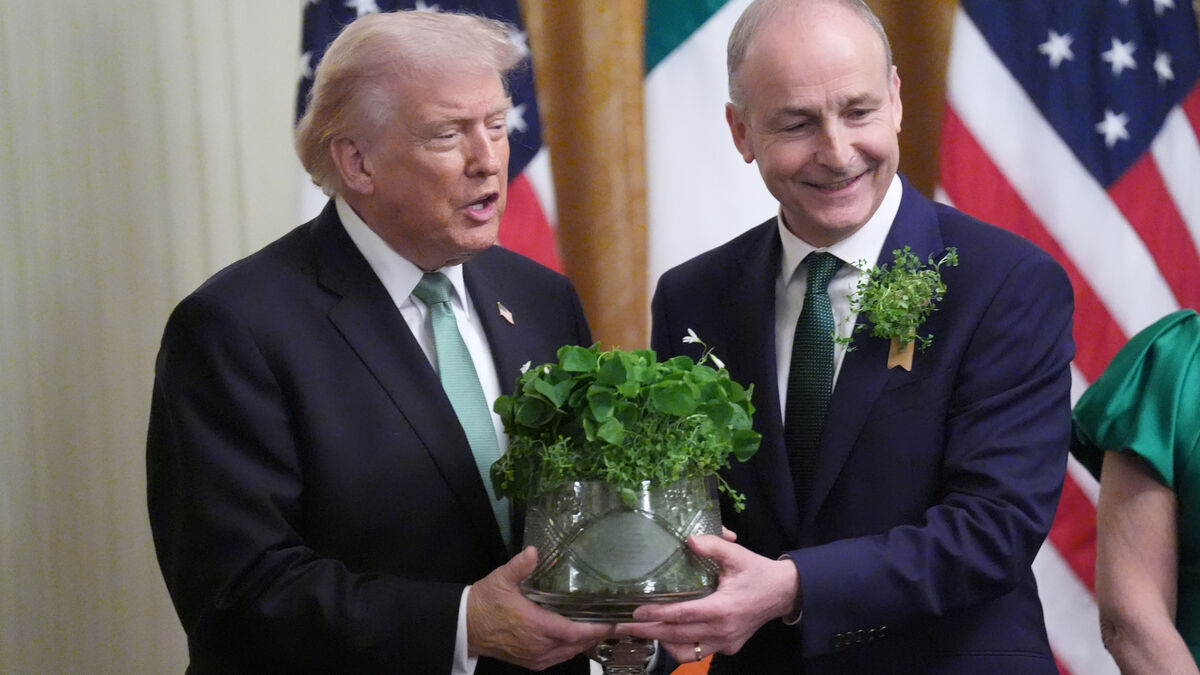
US President Donald Trump with Taoiseach Micheál Martin during the St Patrick's Day shamrock ceremony at the White House in Washington DC last Tuesday.
The camera pans around the cluttered police station as soft-spoken and rather pathetic, small-time conman Roger 'Verbal' Kint spills the beans to the police interrogator on who criminal mastermind Keyser Söze really is.
Buried in a seemingly pointless stream of consciousness is Kint’s comment which helps elevate into one of the most iconic crime-thrillers of all time.
“The greatest trick the devil ever pulled was convincing the world he didn’t exist.”
Because the limping Kint, played terrifyingly brilliantly by Kevin Spacey, was actually Keyser Söze himself, which the police only realised after letting him go. In politics, the trick has been different, but no less dangerous.
It is not that Donald Trump is invisible (or a mastermind). It is that the version of him presented to the public by the media has so often been a caricature, flattened, exaggerated in the wrong ways and ultimately too easy to dismiss. Even after over a decade of wall-to-wall coverage, the most remarkable thing is not what Trump says or does, but how persistently he is misunderstood.
This is evidenced by a recent episode of Sky News’ Trump 100 podcast, featuring a special St Patrick’s Day discussion of Taoiseach Micheál Martin’s visit to the White House. Hosted by Martha Kelner and featuring Sky’s Ireland correspondent David Blevins, the segment was framed around a simple clickbait question: Why is Trump talking about reunifying Ireland?
Kelner’s and Blevins’s tone was familiar: self-satisfied amusement, faintly incredulous and entirely confident in their own interpretation. Trump, we were told, appeared not to understand the sensitivities of Irish politics. Surely, it was suggested, a president should have been better briefed. Surely, an aide might have been on hand to whisper the necessary details.
But this analysis willfully ignores everything we know of Trump’s presidency and how he sold himself to his voters. He just does not care of such things.
Donald Trump is not a conventional political figure. This is not a revelation. He does not operate from briefing notes, nor does he appear especially interested in the finer points of diplomatic etiquette. To point this out, at this stage, is not insight, it is repetition and lazy journalism.
What matters is something else entirely: that he understands just enough and knows how to play the media at their own game. Every. Single. Time.
Trump’s remark about Irish unity at the traditional St. Patrick’s Day Speaker’s Lunch at the US Capitol, was not made in a vacuum. It was made precisely because it is a sensitive issue. The joke only works because of that sensitivity. Strip away the politics and what remains is a marketeer’s instinct, an ability to identify pressure points in a room and play with them.
Indicating to the DUP leader Emma Little-Pengelly, Trump mused of her meeting with the Taoiseach’s entourage: “Deputy First Minister of Northern Ireland…and they get along so well - I saw that - you get along very well together, that’s the way it’s supposed to be, huh? I don’t know if I should be promoting merger [smiling]... I love mergers - but I don’t know… we’re going to get into a lot of trouble with that one [laughter in the room].”
In fact, long-time readers of my column will know he said something similar at last year’s event.
You don’t have to admire that instinct. But you do have to recognise it. Despite the smug Sky reporters claiming otherwise, Trump knows exactly who Emma Little-Pengelly is and her utter opposition to Irish unity.
And yet, time and again, his instinct, his humour, is misread as ignorance.
This is where the problem lies. Not in criticism of Trump - there is no shortage of that, much of it justified - but in the nature of the criticism itself. When analysis begins and ends with the assumption that he simply doesn’t know what he is doing, it ceases to be analysis at all. It becomes click-bait performance.
There is a second layer to this and it is just as important. The media is not only misreading Trump, it is misreading its audience. The suggestion that viewers require correction on every perceived faux pas, that they will be shocked by a casual misstatement or a poorly timed joke, speaks to a certain condescension. In fact, most people are not impressed by politicians playing it safe with diplomatic, safe and respectful language.
Trump’s supporters pay attention because he is charismatic, outspoken and outrageous, not in spite of it. Because he misgenders the Irish President Catherine Connolly whose speech criticised his actions in Iran. Because he claims Keir Starmer is not Winston Churchill. Because he is playing the media.
This matters not in the abstract, but in the most concrete sense imaginable. Trump’s views shape policy on Ukraine, on the Middle East, on trade, on immigration. Decisions taken in Washington ripple outward, to Europe, to Ireland, to the wider world. This is not theoretical. It is immediate.
Which brings us back to Ireland.
The meeting between Trump and Micheál Martin was amicable, friendly and handled with care. Martin did not grandstand. He did not attempt to score points for a domestic audience. Instead, he did something far more effective: he nudged, he reassured and he kept the door open for dialogue.
That is what diplomacy looks like in practice.
Yet much of the US coverage framed the Taoiseach’s public reminder to Trump of “his capacity” to do deals with Kier Starmer and the European leaders as a kind of moral victory, or even an embarrassment for the US President. This is a misunderstanding of a different kind. It mistakes restraint for weakness and subtlety for spectacle.
In reality, there was no humiliation and no attempt at it. There was, instead, an effort to maintain a working relationship with a fickle president whose decisions carry enormous weight. Whether one agrees with those decisions is beside the point. They exist and they have consequences.
This is where the idea of underestimation becomes dangerous.
Donald Trump was underestimated before he secured the Republican nomination in 2016. He was underestimated during the election that followed. He has been underestimated, in various ways, ever since. And even now, with years of evidence to draw upon, the instinct persists to reduce him, to caricature him, to treat him as a figure of ridicule rather than a figure of power.
It is, in its own way, comforting.
Because if Trump is merely a buffoon, then he can be dismissed. If he is simply chaotic, then his actions need not be taken seriously. If he is an accident, then there is no need to reckon with the conditions that produced him or the reasons he continues to command attention of millions of voters.
Broadcasters willfully present a version of Trump that invites laughter more than understanding. And in doing so, they offer something reassuring but misleading: the illusion that he can be ignored, or explained away.
By continuing to deliberately misunderstand him for cheap views, the media such as Sky News are not holding him to account in the way that his voters care about. In the way they should care about.
Because the stupidest trick the media ever pulled was convincing the world that the real Donald Trump didn’t exist.