Like drug barons, speedsters are carriers of death
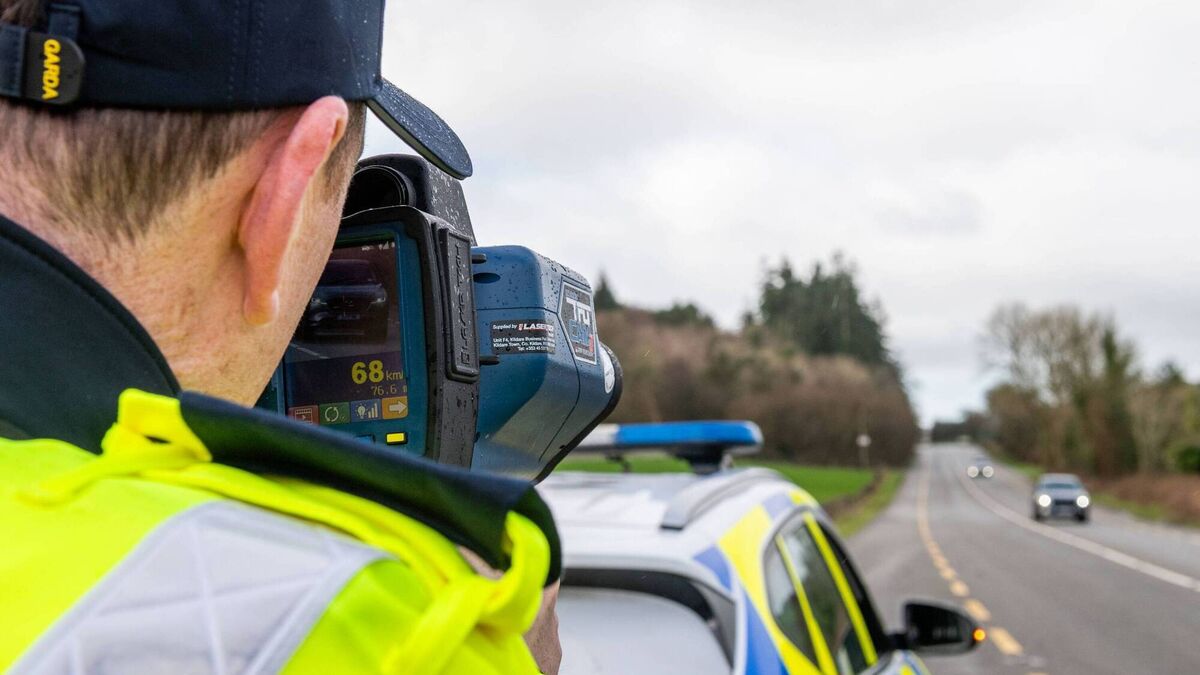
A garda checking for speed on An Garda Síochána's National Slow Down Day last February. The aim of National Slow Down Days is to remind motorists of the dangers of speeding and to deter and detect those that are intent on driving at excessive or inappropriate speed - but is anything truly working? Picture: Andy Gibson
A car, we need to keep reminding ourselves, is a lethal weapon. And even if we don’t – remind ourselves, that is – we are constantly reminded of it, whether we like it or not. It seems as if almost every day now there are mind-chilling reports of lives lost, life-changing injuries sustained, families plunged into grief, ‘first responders’ to horrific accidents traumatised and communities devastated by the phenomenal level of death and serious injury on our roads.
It seems that no matter what we do. Or what we say. Or what advice is given. Or what adverts on television present the horrific reality of death on the roads. Or what punitive measures are attached to whatever crimes or misdemeanours are perpetrated – by way of fines, or loss of driving licences and up to and including terms of imprisonment – are in effectiveness cumulatively not worth a hill of beans.
Either no one is listening or not hearing or not caring or have despaired of ever stymying the carnage and the fall-out from the life-long repercussions of death on the roads and the nightmares that are an inevitable part of that legacy.
Here’s an agreed indeed incontestable conclusion by the established experts in this field – An Garda Síochána and the Road Safety Authority (RSA): ‘Speeding is the single biggest factor in a significant number of road traffic crashes resulting in death or serious injury’. But place beside that obvious truth, the result of a new report by the Central Statistics Office (CSO) measuring how successful the Gardaí have been at solving crimes: ‘The number of people being caught speeding on Irish roads is now at almost half the level of a decade ago’. Let that sentence sink in.
The CSO report explains that in 2024 the number of drivers caught speeding and issued with penalty points declined again compared to 2023, as road fatality rates continue to surge. The following CSO statistics put that decline in context: ‘A total of 124,632 fixed-speeding charge notices for 2024 were issued, down 11 per cent on 2023. Longer-term figures show last year’s total was down 43 per cent on 2014 (217,475)’.
An obvious question arises from those scandalous figures. If in 2014 when there were significantly fewer cars on the roads and there were 217,475 fixed-charge notices for speeding, how come that in 2024 when there are more cars on the roads that the number of fixed-charge notices were 124,632, 43% fewer?
Could someone, preferably from An Garda Síochána, explain this discrepancy? Or can we conclude that, if the number of notices for speeding were so much higher when cars were noticeably fewer that something has gone badly awry with Garda surveillance? And to ask what can be done to limit the number of deaths on our roads by devising a more effective strategy for removing the speeding culprits from our roads and from their cars.
A starting point is an acceptance that the present combination of the Garda strategy and the Road Safety Authority publicity campaigns are incapable of coming to terms with the problem. Clearly the Gardaí have questions to answer about the effectiveness of their contribution and the recent scandal – of some Gardaí sitting in their cars when they were supposed to be on road-duty and, apparently, unashamedly thumbing their noses at the Garda authorities in the process – does not augur well for their contribution. And at this stage, after a number of RSA campaigns based on the horrific consequences of fatal accidents, those campaigns of persuasion seem ineffective and probably pointless.
Could attention be given to the following clear and obvious truth? If speed is the compelling reason why road deaths are continuing to spiral out of control, what’s the compelling response that makes the ‘speedsters’ slow down?
the possibility of their playing a starring role in a real-life experience of one of the RSA adverts. the failed persuasion of a Garda standing at the side of the road pleading for them to slow down. their parents begging them to be responsible. even that they might suffer the life-long trauma of knowing that their selfishness and irresponsibility was responsible for the death of, say, a mother of a young family.
The one and indeed (it would seem) the only worry that speedsters have on their minds is the possibility that they might lose their driving licenses and find themselves sitting looking out the window of their homes for a few years twiddling their thumbs. And unless Irish society can come up with an effective and implementable policy of spreading that fear among speedsters, repeating some version of all the other (failed) strategies is a waste of time – and money.
The grim truth is that the speedsters are beyond appeal and beyond any other influence – apart from fear of losing their licences. So just as An Garda has special units to tackle drug-crime and offer little or no relief to the drug barons when they catch them, a similar campaign and a similar no-nonsense result is part of the solution to the ever-increasing deaths on our roads.
To put it simply, it is now essential for An Garda – who know or can find out who the speedsters are in every local Garda area in Ireland – to take them off the roads. Because like the drug barons speedsters are carriers of death.
It’s time to stop indulging this insane compulsion with speedsters and with speed on our roads. Like the road-bullies who feel entitled to force responsible road-users to break the speed limits in order to get out of their way. Like the crazed drivers who seem to be incapable of NOT passing out whatever car happens to be in front of them. Like those ‘innocent’ drivers who flash their lights to warn others of a speed-camera ahead, and who thereby conspire to undermine the authorities in their efforts to encourage responsible driving among recalcitrant speedsters. Do they ever think of the possible repercussions of undermining the law or the injuries or deaths that in consequence of their actions may occur?
Speedsters need to have their licences removed because to stem the growing tide of death and serious injury on the roads, Irish society can no longer NOT take this nuclear option. Every other alternative has been explored.
Repeating the same thing and expecting a different result, as Albert Einstein said, is just another form of madness.