Life in Mayo will never be the same again
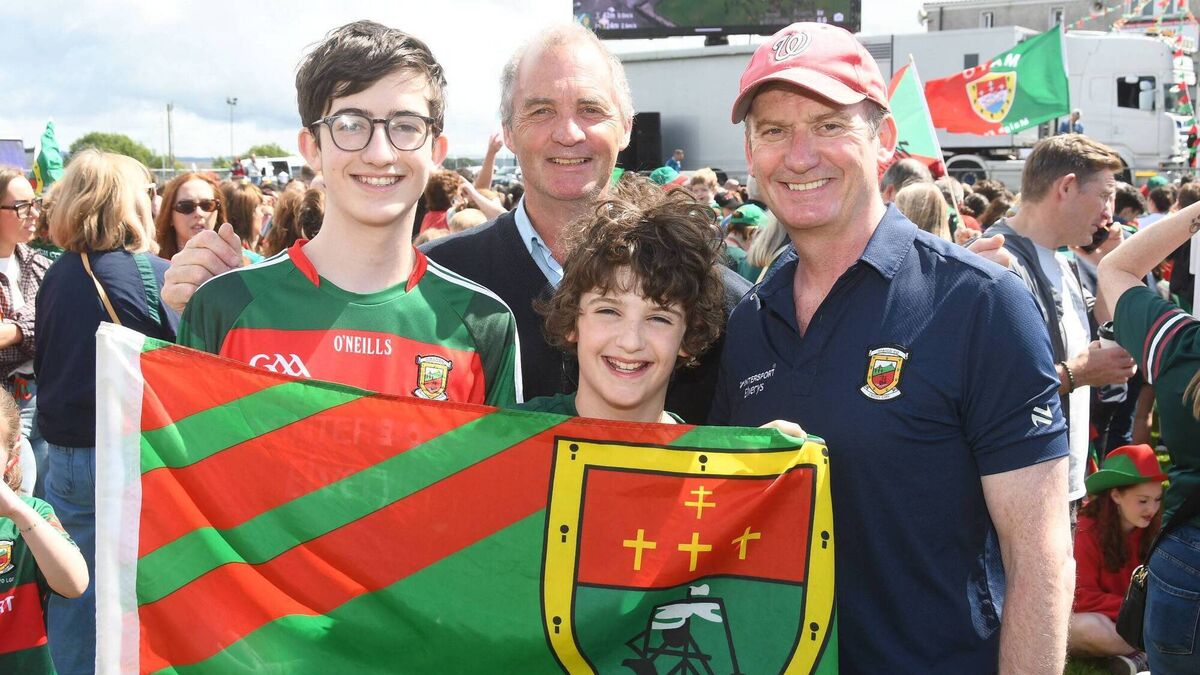
Pictured at James Stephens Park in Ballina for the homecoming of the All-Ireland champions were Oscar Garrett English, Ferdia Garrett English, Matthew Garrett and Mark Garrett. Picture: John O'Grady
There's a video you'll have seen by now. A man in red and green, sixty if he's a day, his face folding in on itself at the final whistle. Everyone knows that face, or thinks they do. Overwhelming joy, they'll caption it. Seventy-five years of it let go in one breath. I've worn that face myself, and I think quite a few of us were crying along with him.
Like my readers, I’m a Mayo man, so I ought to declare an interest here, though it had become less an interest than a sentence handed down at birth. We hadn't brought home the Sam Maguire since 1951. Shout that number aloud in a Ballina or Castlebar pub and watch what it does to the room. It isn't a statistic; it's an emotional scripture. Whole marriages have been conducted around the certainty of us not winning, children raised on it. We didn't follow a football team. We kept a vigil.
And there was the curse to explain it, which helped, the way a good story always helps. The 1951 men, coming home with the cup, were meant to have passed a funeral without lowering the celebrations. A grievous act of disrespect to the dead and the living, and a priest put it on them. No All-Ireland again until every last one of that team was under the sod. You can believe that or not. At home, plenty did, quietly. The last of the '51 men died a while back. The curse was spent. And we lost the next championship anyway, and the one after, and something colder set in than any curse. The suspicion that this was simply what we were.
Because our players were good, beyond good, that's the part outsiders never grasped. We got to finals, again and again, and found new and baroque ways to leave with funereal gravitas without the cup. A free missed in the last minute. A goal that went in off our own man. The bounce of a ball at the death, a sending off nobody could explain, a penalty coming off the post. We were the best team never to win, which in this country is its own kind of sainthood. People could love us precisely because we'd break their hearts. It was safe. The heartbreak was scheduled.
The football carried more than football. It was the fixed point in the year when a county solemnly agreed to feel guarded expectation tempered with resignation at the same hour. The teams forever almost winning kept that feeling renewable, a shared injustice as much a part of the county as the Atlantic rain. There was an unacknowledged security in a heartbreak you can set your watch by. The wound was as much a fixture as the lost final. We wore it like a good coat.
Then there was the win, the epic final, the flags at last unfurled and the fireworks of unbridled emotion. A beautiful day.
The clever men were sure it wouldn't happen. Every panel, every preview column, every bookmaker had Kerry, and not shyly either. Paul Flynn told the RTÉ audience the Kingdom had the stronger squad, the big-day experience, the superstars, and who was going to argue with him. Over in , Shaun Casey said he'd love to see us do it and in the very next breath that he couldn't see it, which is the pundit's way of sending flowers to the funeral in advance. The bookies had Kerry priced the way you'd price rain in November.
Here's the uncomfortable bit for a Mayo man to type. On the evidence, they were right. Roscommon had put two goals and twenty-five points on us in the Connacht championship, the sort of hammering that sends managers packing. Expertise reads the form, and it said we were done. That’s pretty much the whole of the job.
Which brings us to the manager. When the job came up, the sensible money said Mayo needed less Mayo. A tough-talking Ulsterman, a McGuinness type, some cold-eyed firewall against our own genius for hope. Instead we gave it to Andy Moran, and you could not have picked anyone more Mayo if you'd held auditions for it. He had stood on the pitch for half the heartbreaks of the last few decades. He carried no distance from any of it and made no show of wanting any. Every template of the modern manager said this was sentiment over sense. Every template was wrong.
Here’s what they all missed. Moran is the rare man who has read the last page of this particular book and took the job anyway. His own autobiography skipped the triumphal ending and owned the loss, shunning any self-pity, just a cool, calm study of the repeated pattern. He knew too well what defeat felt like, an odd qualification for lifting a cup, and it turned out to be the only one that counted. And he was ruthless where it mattered. He brought Tyrone native Paddy Tally with him, a coach who knows the Kingdom's own mind better than they know it themselves. Warmth on the surface, something harder underneath. That was the part nobody bothered to weigh.
We might ask why the knowledgeable got it so gloriously wrong? Because punditry can only weigh what sits still to be weighed. Kick-outs retained, metres carried, the depth of a bench, the yard of pace off the shoulder. It’s afforded no analysis for what five weeks does to a beaten team left alone with the stinging memory of a hammering. Whatever Moran did in those weeks, he did quietly, a man who by every account knows precisely what a losing final dressing room feels like and refuses to sit down in it. The Roscommon day was the making of the whole thing, and no model on earth forecasts that, because humiliation doesn't become visible in the numbers.
We beat Kerry to do it, which is almost too neat, Kerry being the county that treats Sam Maguire as an annual visitor, a thing that simply arrives. To take it off them, of all people. There'll be supporters at home who'll die happy on the strength of that alone.
But here's the contradiction with getting the one thing you've organised your whole self around wanting. You get it, and then you have to grow into someone who has it. The man defined by the novel he'll write one day is a romantic figure right up to the morning he writes it, and it turns out fine, and now he has to work out who he is. We've just written the novel. Three generations spent their lives being magnificent about not winning. That was a personality, a rather glorious one. And it's over.
So what replaces it, when the flags are folded away and the jerseys shelved? Ordinary expectation perhaps, which is a more prosaic thing than longing. Now we'll be favourites some year and lose, and it'll just be a defeat, flat and unlucky, with no myth to embroider it. No demented priest to blame. The loss will finally mean nothing more than a singular loss without the shared fatalism. It swaps the hurt, which at least you could sing about, for the plain arithmetic of a season.
I keep going back to the homecoming footage. The street parties, the open-top bus, the small ones who'll grow up thinking this is normal, poor devils, with no clue what was carried so they could stand there familiar with a cup. Somewhere the 1951 men are properly at rest at last, released from being a benchmark. It's those of us still standing who have to find a new way to be sad.
We'll win again now, hopefully. Winning is a habit once you've had an epic victory that banished the paralysis of self-doubt. And that, if you ever understood Mayo at all, requires a whole county to re-mythologise itself.