Leaders editing history is a sad song
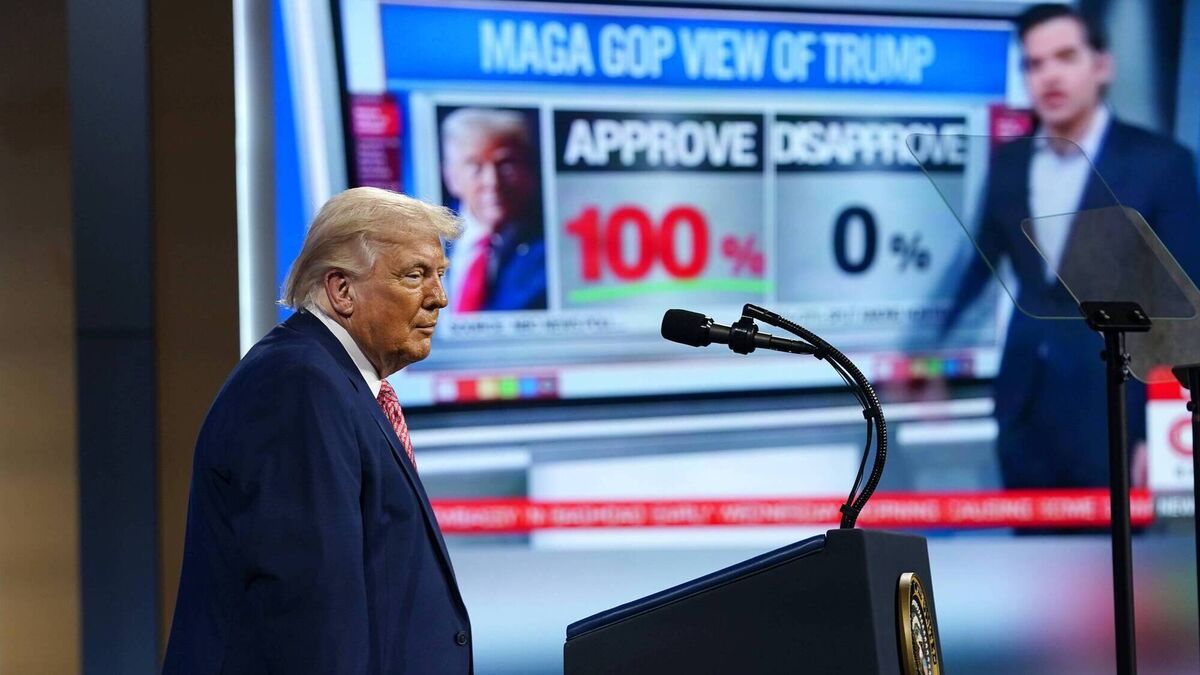
U.S. President Donald Trump speaking at the FII PRIORITY - a Saudi-backed investment summit - at the Faena Hotel, Miami Beach last Friday. Picture: Nathan Howard/Getty Images
I remember the heat of the June Bank holiday sunshine, giddy excitement in the air, rustling trees against the blue sky behind our house, as my sisters and I waited around nervously. My father had already gone ahead to help organise everything, while my mother finished the morning chores.
I remember that feeling of anticipation. Delicious anticipation.
We were in our shorts and runners, ready to go, as a car pulled up outside. A young Gerard McHale leapt out. He reminded me of one of the Hardy Boys from TV, the younger one with the charismatic smile. My father had sent Gerard to bring us down to the annual Moygownagh GAA sports day.
We jumped into his car as Gerard laughed with my mother who seemed as giddy as we were. I remember him singing along with “Song Sung Blue, everybody knows one...” as it drifted out from the car stereo.
I remember the short drive to the football pitch, the wind rushing through the open windows, the sound of their voices in the front and us in the back, almost bursting with excitement, watching stone walls and hedges fly by.
It’s one of my most vivid childhood memories. And one of the happiest. What’s strange is that I don’t remember the sports day. Not a single detail of it. But I remember the journey, the happy feelings. I remember the song.
And that, I think, is what’s important. Because, when you look at what’s going on in the world right now, it’s hard not to notice a pattern. How our feelings of the past are being weaponised to justify our present.
Take Donald Trump. His rise was built, in large part, on a simple idea: that a failed America was once great and could be restored. Make America Great Again was not just a call not just to policy, but to memory. To a feeling. To a version of the glorious past that people recognised, or thought they did. But he was not the first to evoke MAGA. It was first coined in 1980 by Ronald Reagan and was later used by Bill Clinton among others, but Trump trademarked it in 2015, making it synonymous with his campaign.
And it worked. Because MAGA spoke to something deep, not just in the American psyche, but in our human one. The tendency to remember the past through rose-tinted glasses, to smooth out its rough edges, to forget what was difficult and hold on to what felt good. To remember the song.
This instinct is not just anecdotal. It is measurable and surprisingly effective among non-partisan American voters.
A 2022 Cooperative Election Study of 1,000 U.S. adults found that more than half (54%) agreed that “the world used to be a better place”. And among those who felt that nostalgia most strongly were independent voters who were significantly more likely (74%) to support Trump’s message. In other words, nostalgia is not just a feeling. It is a political force. And it can be measured, targeted and used.
You see a similar instinct at work in the thinking of Vladimir Putin.
On July 12, 2021, the Russian president published a 5,000-word essay on Ukraine titled “On the Historical Unity of Russians and Ukrainians”, less than a year before his tanks would roll across the border. It was not a policy document so much as a historical excuse for what was to come. A story about the past to justify his ‘special military operation’.
In his Kremlin-hosted article, Putin claimed that “Russians, Ukrainians, and Belarusians are all descendants of Ancient Rus, which was the largest state in Europe,” and that the breakdown in their relations was the result of foreigners. He argued that “Russia was robbed” of its historic lands, that something rightful had been taken from them and must be restored.
Again, the same pattern. A selective reading of history. A memory shaped into grievance. A glorious past reimagined not as it was, but as it is needed to be. And from that story came justification for what followed.
A similar dynamic can be seen in the rhetoric surrounding the contested lands occupied by Israel, particularly among the current government under Benjamin Netanyahu and their allies abroad, including international media both liberal and conservative. Here, the appeal to the past reaches back beyond the holocaust, further still, not in decades or centuries, but millennia. And this Jewish argument is not simply political, but biblical.
Among Israeli leaders and segments of the American Christian right, there is a belief that the ‘Jewish’ land in question is not merely territory, but inheritance, rooted in scripture, in the great, ancient kingdom of Judea and Samaria. In this telling, modern borders become secondary to something older, deeper and, for those who believe it, unquestionable.
Even Israeli establishment language reflects this. The term ‘West Bank’ is rejected in favour of ‘Judea and Samaria’ for the land called home by Palestinians, a shift that does more than rename a place. It reframes it. It anchors the present in a particular version of the Jewish past, which glorifies a greater Israel and the influential Israeli lobby in the U.S is being called on “to make Judea and Samaria great again”.
Once again, history, selectively interpreted and emotionally charged, is used to justify present action and future ambition. To justify war.
In Ireland, we have long told stories of a glorious Gaelic past, of unity, of freedom before division. Of a nation before partition, before the six counties were separated from the twenty-six. Before 800 years of occupation. We reach back through centuries of memory, through stories, songs and myth.
While researching my PhD, I came across a constabulary report from 1831 describing a priest in the parish of Lacken in North Mayo. He was urging his flock to organise and resist rents and tithes, to stand together in agitation.
And how did he make his case? By looking back to a glorious past.
He called on his people to restore the rights they had enjoyed 300 years earlier before the plantations, before dispossession, before the long memory of loss had fully taken hold.
Even then, the appeal was not just to justice in the present, but to a vision of the past. A better time. A fairer time. A time worth reclaiming.
And it worked, because it always does.
Every time I hear I am back in that car. The windows are open. The warm wind is rushing in. A young Gerard McHale is driving, laughing, singing along. My mother is talking excitedly with him in the front. And my sisters and I are in the back, on the edge of something wonderful. It feels perfect.
I don’t remember the sports itself. I don’t remember what happened next. I don’t remember whether the event lived up to the promise of that journey.
What I remember is the feeling of a supremely great day.
And that is enough.
If someone could promise me that feeling again, if they could tell me they could take me back to that moment, to that happiness, I would want to believe them. I might even choose to believe them. Multiply that by a nation and it becomes very difficult to refuse.
Perhaps the irony of by the iconic Neil Diamond, is that it was itself inspired by something far more melancholy, Mozart’s Piano Concerto No. 21, whose slow movement, carries a deep, wistful sadness.
Out of that, Diamond created something lighter, something singable. A song that turns sorrow into something shared, almost comforting but as the singer admitted wryly, less meaningful.
And perhaps that is what we do with the past. We take something more complicated, more nuanced, often harsher than we care to admit and we soften it. Simplify it. We select the notes we like. We ignore the rest.
Leaders do the same. They don’t give us history as it was, they give us history as it feels. As it can be made to feel. A distilled and potent past that can be sung back into life but on their terms, whether it be ‘Pax America’, ‘Russkiy Mir’ or ‘Samaria and Judea’. Or indeed ‘Gaelic Ireland’.
But like any song, it is arranged. Edited. Simplified.
And if we’re not careful, we find ourselves not remembering the past at all, but listening to a version of it, played back to us, note by note, wearing rose-tinted glasses, until we begin to believe it was always that way.
We remember the remembering, not the memory.
To the sound of a song, sung blue.