Lay leaders are invaluable to Church’s future
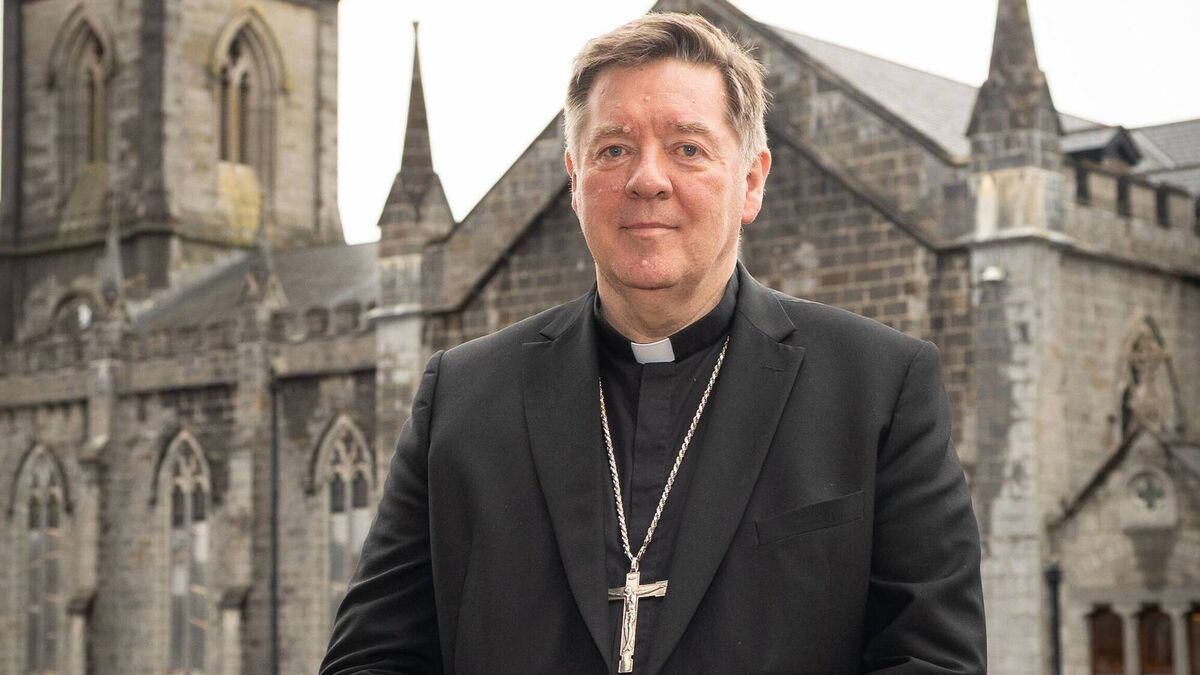
Archbishop Francis Duffy commissioned 18 women and men as Lay Leaders and Funeral Ministers in the diocese of Killala at the Mass of Chrism during Holy Week. Picture: Steve Rogers
Now that Easter is over and that (hopefully) a long and miserable winter is behind us and spring is in the air, we have what will (hopefully) be the prospect of a good summer ahead of us. The early Easter this year augurs well for a long season of light and promise before another winter claims its place.
I always feel that Easter, the great Christian feast of the year, is synonymous with the golden daffodils that almost invariably report for annual duty in such glorious profusion at Eastertime. Symbolic of new life and light they insist on claiming their space, blooming determinedly in spite of the prevailing wind and rain.
This year for me the highlight of Easter was the commissioning by Archbishop Francis Duffy of 18 women and men as Lay Leaders and Funeral Ministers in the diocese of Killala at the Mass of Chrism during Holy Week in St Muredach’s cathedral in Ballina. At the same Mass last year, 62 Lay Leaders and Funeral Ministers were commissioned and this year’s new complement is the result of additional requests for such ministries from the remaining few parishes still to have this ministry rolled out.
As Killala waits to merge with Tuam into a new diocese, and with Archbishop Duffy already in place as Bishop of Killala (with his installation to take place on Sunday, April 26 in St Muredach’s cathedral), it is a source of diocesan pride that Killala now has 80 Lay Leaders and Funeral Ministers to help co-lead with a declining number of Killala priests in a new leadership partnership of laity and priests.
The ‘Killala 80’, as we can describe them, will be badly needed as the number of priests has declined from 64 in 1974 to 25 in 2026 with an ongoing comparative decline in priest numbers expected into the future. The official expectation is that in fifteen years’ time, there will be very few priests left (in the diocese) and that the future of the Catholic Church in Killala diocese will be mainly driven by Lay Leaders active in a variety of crucial lay ministries.
When back in 2015, Bishop John Fleming and the Killala priests decided – prophetically as it turned out – that the future of the diocese would be in the hands of lay women and men and that this indisputable reality necessitated structures to develop and embed new and necessary lay ministries, what emerged was the (PHIF) project that provided the ballast for a range of developments in pastoral care in preparation for the critical years ahead.
One such was the decision to train Lay Leaders – with at the time over 60 women and men volunteering for a course in of two years and three months duration (2023-2025) and developed and delivered by the Newman Institute, and a more recent course with 18 others also delivered by the Newman Institute. Their commissioning, in 2025 and in 2026, has delivered a huge resource of a total of 80 committed people at the centre of the PHIF project that helped deliver a series of developing lay Ministries, including the election and training of Parish Pastoral Councils, co-led Funeral Ministries, the development of lay-led liturgies, the use of lay Ministers of the Eucharist in bringing Communion to the elderly and housebound, a developing youth focus and so on.
While it might seem that the existence and function of Lay Leaders derived solely from the growing scarcity of priests, that’s certainly the case. As the Second Vatican Council underlined, the baptised – women and men have their inalienable rights to ministry in their church and those rights should not be blocked or sidelined – and by extension to block or sideline or discourage lay ministry is contrary to the now obvious need of our Church.
Out of that key principle has come among priests a deeper understanding of the need to consider in their own present ministry not just the pastoral care of their present parishioners but their responsibility as well to support the development of a scaffolding of lay ministries that will secure the pastoral care of future parishioners.
Priests are now very conscious that there’s no guarantee that their present parishes will have a resident priest in the future. And they understand too that, when they retire or become ill or are unable to continue due to ill health or die, part of their legacy to their present parishes includes the steps they took to prepare them for the future challenges that will define their inevitable priestless character.
So front and centre for priests in parishes at present is to resource their present parishes for a priestless future by encouraging and supporting a comprehensive structure of lay ministry and helping to embed it in the lives of the people.
That’s why with this acceptance and understanding, the 80 Lay Leaders and the declining number of priests in Killala parishes going forward are now at the coalface of parish life representing the main ministry in Catholic parishes into the future.
It is instructive that, in his homily at the Chrism Mass during Holy Week at which he commissioned 18 Lay Leaders, Archbishop Francis Duffy placed a clear focus on the importance of the legacy issue and the part commissioned Lay Leaders would play in it. Now taking over a new diocese of 78 parishes – an amalgam of Killala (22) and Tuam (56) – in a clear exposition of the need for a clear focus on what legacy now entails, he placed the 80 Lay Leaders now available from the former Killala diocese as an outstanding resource for the future.
It was too a welcome endorsement of the many who in different ways over the last eleven years had contributed to the project we called with its promise now unfolding.