It's time for Ireland to start dreaming big
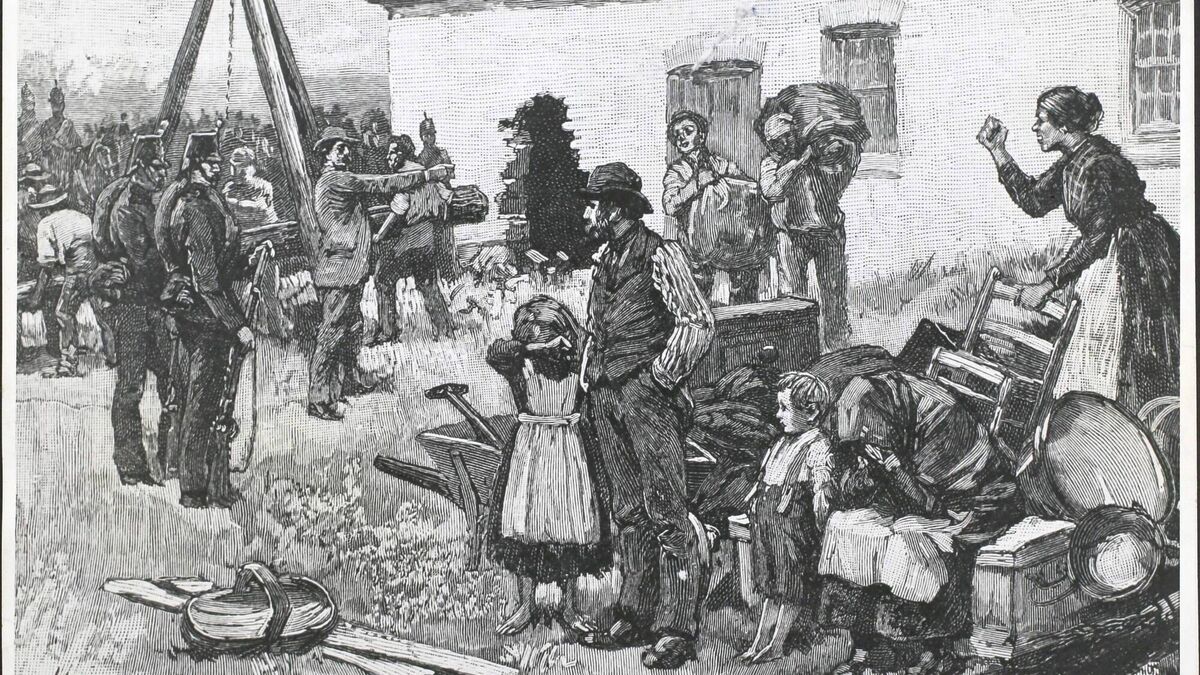
An eviction of a family in Ireland in 1870 when the only options were the workhouse or the emigrant ship. Picture: Hulton Archive/Getty Images
- Morpheus speaking to Neo in the movie (1999)
I once came across a article that struck me as a kind of nineteenth-century version of Neo taking the red pill. Writing in 1864, the Ballina newspaper attempted to explain the seemingly endless tide of emigration leaving the west of Ireland. It blamed landlords and government for treating tenants with a “harsh character”, but what caught my attention was their explanation for why so many ultimately left.
The paper argued that when “a little light broke in” through the national schools and through letters arriving from America, people opened their eyes to possibilities beyond the narrow world into which they had been born. Increasingly, they then chose to leave for “a land where no restrictions are placed on liberty, or advancement in mental, social and material property”.
It was an extraordinary observation.
For those few who have never seen , Neo’s journey is essentially one of awakening. He discovers that the confines of his mundane life, which he thought were real, only existed because he had been conditioned to accept them. It took him swallowing a red pill to finally see the truth.
In many ways, the was describing a similar awakening in Mayo of 1864. When “a little light broke in” through education and emigrants’ letters home, ordinary people suddenly realised that the limiting world they had always known was not the only world possible.
The newspaper was not simply describing poverty. It was describing an ordinary Irish peasant opening their eyes to the emasculating condition which society and their superiors had created for them.
It was Neo awakening from the Matrix, 135 years before he met Morpheus. Once the Irish peasant saw this wider world, many found it impossible to remain content within the narrow confines of the old one and they left for far-off shores.
Education did not merely teach people to read. It taught them to imagine. Letters from America did not merely convey information. They revealed possibilities.
For generations, most in rural Ireland had lived within a social order that offered little prospect of advancement. The Great Famine was not the cause of emigration, but it became the great catalyst through which ordinary men and women discovered that elsewhere people could own their own land, start businesses, secure employment, improve their circumstances and exercise a degree of control over their own lives.
Once that “little light” broke in, many became unwilling to remain within the limits of the old world. The issue was not that they lacked ambition. The issue was that they increasingly concluded they would have to leave Ireland in order to fulfil it.
So, generations of Irish left this island in a bleeding of population that lasted for well over a century. They left for the America described in those letters as not merely richer than poor Ireland. It was more ambitious.
The idea that became known as the ‘American Dream’ was radical by nineteenth-century standards. It held that an ordinary person, regardless of birth, class, religion or family background, could improve their condition through unshackled effort, enterprise and imagination. The reality was often messier than the dream. Many struggled. Many failed. But the dream itself mattered. It encouraged people to think beyond the limits of their circumstances. It rewarded ambition and celebrated possibility.
It attracted millions of people who believed that tomorrow could be better than today. Including countless Irish emigrants.
Indeed, one could argue that America’s rise to become the world’s most powerful nation was not simply a consequence of geography, natural resources or military strength. It was a consequence of imagination. Generation after generation, America attracted people who were dissatisfied with the limits imposed upon them elsewhere. The restless. The ambitious. The inventive. The people who looked at the world as it was and imagined what it might become.
Many of them came from places like Ballina in County Mayo.
I have often thought about that passage in the because it raises a question that remains relevant today.
The tragedy for Ireland was not merely that people left. It was that so many of those who left carried their imagination and courage with them. For over a century, most of our most ambitious citizens concluded that their dreams had a better chance of becoming reality in Boston, Chicago, New York or San Francisco than they did in Ballina, Castlebar or even Dublin.
What happens to a society when generations grow accustomed to looking elsewhere for opportunity, validation and advancement because it was not possible in their native land?
There is an old story about circus elephants. When young, they are tied to a heavy stake by a strong rope. No matter how hard they pull, they cannot break free. Eventually they stop trying. Years later, as enormous adults capable of uprooting trees, they remain restrained by nothing more than a thin piece of twine. The rope no longer holds them. Their memory does, being stronger than any binding.
The people described by the were not irrational. Against them stood landlords, government, social hierarchy, custom and the largest empire the world had ever seen. It was perfectly understandable that many concluded the opportunities they sought would never emerge at home.
The rope was real.
But over a century after independence, much of that mentality remains. Not because Ireland lacks opportunity. Quite the opposite. Ireland today is wealthier, freer and more successful than at any point in our history.
And yet I sometimes wonder whether we have fully realised it.
The modern Irish State possesses resources that previous generations could scarcely have imagined. We have one of the highest standards of living in Europe. We have a highly educated population. We have a thriving technology sector. We have budget surpluses and sovereign wealth funds. We are debating what to do with billions of euro in windfall tax revenues including the Apple back-tax settlement of some €14 billion in accumulated interest, “imposed” on us by the EU Court of Justice in 2024.
For the first time in our history, it is not fanciful to say that Ireland possesses both the money and the expertise to shape its own future. Yet listening to much of our public debate, one is struck by how little imagination it contains.
We discuss what can be managed rather than what can be achieved. We debate constraints rather than possibilities. We focus on what might go wrong rather than what might go right.
Take housing. Ireland faces a crisis that demands solutions on a grand scale. Yet much of the conversation revolves around Kafkaesque regulations, incremental measures, procedural reforms and small adjustments. Where are the serious discussions about entirely new towns and cities?
Where are the plans for modern rail infrastructure connecting our airports, regions and capital?
Why does Dublin remain one of the few capital cities in Europe pathologically reluctant to build upwards despite a desperate need for housing and despite the obvious environmental advantages of reducing endless suburban sprawl?
The same applies elsewhere.
Why should Ireland not aspire to become genuinely energy independent?
Why should we not seek to become the leading European destination for scientists, researchers, educators and innovators?
Why should local government remain among the weakest in Europe when stronger local democracy might empower communities to shape their own futures?
Why should we not make the preservation of our heritage a national mission, rewarding landowners who protect archaeological monuments, restoring neglected sites and investing in history, language and landscape with the same seriousness that we invest in roads and buildings?
Every one of these ideas involves risk. Every transformative decision always does. The Ardnacrusha hydro-electrical power station was once considered ambitious.
The economic reforms of Seán Lemass and T. K. Whitaker were once considered ambitious.
The people who proposed them are remembered because they were willing to think beyond the assumptions of their age. Today, by contrast, much of Irish public life feels managerial rather than visionary.
Our institutions are often populated by competent people whose primary task is administration. Their job is to keep things running smoothly, minimise risk, follow procedure and avoid mistakes. They operate in a culture of the past when Ireland was broke and every penny had to be pinched. When thinking small was rewarded and ‘having notions’ wasn’t.
There was value in that mediocrity. But no great society was ever built solely by administrators and we no longer live in the 1960s, never mind the 1860s. This legacy of the old mentality still lingers. Not necessarily in self-hatred. Certainly not in a lack of talent. But in a lingering hesitation about our own capacity for greatness.
For generations, Irish people learned that the biggest opportunities lay elsewhere. The most ambitious projects happened elsewhere. The great cities were built elsewhere. The transformative ideas came from elsewhere.
The people who took the red pill emigrated. They were usually right to do so as the opportunities genuinely were elsewhere. But in our Ireland of 2026, someone has to stay and imagine. Someone has to ask not merely how things work, but how they could work better. Someone has to think on a scale that initially appears unrealistic. Someone has to dream.
The empire is gone. The landlords are gone. The Catholic church-dominated, repressive, poor, insular society is gone. But have we fully accepted that the world described by the no longer exists? Or are we still, in some small way, behaving as though it does?
The lesson of the was that once “a little light broke in”, ordinary people became unwilling to accept the limits imposed upon them.
Perhaps the challenge facing Ireland today is similar. To look anew at the world and our place in it. Not to fear progress and change, new immigrants, new ideas, new communities, a new democracy. Not to leave in search of a bigger future but stay, build and create while supporting our leaders, educators, advocates and entrepreneurs who aim to lead us there.
The rope is gone.
The matrix only exists in our heads.
It’s time to wake up and dream big.