Ireland's view of Brussels needs to change
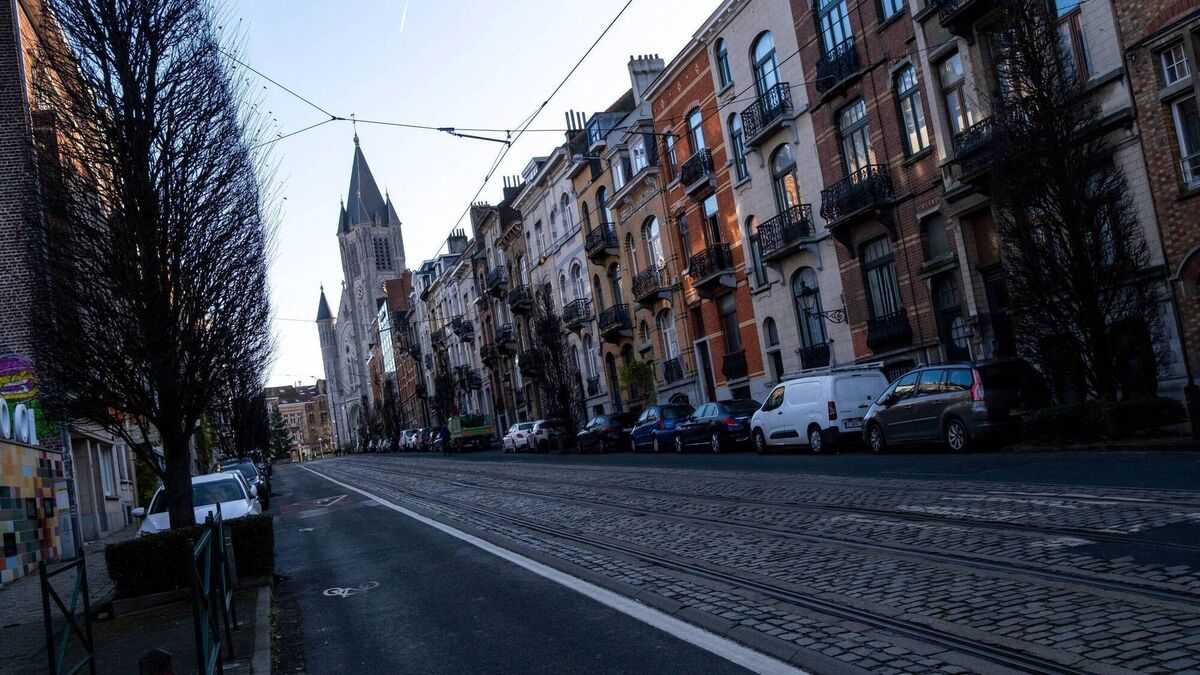
A tram street lined with parked cars and row houses leading to a church tower in Etterbeek, Brussels. Picture: Martin Bertrand/Hans Lucas/AFP via Getty Images
Brussels for us is more than a place. For when we say ‘Brussels’ we don’t mean the city: we mean either the European Union (EU) as an institution or use it as shorthand for a set of rules. And often we decide to say ‘Brussels’ based on the point of view we wish to express. When we choose to talk of ‘the EU’, we are usually talking positively, or with respect to some challenge it faces. But when we talk of ‘Brussels’, we are often talking about something we don’t like.
‘Brussels’ has come to be a shorthand in that way because it is the capital of Europe. That’s a big claim for any place but a fair one in this case. When you go there, as I did last week, what is striking is how small the actual city is. Small for a capital of Europe that is. It’s a perfectly decent sized city to be capital of Belgium. But for the capital of Europe?
Of course it was chosen as the capital precisely because of its size. When the then European Economic Community (EEC) was founded in 1957, it had one big job: to bring France and Germany together so that they wouldn’t go to war with one another anymore.
That meant the capital of this new international entity couldn’t be in either France or Germany. The new institutions of this new ‘European Economic Community’ had to be located somewhere relatively small, somewhere reliable and, crucially, somewhere that was neither French nor German. Step forward Brussels.
Brussels of course has another reason to be the European capital. It has good experience as the capital of Belgium in reflecting the complex mix that makes up European people. Belgium, with its French, Dutch and German speaking communities, is a little European union all of it itself.
‘Belgium’ is made up. It – and the idea of being Belgian – was created in the 1830s. Nobody in Belgium speaks Belgian. Almost everyone speaks either French or Flemish, which is essentially Dutch, with a small German-speaking community in the east of the country.
How that arose is a very complicated story. Over the course of time, rulers of what are now France, the Netherlands and Germany all tried to control the territory that is now Belgium. None succeeded, and so creating Belgium as its own state was the solution. It exists because it was an acceptable compromise - or a stalemate - between all those other nationalities. Better to have an independent Belgium than have it controlled by one of your neighbours, was the idea.
Historically, what united the people of Belgium - whatever language they spoke - was their Roman Catholicism and their King. Nowadays it is probably also their soccer team. The French and the Flemish speakers - and those few Germans - live in their own regions, with their own local laws, local government, customs and institutions. But they all come together as Belgians for certain things. And the Belgian institutions that give effect to that are located in Brussels. So Brussels is where this language mix meets, which is why every street sign in the city is in two languages.
With that kind of history and dynamic, Brussels is the perfect capital of Europe. The EU and Belgium do a similar job - create shared institutions between people with some shared interests, but also with lots of differences. This is why John Hume always spoke of this model of what was needed in Ireland to bring people of different identities and traditions together, recognising difference and finding ways to accommodate them. Indeed, if a United Ireland ever did come to pass, the reality is that it would have to look a lot more like Belgium than our current state.
As the EU capital, Brussels is the place where European-wide shared interests and differences are reconciled. That happens in a set of institutions, many of which are located in the city. The European Commission is located there permanently. The European Parliament sits there most of the time - it goes to Strasbourg for the rest. The European Council - where the Heads of Government of all the member states make big decisions - also meets there.
What is our relationship to the city and why does that matter? We have a major interest in making sure those Brussels-based institutions make good decisions and take good actions. That is not least because all our trade - and thus our income - is shaped by what happens there. We of course want to try and influence them to reflect Irish interests as much as possible, but we also need to recognise that an EU as large as it is cannot both be an effective actor in the world and give us everything we want.
We need to appreciate that give and take and the big picture. An EU that doesn’t function well on the big stage is a hazard to us. The Irish used to have a reputation for being great players in Brussels. We produced officials in the EU institutions at all levels who understood both the importance of EU effectiveness, and the importance of Irish interests. We had a political scene back at home where this was also widely understood.
There is a feeling that that track record is being challenged. Our news and public debates are too often dominated by the local or by things over which we have no influence whatsoever. What happens in Brussels - where we have both interest and influence - too often loses out in our focus, and fewer of our brightest and best young people are choosing Brussels as the place to make their career.
There is also a sense arising that our view of ‘Brussels’ is becoming more and more transactional. If the EU doesn’t do exactly what we want, we will complain about ‘Brussels’ and blame it for our ills. That approach will lead us into a cul de sac.
With bullying and hectoring and raw power deciding more and more questions in the world, there has never been a greater need for us to sit within the EU. Sure we won’t win all arguments or get our way on everything. Sure we will have to think hard, and perhaps uncomfortably, about how we can give as well as take. And sometimes the bizarre positions we take up - trade deals come to mind - will cause us to lose influence and our reputation for seriousness among decision makers. But the world we are living in, and the world we are facing, mean we need to be connected to Brussels, and what goes on there, more than ever.