Ireland needs a Plan B if the EU were to fail
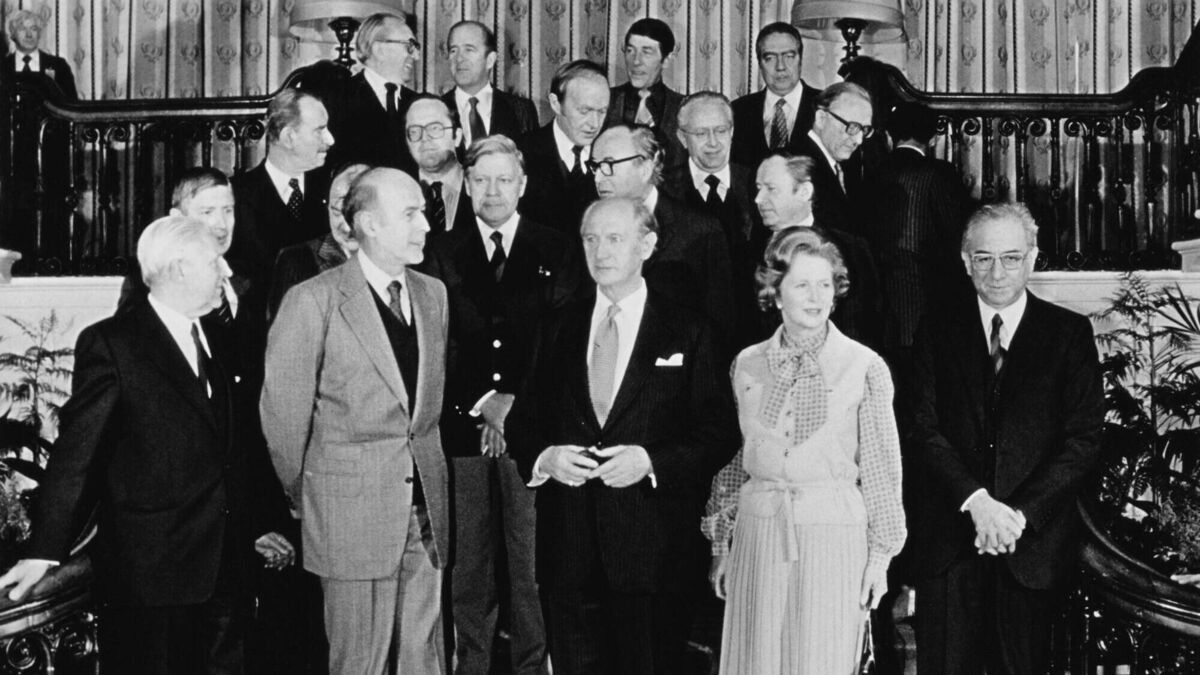
European leaders at a European Economic Community (EEC) summit in Dublin in December 1979, hosted by then Taoiseach Jack Lynch. Included are French President Valery Giscard d'Estaing, British Prime Minister Margaret Thatcher, Italian Prime Minister Francesco Cossiga, German Chancellor Helmut Schmidt and President of the European Commission, Roy Jenkins. Picture: Keystone/Hulton Archive/Getty Images
What will we do if our way of making our way in the world disappears? What happens then? We had better get our thinking caps on because we might just need to know the answer.
We make our money in Ireland from being in the European Union (EU), from our membership of the EU’s Single Market. The sharing of our decision-making powers – and thus our sovereignty – with our fellow EU member states is how that market operates and survives. We got a lesson on that during Brexit. That is our Plan A.
We should be under no illusions about how important it is. You can list off all sorts of industries and sectors of our economy that don’t trade into the Single Market, and that list might seem impressive – and it might fool you. Because if we weren’t in the Single Market, most of those industries wouldn’t amount to much. Why? Because they rely on the income and wealth that comes from our primary source of both: the EU’s Single Market. And if you looked at what we would take in and have to spend without our Single Market membership, you would be looking at a lot less money to pay pensions and social welfare, and for hospitals, and all the rest of it.
Our business model rests on membership of the Single Market, which sees American companies invest here to sell into big European markets, like France. It’s the third business model we have had since independence. From 1922-'32 we went for political independence without changing much about the economy. We painted the post boxes green and hoped we could continue to sell cattle to England without customs duties. We were under England’s thumb economically as sure as we were in Daniel O’Connell’s time.
From 1932 until the late 1950s, with a more nationalistic mindset driving us on, we went for protection. Close ourselves off to the world, put up high tariff barriers, and try and build a few essential industries to sit alongside a primarily rural economy. We removed the oath of allegiance to the King, we got rid of the Governor General, we gave ourselves a new constitution. Politically a lot happened. Economically, less so.
Because by the 1950s the absolute absurdity of a small country with no native capital trying to go it alone was laid bare. Like a star dying, by 1959 the country was collapsing inwards. While the rest of Western Europe boomed post war, we were on the verge of becoming a failed state. The population was declining as everyone with energy and who had the means got out – many of them to build England, not Ireland.
From then on, we opened our economy; invited inward investment; made things here to sell them elsewhere; educated our people to work in the industries this policy would create. For all our problems today, Plan A has worked really well. It has transformed us.
If the EU and its Single Market were to fail over the next few years, we are going to need a Plan B.
Why would it fail you might say? Well, if you listened to what makes up much of our national debates about international matters, you might well wonder why anyone would think such a thing. But what have we learned over the last few years is that just because something exists doesn’t mean it is going to continue to stay that way.
There are plenty of reasons that the EU might fail. We now know that the American government openly opposes the continued existence of the EU. You might say in response that this is only one of President Trump’s more wild schemes, and it might not come to anything. But the fact that it is being openly promoted should make us stop in our tracks, because it was once unthinkable and now it isn’t.
We also all know the pressures on the EU from the other side of our continent, and on top of that, many people inside the EU itself want it gone. The French state is overwhelmed with debt. The government can make no significant decisions, hopelessly caught between extreme left and extreme right views – both of which are opposed to the very basics of the EU. If one of those forces win the French Presidency next time, the EU is in big trouble. And that is only France.
What would we do in the scenario of an EU collapse? Will we have to go back to protectionism? Put up tariff barriers to Make Ireland Great Again? You might say that we would never do that, but if there is no EU, we will find that the tariff barriers are in our face not in our power. When you are small and rely on exports, it’s not much of a strategy.
Some might say don’t worry, look at Switzerland and Norway: they’re small and they manage just fine without the EU. Well, I suppose they do if you don’t factor in that they align their economies and pay a load of money to access the EU Market. But even if you discount that, do we have enough capital built up here in Ireland, like Switzerland, the holder of vast amounts of the world’s wealth, to try and go it alone? Could we amass an almost $2 trillion sovereign wealth fund like Norway has? And they didn’t get it from selling fish, but from finding gas in the North Sea. Maybe we can hope to discover a natural resource like that, and live high on the hog off it, but it doesn’t seem very likely.
And so, if the EU fails, will we not find ourselves inevitably back under the economic control of our nearest and biggest neighbour? Because in a world where we don’t have an EU, big states will dominate small ones as sure as night follows day. That is why so many people around the world want rid of it.
If you hear any voices around here agreeing with them, perhaps you might ask how they see our future unfolding once the EU is gone. And if they tell you all about the problems and limitations of Plan A by way of response, you might remind them that’s not actually a plan.