How rage bait became our daily bread
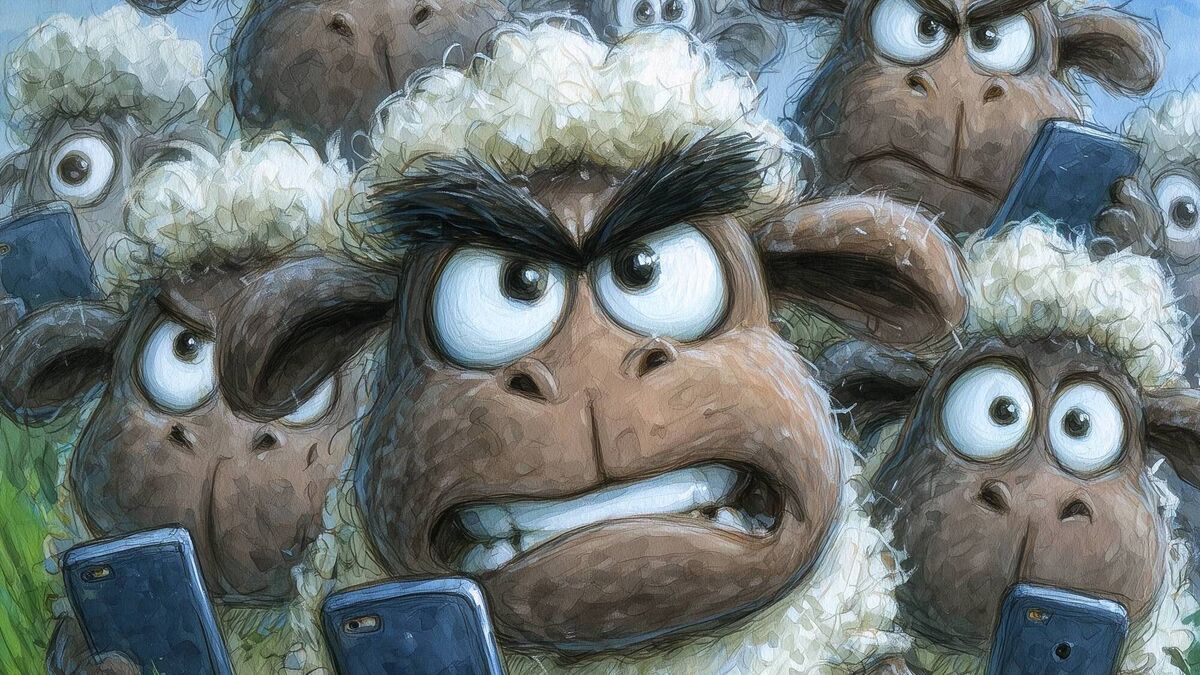
Next time you're you're about to type a furious response on social media, will you pause and wonder are you the 'farm animal' rage baited? Illustration: Conor McGuire
The woman filming herself in tears because her €400 facial left her skin “only” 98% perfect knows exactly what she's doing. So do you, when at three in the morning you start typing out some cutting remark about her narcissism that you'll delete before breakfast. The difference is she's getting paid for this little transaction while you're just donating your insomnia and self-respect. She's a farmer and you're livestock. And somewhere in Silicon Valley, an algorithm is making a note that you both performed beautifully.
The Oxford University Press, in its infinite wisdom, has christened “rage bait” the word of the year for 2025, a phrase that has been spreading online since 2002 but it’s taken until now for it to go viral. Not unlike a rash that finally gets bad enough to see a doctor about, even Oxford’s official definition resembles a medical examiner’s report, spotlighting content designed to elicit anger or outrage by being frustrating, provocative or offensive. It's the same energy as calling murder “unlawful death”; you've simply named the thing without capturing any of its texture, its particular awfulness.
What fascinates me isn't that manufactured rage is thriving, but that we've industrialised and monetised it. We humans have been baiting each other with lethal efficiency since Cain got jealous about God's barbecue preferences. There are people making six figures by posting videos of themselves pretending to be so pretty that everyone in the coffee shop stops and stares. The cruel genius of the pretence is that the more you tell them they're delusional narcissists, the richer they get I know people who work in advertising. They're the sort of people who use “synergy” unironically and think a good meeting is one where someone cries or has an emotional meltdown. Even they should be disturbed by what's happening. The old internet was about clickbait – headlines that made you curious enough to click through. “You Won't Believe What Happened Next!” That sort of thing. Annoying but essentially harmless, like a persistent door-to-door salesman. This new incarnation is something darker. It's not interested in your curiosity. It wants your rage. It needs your rage. Because rage is the premium fuel that makes the algorithms sing.
The psychology behind it is almost embarrassingly simple, manipulating the knowledge that we are hardwired as a species to pay attention to threats. When our knuckle-dragging ancestors confronted a sabre-toothed tiger, they didn't stop to admire its coat, but either fled or died. Social media has figured out how to hijack this ancient survival mechanism, manufacturing wilfully outrageous content that triggers our threat response that transmutes into rage. Unwittingly, we start commenting, sharing, quote-tweeting, doing the digital equivalent of standing in the town square screaming at pretentious strangers. The algorithms see all this engagement and think: “Excellent! The humans love this! Give them more!” So we get an endless stream of political and topical posts that aren't designed to inform but to inflame outrage. Recipe videos where someone pours an entire bottle of ketchup into carbonara just to watch the Italians lose their minds. Lifestyle influencers whose biggest problem is being too wealthy and beautiful. It's cynical, manipulative and profitable – the holy trinity of modern media.
We Irish get this, to a point, I think, as it echoes our old relationship with our beloved ‘slagging’. We've always had a cultural gift for the cutting remark, the backhanded compliment, the ability to take someone down a peg with surgical precision. But rage bait begets ‘slagging’ stripped of wit and weaponised for profit. It’s all the anger without any of the artistry. At least when your pal was destroying you over some unchecked pretence, he had the decency to be entertaining about it.
Some creators are pulling in over a hundred thousand pounds a year, specifically from hate engagement. Their entire business model is predicated on making you so angry that you can't help but respond. They're emotional pickpockets stealing your wallet and knowingly sowing seeds of anger while harvesting your fury to sell to advertisers. One notable creator, an average-looking 24-year-old woman who pretends to be an unbearably vain model, claims every video that gets millions of views does so because of hate comments. “I get a lot of nasty comments,” she admits, they being the true barometer of her success.
The platforms claim they're working on it, and Meta said something vague about getting engagement-bait “under control”. X changed its monetisation model to reward a more wholesome audience interaction instead of just ad views, which feels a bit like treating a gambling addiction by switching from slot machines to roulette. The unsuspecting consumer is still in the casino – and the house always wins. TikTok and YouTube have rules about demonetising misinformation yet rage bait lives in a grey area where nothing is identifiably false, but it's just infuriating. And infuriating, it turns out, is perfectly fine.
What bothers me most isn't even the creators. They're just responding rationally to perverse incentives. If someone told you that you could earn your annual salary by pretending to be insufferable online, quite a few of us would at least consider it. No, what bothers me is what this is doing to the rest of us. We're becoming a society of people who've been trained to respond with fury at the drop of a hat. We're jumpy. Exhausted. Perpetually angry about things that don't matter while the things that do matter slide past unnoticed.
Last year's word of the year was “brain rot” – that graphic phrase for the mental deterioration caused by consuming too much trivial digital content. The relationship between brain rot and rage bait isn't coincidental. They're two sides of the same cursed coin. First, the endless scrolling dulls your ability to concentrate. Then, the rage bait hijacks whatever attention you have left. It's like someone giving you a sleeping pill and then setting off fireworks in your bedroom.
There's a deeper irony here that Oxford's lexicographers probably enjoyed. By choosing “rage bait” as their word of the year, they've entered the same ecosystem they're describing. Every year, people get furious about the word of the year. Too trendy. Too American. Too online. In 2015, when they chose the tears-of-joy emoji, traditionalists lost their minds. Oxford knows this. They know that whatever they pick, a portion of the word-loving public will flame out online. But they do it anyway, because – and here's the uncomfortable truth – being talked about is better than not being talked about. Even Oxford isn't immune.
So what do we do about it? The easy answer is just to stop engaging, to let rage bait wither on the vine from lack of attention. But that's asking our species to override millions of years of evolution voluntarily, to see something outrageous and just scroll past. It's like asking fish not to swim. We can know intellectually that we're being manipulated and still fall for it. Knowledge isn't protection when the manipulation operates below the level of conscious thought.
Perhaps the real question isn't how to stop rage bait but whether we're willing to recognise that it's turning us into a culture that runs on manufactured outrage and that's quickly forgetting how to think. We're so busy being angry about performative nonsense that we've lost the ability to be appropriately angry about things that actually matter. It's emotional inflation – when everything is outrageous, nothing is.
I've weaned myself off Twitter – sorry, X – many months ago, and I can't say I miss it. What I miss is the idea of what it was supposed to be: a digital town square where ideas could be exchanged and connections made. What it actually became was a rage farm where crops are harvested three times a day, the farmers get rich while the rest of us just feel exhausted, and the same strategy is in place across multiple platforms.
Part of me thinks we're probably doomed as these nasty algorithms are just too efficient. For the purveyors of calculated rage, the monetary incentives remain too powerful while our human vulnerability to emotional manipulation remains so profoundly unchanged over the millennia. So we'll keep clicking, needlessly commenting, feeding the beast while telling ourselves we're sophisticated, that we're onto the game, but in truth, the game is onto us, and it's on a winning streak.
Still, I can't help thinking about what happens when a word becomes so ubiquitous that it loses its power. Maybe that's what Oxford has done here – not just named the phenomenon but inoculated us against it slightly. Every time you're about to type that furious response, maybe you'll pause and think: Am I being rage baited? Am I the farm animal here?
And if that makes you angry, well, you're probably proving the point.