How one telegram altered the course of history
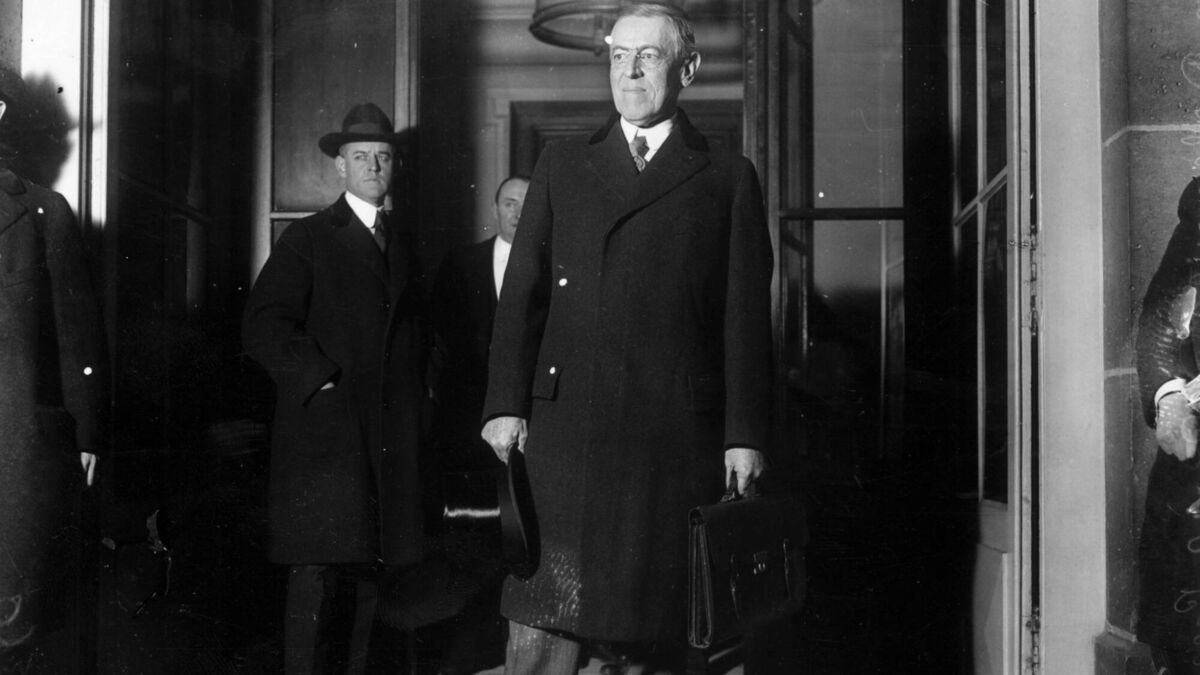
American President Woodrow Wilson (1856-1924) leaving the Quai d'Orsay at the start of the Paris Peace Conference known as the Treaty of Versailles. At these talks a peace treaty signalling the end of World War I was signed between Germany and the Allied Forces, and the League of Nations was established. Picture: Hulton Archive/Getty Images
You may never have heard of a fella called Arthur Zimmermann, but the hacking of a message belonging to him ranks in the top events of this past hundred years or so. It helped shape the fortunes of this country in profound ways.
That hacked message was a telegram sent on January 17th, 1917. It was sent by Zimmermann, then a senior official in the German Foreign Ministry, to the Mexican government.
The background was World War I, which by that stage had been going on for two and a half years. There was stalemate with the Western Front a series of trenches where men died in their thousands for a few metres either way. No one thought that the war could be won militarily.
To try and break the stalemate, the British used their fleet to block supplies getting to Germany - a measure designed to starve them out. The Germans called the winter of 1916-17 the ‘turnip winter’, which will tell you about the effectiveness of the strategy.
The Germans in their turn needed to break the flow of supplies to Britain but their fleet wasn’t powerful enough to defeat the Royal Navy. They had tried and failed in the naval Battle of Jutland the previous year. So the only way to do it was by allowing German submarines to sink any vessel - military or civilian - which they saw was on course for Britain. Many of those vessels were American. To sink them would risk war with the United States.
With their people getting hungry, the German high command decided that was a risk they needed to take. But should such a war start, to distract the Americans, and to give themselves time to win the war in Europe, they came up with a plan to delay them. That plan was contained in the message from Zimmermann.
It was an offer to the Mexican government. It proposed that should the United States go to war with Germany, the Germans would offer Mexico an alliance and support it in a war to win back Texas, Arizona and New Mexico - territories which the United States had annexed from Mexico in their war of 1846-8. The German idea was that if the Mexicans attacked the United States, the Americans would have to fight and defeat the Mexicans first, delaying them from sending their forces to Europe. In that delay, the Germans would win in Europe.
There were many problems with this plan, not least that the Mexicans were in the middle of a Civil War. But the most significant problem was that the message from Zimmermann was intercepted and decoded by British intelligence. It was then shown to the American President Woodrow Wilson on February 24th. Wilson read that Germany was proposing to help Mexico conquer large parts of the United States. You can imagine his response. He stewed over it all during that last week of February before publishing it on March 1st. The reaction in the United States led directly to their declaration of war on Germany in April that year.
The rest, as they say, is history. But that history is important, because when the United States entered World War I, it ushered in the American century. The century in which the United States dominated world affairs. The century in which we in Europe lived in a security environment built around that reality. That was a big change.
Prior to February 24th, 1917, the United States had broadly followed the advice of its first President, George Washington. In his last address as President, he had warned his country to stay out of foreign entanglements. He did not want the United States to get involved in the pattern of European wars – of ever shifting alliances – that characterised the Europe of that time. Most of the Presidents who followed him agreed with that approach.
As a result, the United States stayed out of the Napoleonic wars from the end of the 18th century into the early 19th. The United States stayed out of the wars of German unification from the 1850s to 1870. The United States did not take sides at the start of World War I, even though its sympathies - and, vitally, most of its sales - were to the Allies.
The United States fought wars during this period sure enough, but they didn’t get involved in European alliances. They did most of their fighting on the American continent – including during their Civil War, where they fought amongst themselves, and some imperial adventures elsewhere in the later part of the 19th century.
This period of isolation from wider international events and especially European alliances ended with the interception and revelation of that telegram from Arthur Zimmermann. The proposal in that telegram might seem utterly crazy to our eyes now, but the tactic was much the same as led to German arms being sent to Ireland for the Rising. If the Mexicans had taken up the offer - they didn’t - they would no doubt have mentioned the support of ‘gallant allies in Europe’ in their proclamation of war.
The net effect of the telegram was the complete opposite of the intention: Mexico did not attack the United States but the United States sure did attack Germany, and that support was vital to the Allies winning the war. The victory though led to a reaction. Many Americans came to resent their involvement in the war, feeling Europe was no business of theirs, and so the period from the end of World War I until the beginning of World War II saw the United States retreat even further from involvement in Europe. But that was a temporary halt. When the Japanese attacked Pearl Harbour in 1941, Hitler made the fatal mistake of declaring war on the United States, and that changed the dial fully back. The Cold War - and fervent anti-communism - kept them in Europe this time.
Even with the fall of the Berlin Wall, American involvement in European affairs did not pause from that point on until the election of Donald Trump - and arguably not until his second term. That involvement was threefold: political, military and economic. We of course don’t talk about political and security matters except when we are making sermons. But this is not unconnected or abstract stuff for us. The economic involvement of the United States in Europe is how we transformed from a poor to an advanced society. The security and political connections is how that economic system is maintained.
Now we face a big change again and a new reality. Will this new American approach to Europe become permanent, or will it prove to be temporary, like it was between the world wars? On that question, much depends, and nobody knows.