Housing to dominate agenda again in 2026
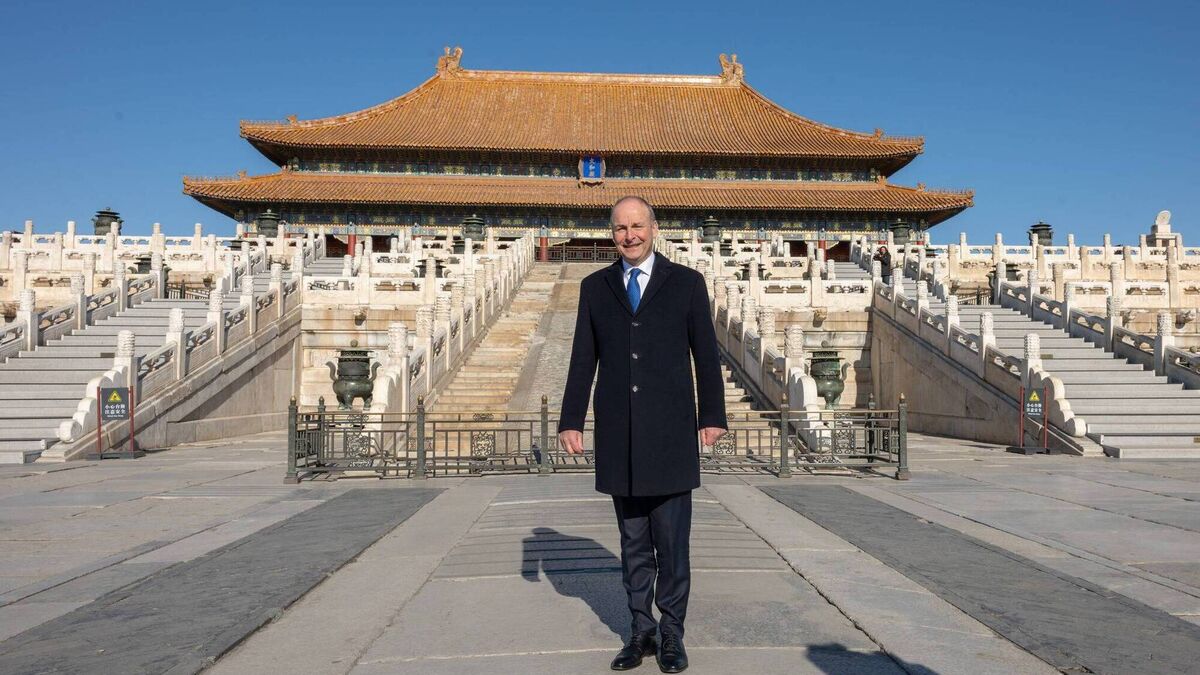
An Taoiseach Micheál Martin visits the Forbidden City in Beijing during his state visit to China.
2026 starts with a lot of clouds overhead. The international system is volatile and unpredictable. Our problems on the domestic front seem intractable, even unsolvable. So what will the year bring us politically?
We should start with our biggest problem: housing. It is the most difficult problem we face and there is a widespread sense that we are not going to be able to fix it. There is certainly no confidence or even optimism that we can.
The housing issue has developed in stages: from being a problem in our society into a phase of crisis which now risks spilling out of control, becoming a fundamentally destabilising factor for us all. That is reflected in people’s attitudes and thus our politics in a wide range of seemingly unconnected ways.
If young people can’t buy a house, or rent a decent one at a reasonable rate, the societal consequences are disastrous. Fewer young people are marrying, they are having fewer children, and they are having those children later in life.
Many young people are wondering why they should work really hard and get a decent salary when all that will do is get them stuck in private rental: with too much means to access social housing and not enough to buy privately.
That is of course only one dimension to the housing crisis, but it is very real and does not always get the attention it requires. It cannot be allowed to linger and become embedded. Your political outlook – whether you are left or right – is irrelevant to that. If young people do not see an incentive to get on in their life and in their career, then we are in deep trouble.
It is already a pervasive feeling among them. And that social effect of the housing crisis is felt more widely in our politics. For those of us of an older generation, who simply cannot understand how young people could sing ‘ooh ah up the Ra’, we must remember that social crises and politically radical views are connected. The first leads to the second.
So throughout 2026, the government is going to be hoping that the measures it adopted in 2025 start to bear fruit in terms of new starts and new builds. The political heat map will change in response to that. Objections to new housing will be more harshly analysed and treated. But the fundamental generational fault line in our politics won’t change: many who have good housing will place much less priority on – and even sometimes resist – the actions that are required to house those who don’t.
Another area where political actions in 2025 will shape the political year of 2026 is with respect to the Presidency. One of the political questions of the year will be to what extent and on which issues President Connolly will openly challenge and contest government policy. Her supporters will argue that she was elected to do so. Politically, they may have a point. Constitutionally, less so.
How that plays out in the context of the frankly wild international situation we have right now will be one of the political interest points – and fault-lines – of 2026. The government remains committed to removing the ‘Triple Lock’, the provision that states a United Nations Security Council resolution for an action is needed before Irish troops can serve abroad. President Connolly’s view is diametrically opposed to that of the government. How that plays out will be a test of both strength and resolve between the two.
Of course, now that literally the entire system of international relations and stability is collapsing around us, some may well see a debate on the Triple Lock as falling somewhat below the level of events. Others may point out that a country which has decided to oppose the Mercosur trade deal, just at the moment when the international trade which has made us prosperous is under direct attack, can hardly be said to be engaging at the highest level in general.
In that kind of context, it might have been best to hide away in the corner in 2026 and hope we wouldn’t be noticed. But 2026 won’t be that kind of year, because the second half of the year will see the European Union Presidency in Ireland. That means that most of the big decisions or indecisions the EU will make in that period will happen here. By then, our European partners may have decided – or have had it decided for them – that they need to create a European Defence Alliance to succeed NATO. Reforming the Triple Lock will seem like small potatoes then.
Luckily, and perhaps also unluckily, for the government, the pot of money from Corporation Tax keeps on growing. It’s marvellous of course to have loads of money flowing in and it is very easy to spend. But it is awfully hard to keep the public finances in check in that context. Let’s hope that whatever is bringing in that vast sum of money doesn’t change. But don’t think for a moment that we have any hand, act or part in whether it does or not. And if the money dries up, in 2026 or after, our politics will change, whatever the rhetoric on all sides.
The other big political change seen in 2025 which will play out in 2026 is the government’s new line on immigration. The government will continue to take a series of actions on the issue, while trying not to inflame the situation. The opposition will probably find their response to this challenging, partly because public opinion on the issue is pretty clear, but also because there will be different views on the issues within the parties that would make up a potential left government.
Lastly, in 2026, the Taoiseach will be in his last full year in the office. According to the coalition deal, the swap over to the Fine Gael leader as Taoiseach is scheduled to take place in November 2027. Some of the Taoiseach’s critics in his own party will spend time in 2026 trying to make sure he doesn’t get there. A man who has been leader of his party since 2011 presumably has other ideas, and his own timescale in mind.
But on that, and on almost every other political matter at the moment, we can expect to be surprised by 2026 whatever our predictions are right now. Things are moving so fast we don’t know where we will be next week, never mind by December. But there is one thing we can be sure of, alas: by the end of the year there still won’t be enough houses for all the people who need them.