History shows that tradition is not sacrosanct
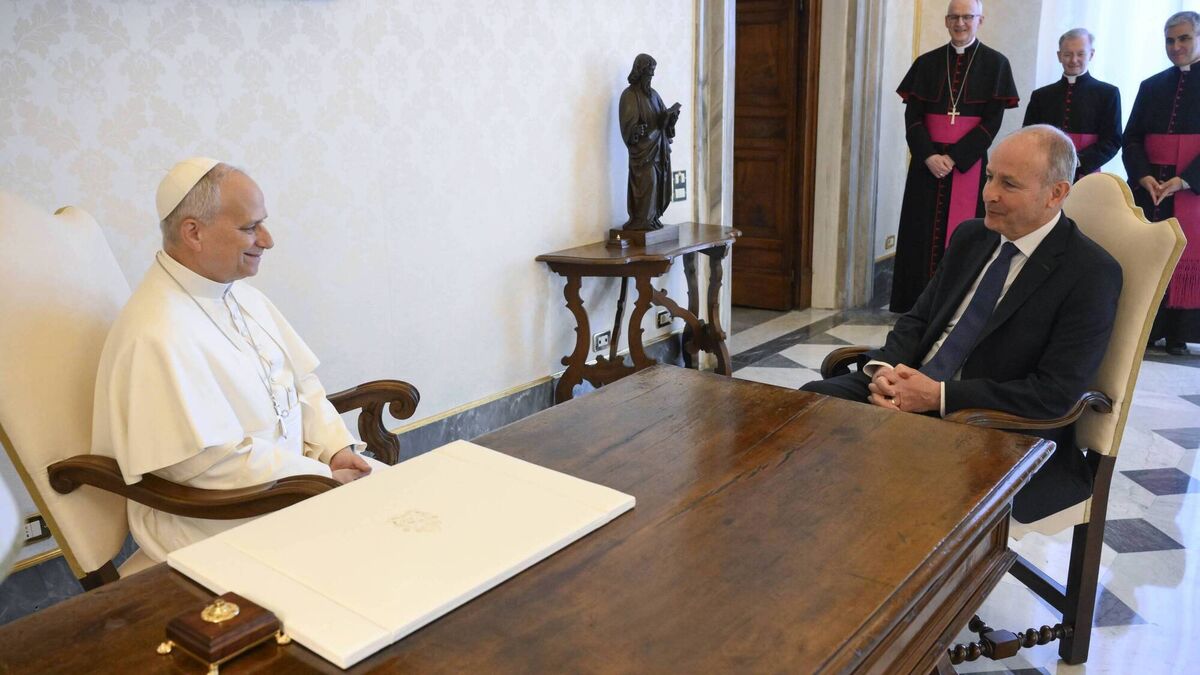
Taoiseach Micheál Martin meets with Pope Leo on a state visit to the Vatican last month.
The most compelling question at present facing the Catholic Church in Ireland is the imminent disappearance of what has been a central and fundamental experience of Catholic life for centuries. It is this: in less years than we can count on the fingers of both hands – in other words in less than a decade – the provision of the central form of Catholic worship, the Mass, will begin to disappear, effectively, from Irish life.
This will happen for two very obvious reasons. One is that priests in Ireland are getting older and fewer and the overall number, for many years in free-fall, is now approaching a steep cliff-face. The second is that, extraordinarily, despite the fact that the word ‘crisis’ seems an accurate description to describe our situation there seems to be almost an official policy of ignoring this ‘elephant in the living room’.
Regular readers of this column will know that for many years I’ve traced this decline and I’m very aware that in raising this issue again, I’m covering old ground here and I need to apologise upfront to my regular readers and to crave their indulgence in repeating myself - yet again. I’m very conscious that in repeating myself I’ve become a Cassandra figure warning about the equivalent of the fall of another Troy and nobody is listening.
So, once more with feeling, here goes.
This ‘crisis’ is almost upon us because we are finding it difficult, if not impossible, to accept what for many are obvious solutions. Let’s put it in the starkest terms.
Without priests there will be no Mass and without Mass there will be no Catholic Church. There could be sufficient priests if we were prepared to countenance changing the present celibacy requirement for male priests and/or ending the present ban on women priests.
While it’s clear that both options are available and support for both is widespread among Catholics, both have been consistently avoided for centuries. But there seems to be no discernible appetite among Catholic Church authorities for belling this particular cat. Indeed the opposite seems to be the case, as the effort to ordain women deacons - what seems little more than a gesture to the central role women could play in Catholic life - has become illustrative of a constitutional incapacity to respond in any substantive way to the growing crisis. While some Catholics including many women see this as indicative of a fundamental prejudice against women - or even that contempt for women that we call misogyny - in Catholicism, authorities sometimes actually compound that diagnosis by self-consciously just looking the other way. There seems to be no prospect of movement as Catholicism seems forever stuck between that rock and this hard place.
So what can we do about it? The answer seems to be some version of that typical Irish response to sorting impossible dilemmas - ‘very little if anything at all’. But we could ordain married men (as distinct from waiving the celibacy requirement for ordination). And no doubt we will - eventually - before the last priests in Ireland have gone to God. But we’re keeping our powder dry for the moment.
We could welcome back priests who have exchanged the ordained ministry for a lay married life if they wanted to come back but that’s deemed unlikely - even though Pope Benedict in his day extended the same offer to Anglican clergy and indicated in so doing that marriage was not officially regarded as an insurmountable obstacle to ordination.
We could, and no doubt one day we will, ordain women and wonder aloud why it had taken us so long to see what so many are now accepting, including many theologians, that there are no credible theological reasons for banning women from ordination and that women’s ordained ministry has been sacrificed for centuries on the altar of an unwise respect for tradition at the expense of the rights of women and the needs of our Church.
But we are not allowed to go there yet. However, the bones of an approach might be contained in a strategy Pope Francis proposed in 2024 when he appointed a group of theologians to examine the possibility of finding a way of coping with ‘controversial doctrinal, pastoral and ethical solutions’, the ‘hot button issues’ as they are often called - LGBT, women’s ordination, etc. Francis’s death sidelined the impetus of the working party but at last the document has become available.
Probably its most valuable contribution is to chart a shift from what is technically called an ‘aprioristic’ approach to solving difficulties - a reliance on preconceived ideas rather than experience - towards an ‘inductive’ approach which relies on arguing from specific cases to a general rule. The group prefers to call ‘controversial issues’ by the name ‘emerging issues’, an approach that’s close to Francis’ belief that reality is greater than ideas and, implicitly, that in wrestling with difficult realities we learn what it means to be human and to be Church.
It will be interesting to see how Pope Leo will respond to a document, emanating from his hero, Francis, whose path to reform he has very often and very publicly endorsed. It might be expected that the recent positive response to his first major encyclical, (Magnificent Humanity) on the difficult question of Artificial Intelligence may encourage him to find a way towards considering key questions around ordination that have already a secure base in theology and that will allow him to underline the importance not just of past tradition but of the future of the Church. The temptation so often voiced by traditional Catholics is that every tradition is absolutely sacrosanct - it isn’t, of course, as the history of the Church clearly shows us.
The past is not more important than the future - as common sense invariably instructs us.