Grassroots priests' movement has now become mainstream
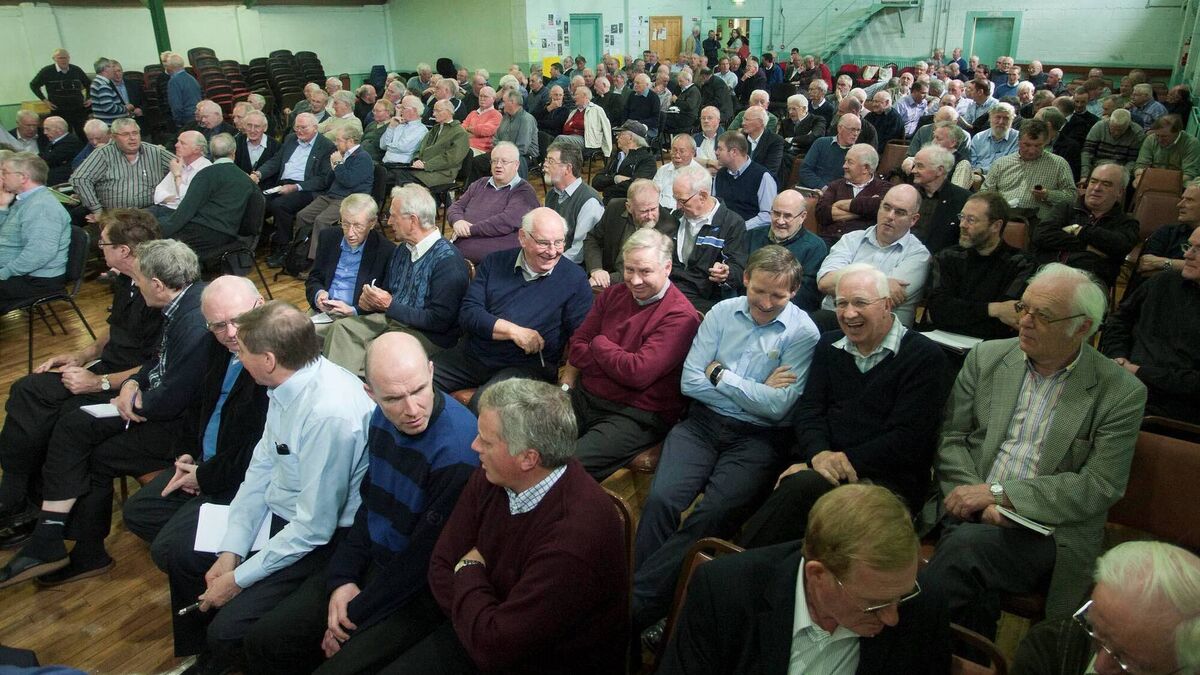
Some of the large crowd who attended the inaugural meeting of the Association of Catholic Priests in Portlaoise, Co Laois, in 2010. Picture: Michael O'Rourke.
In the summer of 2010, that’s 15 years ago this summer, the Association of Catholic Priests (ACP) was founded after a meeting of a small group of priests reflected on what might be done to raise the siege that seemed about to overwhelm the Catholic Church in Ireland. It was during the winter pontificate of Benedict XVI and the very elderly pope seemed defeated by a series of what appeared to be insurmountable challenges. Everything from the abuse scandals to the Vatican Bank and from one embarrassing crisis to another. Where, people began to wonder aloud, would it all end up?
The small group of disillusioned ACP priests reflected on the same issues and concluded that, even though we felt powerless in the face of such immense challenges, we felt we could at least provide a voice for priests. It was the least and possibly the best we could do. To light one candle rather than to sit and curse the darkness.
We set out more in hope than expectation. But to our amazement we discovered that in those dark days there was huge support for our plan. Our agenda, in essence, was to work for the implementation of the vision and reforms of the Second Vatican Council. The documents of that council, despite the occasional tribute paid to them, had been moth-balled. Effectively, they were ‘more honoured in the breach than in the observance’.
We publicised a meeting for priests in Portlaoise and to our surprise more than 600 priests turned up. In a matter of months that figure had expanded to over 1,000, about a third of Irish priests. We started a series of meetings which culminated in a meeting in a Dublin hotel with over one thousand people (priests and people) pondering possibilities for the future of (in Vatican Two-speak) ‘A People’s Church’ in Ireland.
We didn’t attempt to establish an association that would represent the views of all Irish priests. That had been tried before and had failed dismally for the simple reason that priests’ views are many and varied. So our direct focus was on Vatican Two and its possible implementation.
From 2010 to 2013, the ACP sought to establish a voice for priests in Irish media and in building up the profile of the Association. In February 2013, Pope Benedict stunned the world by stepping down from the papacy and a month later one Jorge Mario Bergoglio succeeded him as Francis I. Both events enhanced considerably the prospects of the ACP. Soon Francis was making it clear that his agenda for the Church entailed implementing the vision and reforms of Vatican Two.
Suddenly, after the long, dark days of the pontificates of John Paul and Benedict when the dream of a ‘People’s Church’ progressively faded into the mists of history, it was as if a new dawn had broken. Suddenly, as one commentator memorably described it, ‘the new pope had stolen the clothes of the ACP’ and everything now seemed possible.
On the crest of a wave, we asked to meet the Irish Catholic bishops but it soon became clear that while they were gracious in their approach, they distrusted our new-found excitement. Even though, at the Second Vatican Council, the assembled Catholic bishops of the world in a General Council of the Catholic Church had indicated clearly - specifically in the Decree on the Ministry and Life of Priests, No. 8 - that ‘Associations of priests are to be highly esteemed and diligently promoted’, the Irish bishops (it was said) presumably regarded themselves as a higher authority.
Shamefully the most we (ACP) achieved from the bishops was an offer to extend invitations to our representatives to visit Councils of Priests in the dioceses of Ireland to set out our stall for the Irish Catholic Church.
With my colleagues in the ACP, I visited a number of dioceses to do just that. We usually went in twos (as the biblical tradition has it) but on one occasion, visiting the diocese of Ferns, my designated colleague had fallen ill and I was on my own. It took me four hours to drive to Wexford where I was welcomed by Bishop Denis Brennan and his Council of Priests.
It was an interesting meeting. I presented the reasons for the founding of the ACP, the agenda agreed by our 1,000-plus priest-members, including our three proposals for combatting the now mathematically certain and imminent disappearance of Catholic priests in Ireland: ordain married men; welcome back priests who had left the priesthood to marry; and ordain women deacons.
I ended my presentation by suggesting that while the ACP had been founded in less promising times three years earlier, the election of Pope Francis earlier that year and his utterances in his first months in office were creating the possibility, even an expectation of real change. Indeed it could be said that if Jorge Bergoglio had been a PP in Ireland he would have been a founder member of the ACP!
Bishop Brennan asked me if I was suggesting that the ACP was now, because of Pope Francis, ‘becoming mainstream’. Most of the ten or so priests around the table laughed at the implied incongruity but I said, ‘Yes, I was suggesting just that’, on the basis that, for example with vocations, there was simply no alternative to significant change. Every priest didn’t have to be a celibate but every Catholic had the right to the Eucharist. And if the Church decided to change the church-made rule on celibacy, the Church could and would do that, if it had to.
In fairness to the Ferns gathering, Bishop Brennan’s was a predictable enough response because until Francis became pope, anyone, particularly any bishop who suggested that the celibacy rule should be looked at would have their knuckles rapped by Rome. No one was allowed to mention the elephant in the room.
A week, someone said, is a long time in politics. And, for the ACP, the three years between the pontificates of Benedict and Francis was a long time in the Catholic Church, which is supposed to think in centuries. But, by the time of my visit to Wexford, it soon became clear that change was not just possible but as we know now regarded as inevitable as the Francis agenda gradually unfolded.
We know now that because of Francis’ 12-year pontificate, the ACP in Bishop Brennan’s words, has become ‘mainstream’ and even though some may suggest that Francis has stolen some of our clothes, it was the very happiest of faults.
Fifteen years on, the dream is still alive.