George Mitchell should not be written out of Irish history
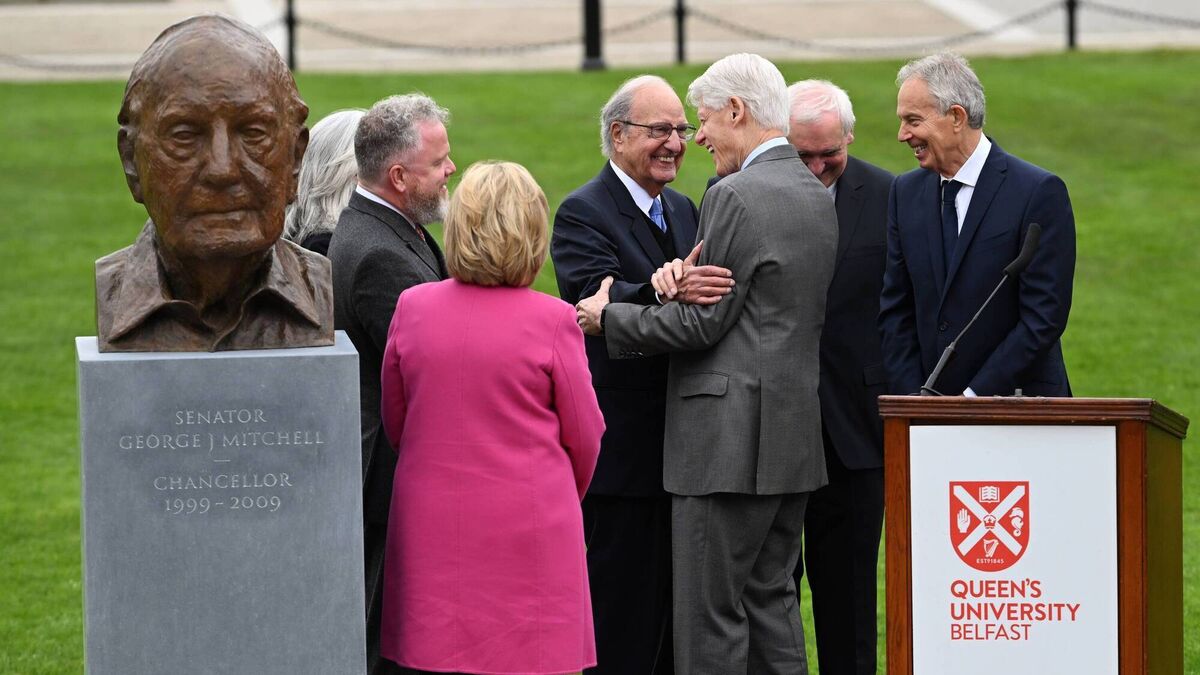
Senator George Mitchell, Bill Clinton, Bertie Ahern and Tony Blair are pictured in 2023 at the unveiling of a bust of Senator Mitchell at Queens University Belfast, honouring his work in relation to the Good Friday Agreement. Picture: Charles McQuillan/Getty Images
There is something deeply unsettling about watching a life’s work reduced to a name on a list.
In recent weeks, George Mitchell - a former United States politician, diplomat and central architect of the Northern Ireland peace process - has seen his name part-erased from history. Queen’s University Belfast announced it would remove his name from its Institute for Global Peace, Security and Justice and take down his bust. Shortly afterwards, the US-Ireland Alliance dropped his name from its prestigious scholarship programme.
The reason given was sensitivity to victims and survivors following the release of a vast tranche of documents associated with Jeffrey Epstein. These so-called Epstein files consist of millions of pages of records in which Mitchell’s name appears in scheduling emails and administrative references. There has been no finding of guilt, no charge and no concluded investigation. Only proximity. Albeit to a convicted sex trafficker.
That distinction matters. Not because public figures should be insulated from scrutiny (of course not) but because how scrutiny is exercised determines whether we are pursuing real justice or merely performing moralistic pearl-clutching.
The Epstein case is uniquely disturbing and it should be treated with the seriousness it demands. There are real victims of sexual abuse and trafficking, by Jeffrey Epstein. There were real accomplices. He did not operate alone and he did not operate outside elite social and financial networks that protected him for years. That much is now clear. Very clear.
While there are clearly many bad, mad and sad associates of Epstein in this vast collection, it is also true that these sprawling investigative archives contain quantities of untested, irrelevant and contradictory material. Names appear for many reasons: logistics, social overlap, professional courtesy, or third-party reference. The appearance of a name here is not evidence of wrongdoing. Each allegation had to be investigated and would have ended up in this vast collection of files. Even if found empty of any validity. Yet, the simple fact of inclusion is now deemed problematic.
So, when institutions collapse the distinction between proximity and culpability they do not deliver justice. They perform it. To suit their own agenda.
During Covid, I met an old friend I had not spoken to in years. Like many people confined to their homes, he had spent months online, immersed in forums convinced that the pandemic was part of a wider conspiracy. He saw an organised effort by global elites to control populations, enrich themselves and indulge in darker appetites. What struck me was not the detail of what he believed, but the deep anger with which he believed it.
At the time, I felt far removed from that world. I was immersed in archival research on the Irish War of Independence and Civil War.
Yet in the years since, something uncomfortable has happened. While the conspiracies that flourished during Covid were often fantastical, the Epstein case has confirmed one basic intuition: elite networks exist; they transcend borders and party politics; and they protect themselves. That does not vindicate conspiracy thinking. But it does explain why distrust has hardened. My friend’s anger seems much less misplaced than it did.
I’m a Green Party activist but I part company here many of my progressive colleagues on the political Left. I believe in class politics not Woke activism. We should be fighting the nepotistic ownership, access and control of economies, institutions and political systems by an elite few - not dividing people by their sexual orientation, skin colour or gender. We should not be more worried about how something looks, than how it actually is.
When ‘progressive’ universities remove a name without investigation or proportion, they are not challenging power. They are managing reputational risk. The bust comes down; the system remains intact. The public is offered theatre in place of truth. This kind of performative morality satisfies no one. It does not serve victims and it does nothing to restore public trust. It certainly does not dampen the conspiracy theories.
We have seen this dynamic before. In 2018, Al Franken, a Democratic senator in the United States and former comedian, who was one of the most effective legislators in Congress, was forced to resign following allegations of inappropriate behaviour. The initial accusation came from a conservative media figure who produced a photograph of Franken jokingly posing with his hands hovering over her flak jacket while she slept during a United Service Organizations (USO) tour years earlier. Franken acknowledged the photograph, denied wrongdoing and requested a formal investigation.
That investigation never happened.
Before the Senate Ethics Committee could examine the claims, political pressure, including from members of his own party, forced his resignation. In the aftermath, several Democratic senators publicly expressed regret, acknowledging that Franken should not have been pushed out before due process had taken place. Though some, as Senator Kirsten Gillibrand, remain resolute that they did so to support the women victims who came forward. Again playing the victim card to override seeking justice.
No follow-on investigation occurred. No finding of guilt was ever made. No evidentiary process was completed. The result was the loss of one of the Senate’s most capable lawmakers and a precedent that accusation alone was sufficient to end a public career.
That outcome did not strengthen justice. It weakened it. It also harmed genuine victims, by blurring the distinction between allegation and proof and by making future accountability battles harder, not easier.
As a historian of Ireland’s revolutionary period, I have spent years reading the detritus of moral certainty: denunciations, reprisals, intelligence reports and claims written long after the shouting stopped. What those records teach, above all, is that history is never clean.
I have yet to encounter a figure from that period - rebel or official, nationalist or unionist - who survives sustained scrutiny unblemished. If we applied today’s purity tests retroactively, vast sections of history would collapse into silence. Not because nothing meaningful happened, but because meaning is uncomfortable.
Consider Winston Churchill. He is rightly celebrated for his heroic leadership during the Second World War. He is also deeply implicated in imperial violence in Ireland and India. Reasonable historians can - and do - argue that aspects of his record meet the threshold of moral criminality.
Yet we do not erase Churchill from public memory. Nor should we. We contextualise him. We argue about him. We teach the contradictions. Why, then, is a radically lower standard applied to Al Franken or George Mitchell?
The answer is uncomfortable: purity tests are applied selectively. They fall hardest on the politically defenceless, those on the wrong side of modern culture wars. They avoid figures whose removal would carry institutional or geopolitical risk. This is not justice; it is triage.
Commemoration has never meant endorsement of an entire life. It marks a contribution deemed significant to a particular historical outcome. Mitchell’s role in the Northern Ireland peace process is not negated by the appearance of his name in an unadjudicated archive. To pretend otherwise is to misunderstand both history and responsibility.
Who benefits when reputations are destroyed not by evidence, but by association? There is a deeper irony here. When institutions collapse complexity into moral panic, they do not weaken conspiratorial thinking, they strengthen it. They confirm the suspicion that truth is managed rather than pursued, that symbolism matters more than substance and that accountability is selective.
Life is messy. History is messier still. This modern strain of performative morality by some professional or manager in Queens University insulates them from any critical eye, while rewarding their virtue signalling with well-paid institutional positions, academic accolades and social back-slapping.
A society that demands purity from its past will soon discover it has no past left worth remembering. History is not a tribunal and commemoration is not a verdict. When institutions erase complexity in the name of moral safety, they do not protect justice, they hollow out truth itself.
Meanwhile the rich and powerful play unhindered on the next Epstein island.